An English Visitor Must Become a King
The Adventure That Created the Ruritanian Romance
A Coronation, a Double, and a Kingdom Saved by Performance
The Story Pattern Repeated by a Century of Films and Novels
Before the celebrated masterpieces came The Prisoner of Zenda: an early work in which Anthony Hope's defining concerns were already taking shape.
The Prisoner of Zenda entered literary history as a work once visible enough to shape popular taste, yet now often remembered only at the edges of the canon. 「
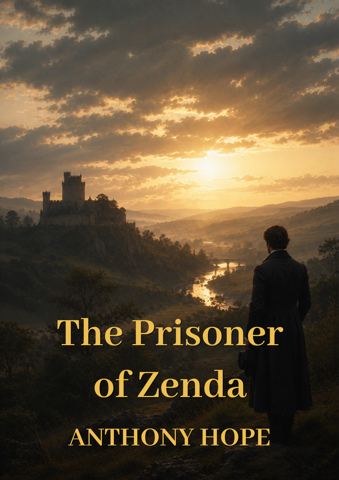
The Prisoner of Zenda is an 1894 adventure novel by Anthony Hope, in which the King of Ruritania is drugged on the eve of his coronation and thus is unable to attend the ceremony. Political forces within the realm are such that, in order for the king to retain the crown, his coronation must proceed. Fortuitously, an English gentleman on holiday in Ruritania who resembles the monarch is persuaded to act as his political decoy in an effort to save the unstable political situation of the interregnum. A sequel, Rupert of Hentzau, was published in 1898 and is included in some editions of The Prisoner of Zenda. The popularity of the novels inspired the Ruritanian romance genre of literature, film, and theatre that features stories set in a fictional country, usually in Central or Eastern Europe, for example Graustark from the novels of George Barr McCutcheon, and the neighbouring countries of Syldavia and Borduria in the Tintin comics.
On the eve of the coronation of Rudolf V of Ruritania, he encounters his distant relative, English nobleman Rudolf Rassendyll, come to witness the festivities. The two men look very much alike. The future king and his loyal attendants, Colonel Sapt and Fritz von Tarlenheim, wine and dine their new acquaintance at a hunting lodge. However, Rudolf V's younger half-brother Michael, Duke of Strelsau, sees to it he is presented a bottle of drugged wine. His friends cannot rouse him the next morning. Not showing up for the coronation would prove disastrous, but Sapt believes that fate has sent Rassendyll to Ruritania. He persuades the Englishman to impersonate the King. They hide the King in the cellar of the lodge and proceed to the capital. The ceremony goes off without a hitch. However, when they go to retrieve the real King Rudolf, they find that he has been abducted.
The novel has been adapted many times, mainly for film but also stage, musical, operetta, radio, and television. Probably the best-known version is the 1937 Hollywood film. The charismatic but Machiavellian Rupert of Hentzau has been interpreted by Ramon Novarro (1922), Douglas Fairbanks Jr. (1937), and James Mason (1952). In a popular but very questionable account, a German circus acrobat named Otto Witte claimed he had been briefly mistaken for the new King of Albania at the time of that country's separation from the Ottoman Empire, and that he was crowned and reigned a few days. However, the date of this claim (1913), and the lack of any evidence to back it up, suggest that Witte made up his story after seeing the first film version of the novel.[citation needed] The novel Every Inch a King (2005) by Harry Turtledove takes Witte's story and places it in a high fantasy setting.
Why The Prisoner of Zenda Still Matters
Read today, The Prisoner of Zenda offers more than the curiosity of a famous writer's beginning. It preserves the risks, experiments, and unresolved tensions of a literary voice before later success made that voice familiar.
Return to the beginning, and discover how The Prisoner of Zenda first opened the path ahead.
Miva: the next reading experience beyond audiobooks
Listen like an audiobook, then ask anything, anytime.
Start Miva's narrationMiva does not just narrate. It keeps explaining based on what you ask.