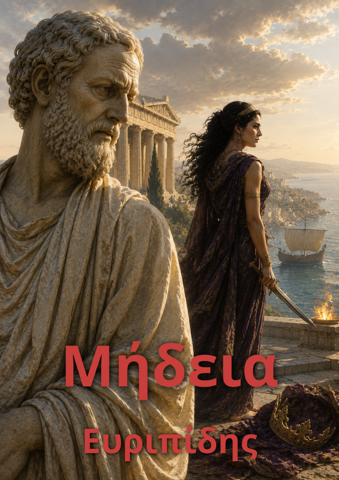
Read Μήδεια at the source, before centuries of translation made its language familiar in other forms.
Medea, preserved here as Μήδεια, is one of the works through which ancient Greek literature and thought continue to speak to later centuries. Betrayal and exile drive Medea toward an appalling revenge, exposing the violence beneath marriage, gender, and civic belonging.
Medea escapes to Athens in a chariot pulled by two winged dragons and is surrounded by the Sun, while on the lower right is depicted an old nurse who mourns over the bodies of children. Their father, Jason, approaches from the left. Above are two winged figures, the personifications of Punishment. Red-shaped krater of the 4th BC. century. Cleveland Museum of Art.
Along with Medea, the tetralogy was accompanied by the tragedies Philoctetes, Diktys and the satirical drama Theristai, three works that have not survived intact. This tetralogy finished third, as the first place was occupied by Euphorion, son of Aeschylus and the second place was occupied by Sophocles.
The play begins with the breadwinner of the house, who confesses to the audience that Jason abandoned Medea, after taking as his wife the daughter of the king of Corinth, Creon. The tutor then arrives with Medea's children and reveals that he heard that Creon was preparing to banish Medea. The voices of the cheated woman are heard from inside the house. This is followed by the entrance of the dance, which persuades the keeper to bring Medea out. While Medea is going out, Creon comes and asks her to leave the country. She manages to secure one more day. Then Jason comes and accuses Medea of being responsible for her exile. She argues strongly with him, while refusing any help he offers her. Then, Aegeus appears on the scene, who agrees to host her in Athens. Medea plans her revenge plan. After convincing Jason that she agrees to his new marriage, she sends poisoned gifts with her children for the bride to wear. A palace messenger comes enraged on the stage and announces the death of Glaucus and her father Creon. Medea kills her children and escapes to Athens in the winged chariot given to her by her ancestor, Helios, while Jason stays behind mourning the loss of his children.
The poet depicts the degree of rage and ferocity that the cheated wife can reach and how much insanity can result from marital fraud, (concluding the elements from the ethics of the Athenian society of the time).
A careful reading of Medea as a complex sample of tragic poetry reveals that it is a work in which strong elements of social concern emerge, at a time when the classical Greek world is about to pass into civil strife and into its phase of decline. At a time when the criticism of traditional values is present in every institution, political and social, Euripides questions traditional cultural values related to biological gender, Greekness and social institutions of the past.
Part of a tetralogy, Medea is essentially a work complex and full of novelties, despite the clear imperative narration and the seemingly simple plot of the sequence of events, its scenographic simplicity - except for the possible use of the crane at the end of the tragedy. The clarity, perhaps, and the clarity of the speech sometimes lead to the perhaps hasty conclusion that this is a tragedy that, while it evokes strong emotions, is simple in its structure.
Initially, the poet as another sophist seems to be a man without a homeland, as A. Lesky puts it, because he justifies the rage of the barbaric pharmacist through the dance in the struggle of words, essentially contradicting the Herodian dictates for the homoemon. It also records on stage the conflicting forces and the internal conflicts of the soul to a degree unprecedented in the context of Greek tragedy. Thirdly - and here lies perhaps the most important surprise - he elaborates one of the most magical in nature myths, essentially following the plot of the myth as preserved for us later in the Argonauts, even though before him Pindar refers to the same theme in his Pythian Odes. Fourth, it demystifies a central figure of the heroic pantheon, Jason, by pointing out his human frailties and tyrannical nature—a logical outcome of the hero who conforms to the institutions of an organized society and abandons his redemptive rebellion.
Approaching Medea in its original language brings the reader closer to choices of rhythm, argument, image, and dramatic emphasis that translations must inevitably interpret. The work is not important only because it is old: it remains a living point of reference for writers, philosophers, historians, theatre makers, and readers confronting related questions today.
Euripides was an Athenian tragedian known for psychologically complex outsiders, forceful women, and unsettling revisions of heroic myth.
Euripides (480 BC - 406 BC) was a Greek tragic poet and one of the three great teachers of Attic drama in the ancient Greek theater.
Coming from Phlya, a municipality of Cekropia located in the present-day region of Chalandrio, he is said to have been born in Salamis on the day of the naval battle, when Aeschylus was fighting as a man of battle, and Sophocles as a teenager leading the dance of the Epinicians on the trophy. The gender of the poet was not prominent, like that of other tragedians. His parents are said to be Mnisarchus and Cleito, whom Aristophanes mockingly mentions as a greengrocer (Acharn. 480, Ipp. 19). Euripides lived his youth in a prosperous age, the golden age of Pericles, but grew old during the Peloponnesian War, where he lost one of his sons.
The work of the sophists and in general new ideas and new problems co-exist in the works of Euripides, reflecting the questioning and intellectual disputes of his time. According to Philochoros, the poet was well-educated, he participated in the celebrations of his municipality, he became the torch bearer of Zostiri Apollo, who was worshiped there, and in competitions he took part in pankration and boxing, where he even won the Panathenaic naked competitions. But he quickly renounced sports and hated athletes because according to him:
for among the myriads of evil beings in Greece, there is no evil generation of athletes [evil is enormous in Greece, but there is nothing worse than the generation of athletes].
He also dabbled in painting, and his works were presented in Megara, and his genius is evidenced by most of the images in his tragedies. For a while he dabbled in philosophy and poetry, but also music. His love for the sea was unprecedented, which definitively sealed the entire work of Euripides. Euripides was an antisocial type (he had few friends), introverted, melancholic and inaccessible, he was not interested in the political and social events of his time, while on the contrary he was actively involved in the spiritual movement of enlightenment. He was a listener of Anaxagoras, Prodicus, Protagoras (with whom he maintained the closest relations) but also of Socrates with whom he maintained a long friendship. Admirer of the philosophers Democritus and Heraclitus because he was not only a scholar but also possessed one of the richest libraries (Athens I,3). Although he was particularly open to the influence of spiritual Athens, he nevertheless maintained his intellectual integrity, often formulating various criticisms of the spiritual conceptions of his time.
In this collection, the author's importance is approached through Medea. The work shows how a particular genre or method could become a durable instrument for examining human action, public life, knowledge, memory, and the demands of justice.
Miva: the next reading experience beyond audiobooks
Listen like an audiobook, then ask anything, anytime.
Start Miva's narrationMiva does not just narrate. It keeps explaining based on what you ask.