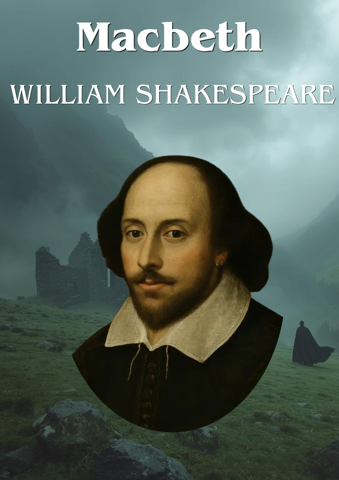
Shakespeare's Shortest Tragedy • His Most Psychologically Devastating
The Play So Cursed It Cannot Be Named in a Theatre
From Orson Welles to Roman Polanski to the Royal Shakespeare Company — Never Off the Stage
A good man is told he will be king. He believes it. That is the first mistake. Everything after is consequence.
William Shakespeare wrote Macbeth around 1606, and it remains, four centuries later, the most efficient tragedy he ever constructed. Where Hamlet takes its time, where King Lear expands to cosmic scale, Macbeth moves with the momentum of a man running downhill—unable to stop, aware of where he is going, accelerating anyway.
Macbeth is not a villain at the play's opening. He is a celebrated general, a loyal subject, a man described by his king as "valiant" and "worthy." The three witches on the heath do not corrupt him. They do something more precise and more devastating: they tell him what he already wants, in the form of a prophecy he cannot un-hear. From that moment, the play becomes a psychological study of what ambition does to a person who was not, until that moment, entirely aware that they had it.
Lady Macbeth provides what her husband lacks—not the desire, but the will to act on it. Her invocation of spirits to "unsex" her and fill her with direst cruelty is one of the most chilling speeches in English literature: a woman deliberately dismantling her own conscience in service of a plan she understands, with complete clarity, to be monstrous.
"Fair is foul, and foul is fair."
—The Three Witches
"I have done the deed. Didst thou not hear a noise?"
—Macbeth, after murdering Duncan
"Out, damned spot."
—Lady Macbeth, sleepwalking
What follows the murder of King Duncan is not triumph but contamination. Macbeth has "murdered sleep"—the innocent, unconscious rest of a man with a clean conscience—and discovers that the act cannot be contained. Each subsequent murder is an attempt to secure what the first murder made permanently insecure. Banquo must die. Macduff's family must die. The crown, obtained through blood, requires more blood to hold.
The witches' final prophecies offer a false security so precisely constructed that it constitutes cruelty: no man of woman born can harm him; he is safe until Birnam Wood marches to Dunsinane. Macbeth believes these conditions impossible. The play has been waiting, from the beginning, to show him what impossible means.
The superstition surrounding the play is itself a cultural artifact of extraordinary persistence. Actors refuse to speak its name inside a theatre—it is "the Scottish Play", always—and the tradition of bad luck attached to its productions has accumulated across four centuries into something that functions, whether believed or not, as a form of respect for the play's power.
Orson Welles staged a celebrated all-Black production in Harlem in 1936, transposing the action to Haiti. Roman Polanski filmed it in 1971—the year after the Manson murders—and brought to it a violence so visceral that critics could not separate the film from his biography. Akira Kurosawa reimagined it as Throne of Blood (1957), transplanting Macbeth's psychology into feudal Japan with devastating precision. The Royal Shakespeare Company has returned to it across every generation.
Macbeth is Shakespeare's shortest tragedy. It is also his most airless—a play with almost no comic relief, no digression, no space to breathe. From the witches' opening chant to Macbeth's death, it moves in a single, unbroken descent.
The witches did not make Macbeth a murderer. They simply showed him the door. He opened it himself.
On a bleak Scottish heath, bathed in mist and storm, the brave general Macbeth and his comrade Banquo encounter three shadowy figures: the weird sisters. The witches hail Macbeth with startling prophecies, declaring he will become Thane of Cawdor and eventually King of Scotland, while also foretelling that Banquo’s descendants will one day inherit the crown. Soon after, messengers arrive from King Duncan, rewarding Macbeth’s valiant military service with the title of Thane of Cawdor. The sudden fulfillment of the first prediction plants a dark seed of ambition in Macbeth's heart. Driven by an insatiable desire for power and fiercely egged on by his ruthless wife, Lady Macbeth, the noble general succumbs to temptation. When King Duncan visits their castle as an honored guest, Lady Macbeth devises a sinister plan. She drugs the royal guards, allowing Macbeth to creep into the sleeping monarch's bedchamber and plunge a dagger into his chest. They frame the unconscious guards for the treasonous act. Overcome by panic and suspicion, Duncan’s sons, Malcolm and Donalbain, flee the kingdom, leaving the vacant throne within Macbeth's ruthless grasp. Macbeth claims the crown, but the throne offers no peace, only paranoid terror. Haunted by the witches' prophecy that Banquo’s lineage will reign, Macbeth hires assassins to eliminate Banquo and his young son, Fleance. Though Banquo is brutally slain, Fleance escapes into the night, keeping the threat alive. At a grand royal banquet that evening, the weight of guilt breaks Macbeth’s composure as he sees the blood-dripping ghost of Banquo sitting in his chair. His unhinged behavior terrifies the assembled nobles, exposing his fragile sanity. Desperate for certainty, Macbeth seeks out the weird sisters once more. The witches summon dreadful apparitions that offer him cryptic assurances: no man born of a woman shall harm him, and his reign shall remain secure until Birnam Wood moves to the stronghold of Dunsinane Hill. Misinterpreting these supernatural visions as a guarantee of invincibility, Macbeth descends deeper into tyranny. Learning that the nobleman Macduff has fled to England to support Malcolm, Macbeth retaliates with unbridled cruelty, ordering the wholesale slaughter of Macduff’s innocent wife and children. In England, Macduff is shattered by the devastating news of his family’s murder, channeling his profound grief into a vow of fierce vengeance. Together with Malcolm and a formidable English army, he marches north to reclaim Scotland. Meanwhile, the psychological toll of their atrocities catches up with Lady Macbeth. Consumed by guilt, she walks in her sleep, obsessively trying to wash imaginary bloodstains from her hands until her mind shatters completely, leading to her tragic death. As the allied forces advance toward Dunsinane, the soldiers disguise their numbers by cutting down branches from Birnam Wood and carrying them forward. To Macbeth, watching from his battlements, it appears as though the forest itself is rising up and moving toward his castle. Even as his fortress falls, a desperate Macbeth fights with violent defiance, relying on the prophecy that no woman-born man can defeat him. However, when he confronts Macduff on the battlefield, the vengeful lord reveals he was not born naturally, but ripped untimely from his mother’s womb via C-section. Stripped of his superstitious illusions, Macbeth fights to his breath's bitter end. Macduff slays the tyrant, severing his head to restore peace and justice to the realm. Malcolm is triumphantly crowned King of Scotland, bringing an end to the reign of blood and ambition.
Fair is foul, and foul is fair:Macbeth Act 1, Scene 1. It establishes the central thematic paradox of the play, warning that appearances are deceptive and moral boundaries will be inverted.
Look like the innocent flower,Macbeth Act 1, Scene 5. It captures the terrifying psychological drive behind their ambition and encapsulates the theme of dangerous deception.
Is this a dagger which I see before me,Macbeth Act 2, Scene 1. It marks the decisive psychological turning point where Macbeth's inner guilt, fear, and fatal ambition manifest into physical delusion.
Tomorrow, and tomorrow, and tomorrow,Macbeth Act 5, Scene 5. It is one of literature's most powerful existential soliloquies, expressing tragic nihilism and the ultimate futility of unchecked ambition.
While Macbeth is written in early modern English verse, it is widely considered one of Shakespeare's most accessible and fast-paced plays. Unlike longer works like Hamlet that feature extensive philosophical soliloquies and secondary subplots, Macbeth moves with relentless, airless momentum. The narrative is focused entirely on a single linear arc: the swift rise and violent fall of a royal murderer. The language is intense and highly poetic, filled with memorable imagery of night, blood, and sleeplessness, but the core plot is as straightforward as a modern psychological thriller. Readers who approach the text using edition notes for specific archaic vocabulary will find that the dramatic tension carries them forward easily without getting bogged down in structural complexity.
Macbeth remains a cornerstone of world literature because it presents an unmatched psychological study of ambition, guilt, and the internal mechanics of moral disintegration. Shakespeare does not present Macbeth as a born monster, but as an honorable man who consciously chooses to commit an evil act and must subsequently live with the terrifying ruin of his conscience. The play's dark atmospheric power, famous poetic soliloquies, and timeless exploration of how power corrupts continue to resonate across centuries. Furthermore, its legacy is sustained by brilliant theatrical adaptations across global culture, ranging from Japanese cinema to Harlem stage productions, proving that its core themes of temptation and regret transcend historical and cultural boundaries.
What waits at the conclusion is the inevitable collision between calculated hubris and supernatural trap. The final act brings the complete reckoning of a man who believed himself above fate, forced to confront the impossible interpretations of the witches' riddles as Birnam Wood marches and a prophesied warrior steps forward. It is not merely the resolution of a bloody political struggle, but a raw, airless portrait of psychological collapse where every desperate action accelerates an unavoidable undoing. Rather than offering a simple triumph, the climax exposes the full cost of unchecked ambition in a breathless cascade of consequence that must be experienced firsthand. Open the text and read these closing pages for yourself.
Chanted by the three witches in the opening scene, this iconic line establishes the moral inversion and deceptive appearances that govern the entire play. It warns that in a world corrupted by treason, double-dealing, and witchcraft, things that appear noble and attractive are actually rotten, while apparent foulness hides deeper truths. Macbeth echoes this sentiment in his very first line of dialogue, noting he has never seen a day so fair and foul at once. The phrase serves as a thematic framework for Macbeth's journey, as he masks his traitorous heart behind a welcoming smile when receiving King Duncan into his home, ultimately discovering that the glowing future promised by the weird sisters is a ruinous trap.
A deep-seated theatrical superstition holds that speaking the title "Macbeth" inside a theatre brings severe bad luck, injury, or disaster to a production. According to theatrical legend, the play's original performance in the seventeenth century was plagued by real violence when actual daggers were accidentally used, and subsequent centuries have accumulated stories of set fires, actor injuries, and financial ruins associated with its staging. As a result, actors and theater workers traditionally refer to it as "The Scottish Play" or "The Bard's Play" while inside a performance space. To reverse the curse if the name is accidentally spoken, tradition mandates that the speaker must step outside, turn around three times, spit, and recite a line from another Shakespeare work.
The three witches act as catalysts rather than absolute controllers of Macbeth's destiny. They do not force or magically compel him to commit murder; instead, they present him with vague prophecies that speak directly to his pre-existing, hidden desires for royal power. By telling him what he already wants to hear, they tempt him to act, but the decision to plunge the dagger into Duncan belongs entirely to Macbeth and his wife. The witches simply show him a potential doorway to power, leaving him to open it himself. In their later apparitions, they deliver clever, equivocal visions that exploit his arrogance, allowing his own overconfidence to drive him toward final destruction.
Miva: the next reading experience beyond audiobooks
Listen like an audiobook, then ask anything, anytime.
Start Miva's narrationMiva does not just narrate. It keeps explaining based on what you ask.