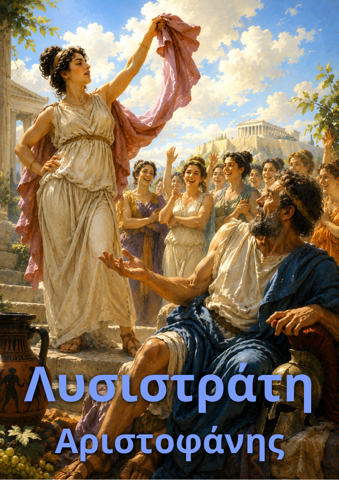
Read Λυσιστράτη at the source, before centuries of translation made its language familiar in other forms.
Lysistrata, preserved here as Λυσιστράτη, is one of the works through which ancient Greek literature and thought continue to speak to later centuries. Women from warring cities organize a sex strike and seize public funds, turning comic fantasy into a sharp anti-war argument.
Lysistrata is a comedy by Aristophanes written and taught in 411 BC. It is considered one of the oldest and most characteristic anti-war plays. The case has to do with the sexual strike declared by the women of Athens and Sparta, thus trying to convince their men to stop the Peloponnesian War. Lysistrata is one of the first and perhaps the best-known sex comedies ever written.
In ancient Athens, during the Peloponnesian War, the women led by Lysistrata decide to stop the war and restore peace to their land. Among the gathered women, apart from Lysistrata, the Athenian Cleonike, the young Myrini, and the Spartan Labito stand out.
The original idea was conceived by Lysistrata who, for this reason, secretly summoned all the Athenians as well as representatives from the other cities. The women gather but when she suggests they declare sexual abstinence until the men decide to end the war, they initially disagree. Finally, and after intense hesitation, they are convinced when the Spartan Labito resolutely joins Lysistrata's plan. The decision is sealed with an oath on the wine.
At the same time, voices of excitement are heard from the Acropolis, a sign that the second part of Lysistrata's plan has succeeded. The old women have taken over the Acropolis, where the treasury of the public money used to subsidize the war operations is located.
The gathering of women breaks up. The dance consisting of old men now enters the stage, followed by a second dance of old women. The men, enraged by the rebellion of the women, come carrying kettles and lighted torches. The women on the other side are holding pitchers of water. The showdown begins. The men threaten the women with their torches, and the women defeat them by emptying their pitchers on the men's fires.
An elderly Probulus (a member of a twelve-member committee of distinguished citizens, whose purpose was to strictly control the economy) enters the scene. As a representative of the Municipality Church, he orders the archers who follow him to capture the women. But women don't allow it.
Lysistrata and Probulus engage in a contest of words, where the female dance attends to Lysistrata and the male dance to Probulus. Lysistrata repeats to Probulus the women's decision to enforce peace, and Probulus is driven out by the women. Abstinence is becoming unbearable for both sexes. But men are beginning to feel the consequences very heavily. Their wives, according to the instructions of Lysistrates, provoke them as much as possible without ultimately yielding to their desires.
At the same time, the women's project is also successful in Sparta. A Spartan herald arrives and requests that Athenian representatives be appointed to begin peace negotiations. The Spartan envoys and the Athenians appeal to Lysistrata to help them compromise. Lysistrata achieves this with the help of a beauty, Reconciliation personified.
Lysistrata blames Athenians and Spartans for betraying their shared religious and cultural heritage. The two delegations, absorbed in the good things of Reconciliation, make mutual concessions and peace is secured.
Approaching Lysistrata in its original language brings the reader closer to choices of rhythm, argument, image, and dramatic emphasis that translations must inevitably interpret. The work is not important only because it is old: it remains a living point of reference for writers, philosophers, historians, theatre makers, and readers confronting related questions today.
Aristophanes was the leading poet of Old Comedy, using fantasy, parody, obscenity, and political satire to confront Athenian public life.
Aristophanes (445 BC – 386 BC) was an Athenian comedian of the 5th century BC. Aristophanes is, along with Eupolis and Cratinus, one of the most important representatives of the period of ancient Athenian comedy characterized as "ancient comedy" and the only one of which survives intact works, with the exception of Menander, of whom only one work survives intact. During the 5th century BC, he wrote 46 comedies. Of these, 11 have been preserved intact, while 924 fragments have been handed down.
We have very little independent information about his life and, often, evidence of his biography is drawn from his comedies themselves, and must therefore be treated with great caution. The ancients disagreed about the poet's birthplace, some asserting that he was a citizen of Lindos or Camiros of Rhodes, others of Naucratida in Egypt, and others of Aegina. These dichotomies resulted in the unfounded information that the demagogue Cleon was seeking a "writ of exile" against the poet. It is a given that Aristophanes stayed most of the time in Aegina, as he owned estates that had been given to his father when Athenian clergy had settled there. It is said that he was an example of a moral, modest, conservative person who watched the political life of the Athenians from Aegina and satirized its vulnerabilities.
He was born in Athens in 445 BC. about, and died in the mid-380s BC. He lived in Athens and grew up in the years that began for Athens and its inhabitants an era of peace and prosperity, during which the political life was dominated by the personality of Pericles (peace with Sparta and Persia) and which lasted until the beginning of the thirty-year Peloponnesian war in 431 BC.
He was the son of Philip, a genuine Athenian, from the municipality of Kydathinaion, so he is also considered a genuine Athenian citizen. About his life, however, only little is known to us today.
In this collection, the author's importance is approached through Lysistrata. The work shows how a particular genre or method could become a durable instrument for examining human action, public life, knowledge, memory, and the demands of justice.
In ancient Greece, as the Peloponnesian War drags on and consumes the Greek city-states, an Athenian woman named Lysistrata decides to take matters into her own hands. Frustrated by the endless conflict, she summons the women from all sides of the war, including enemy cities like Sparta, to meet at dawn. When the play opens, Lysistrata waits anxiously, paced by anger and impatience. Only her neighbor, Calonice, arrives at first. Lysistrata expresses her deep inner fire and distress, lamenting that while men view women as dishonest and untrustworthy, the women are sleeping late instead of gathering for a matter of immense gravity. Calonice tries to soothe her, explaining that it is difficult for women to leave their homes so early, one must tend to her husband, another must awaken a servant, bathe a child, or feed a baby. But Lysistrata insists that her plan supersedes all domestic duties. When Calonice playfully inquires whether this grand plan is something "thick" or substantial, Lysistrata confirms that it is, though delicate enough that the very salvation of all Greece rests entirely in the hands of women. Once the full assembly of women arrives, Lysistrata reveals her radical strategy: to force the men to negotiate a lasting peace, all women across Greece must initiate a strict sexual strike, withholding intimacy until their husbands put an end to the war. Simultaneously, the older women of Athens execute a daring tactical move by seizing the Acropolis, securing the city's treasury to cut off the financial supplies funding the military effort. Despite initial reluctance and comic pushback from the women, who find the sacrifice daunting, Lysistrata rallies them to swear a solemn oath. The strategy instantly throws the city into chaos. The Chorus of Old Men tries to recapture the Acropolis with torches and fire, but they are promptly repelled by the Chorus of Old Women armed with water pitchers. When a magistrate arrives with armed archers to confiscate the treasury, Lysistrata confronts him directly, famously comparing the proper governance of a state to the art of carding and weaving wool, cleansing the city of corrupt elements and weaving all citizens together into a unified, harmonious whole. As time passes, keeping the strike intact proves challenging. Lysistrata has to stop several women from sneaking home under absurd excuses. Soon, however, the men begin to crumble under the agonizing pressure. An Athenian husband, Cinesias, arrives at the Acropolis desperate to see his wife, Myrrhine. Instructed by Lysistrata, Myrrhine teases him mercilessly, setting up a bed, pillows, and perfume, only to lock herself back inside at the last moment, driving him to total desperation. Shortly after, a Spartan herald arrives in Athens in a similarly distressed state, revealing that the women of Sparta have enacted the same strike with equal success. Realizing that neither side can bear the torment any longer, both Athens and Sparta agree to negotiate. Lysistrata steps forward as the chief mediator. Bringing out Reconciliation, a personification of peace portrayed as a beautiful young woman, she sternly reminds the men of their shared heritage, mutual aid in past crises, and common Greek identity. Mesmerized and eager to settle terms, the Athenian and Spartan leaders quickly reach an agreement, dividing territories and ending the war. The play culminates in a grand, triumphant feast inside the Acropolis. Reunited with their wives, the men join the women in joyful dancing, pouring libations to the gods, and singing hymns of peace and reconciliation, restoring harmony across the Greek world.
Let us place a large, black cup face-up, slaughter a jar of Thasian wine into it like a sacrificial sheep, and swear over the cup not to pour in a single drop of water.Original: θεῖσαι μέλαιναν κύλικα μεγάλην ὑπτίαν, μηλοσφαγοῦσαι Θάσιον οἴνου σταμνίον ὀμόσωμεν ἐς τὴν κύλικα μὴ ᾽πιχεῖν ὕδωρ.Lysistrata Lines 195–197. This passage vividly subverts traditional martial sacrificial rituals by substituting a jar of fine wine for an animal victim, highlighting the comedic yet resolute nature of their conspiracy.
And you shall repeat the same oath and confirm it. There is no man, neither lover nor husband, who shall approach me with a hard-on.Original: ὑμεῖς δ᾽ ἐπομεῖσθε ταὐτὰ κἀμπεδώσετε. οὐκ ἔστιν οὐδεὶς οὔτε μοιχὸς οὔτ᾽ ἀνήρ-- ὅστις πρὸς ἐμὲ πρόσεισιν ἐστυκώς.Lysistrata Lines 209–212. It states the core sex-strike premise of the play in direct, unvarnished terms, establishing the central conflict and the drastic measures the women are taking to force peace.
And if you had any sense at all, you would manage all your public affairs the way we work our wool.Original: κἂν ὑμῖν γ᾽ εἴ τις ἐνῆν νοῦς, ἐκ τῶν ἐρίων τῶν ἡμετέρων ἐπολιτεύεσθ᾽ ἂν ἅπαντα.Lysistrata Lines 571–572. It presents the play's most famous allegory, reframing complex civic governance and diplomacy through the domestic art of wool-working and weaving.
I am a woman, but I am endowed with intelligence: I am not lacking in judgment of my own, and having listened to many speeches from my father and older men, I am far from uneducated.Original: ἐγὼ γυνὴ μέν εἰμι, νοῦς δ᾽ ἔνεστί μοι, αὐτὴ δ᾽ ἐμαυτῆς οὐ κακῶς γνώμης ἔχω, τοὺς δ᾽ ἐκ πατρός τε καὶ γεραιτέρων λόγους πολλὸὺς ἀκούσασ᾽ οὐ μεμούσωμαι κακῶς.Lysistrata Lines 1124–1127. This statement serves as the heroine's definitive intellectual self-defense, asserting female rational authority and rhetorical competence within classical Greek public discourse.
While the play was written in 411 BCE, its core structure remains accessible, lively, and highly engaging for modern readers. The narrative relies on broad physical comedy, sharp dialogue, and a clear central premise that requires little background in ancient theatre to enjoy. Readers may occasionally encounter historical references to fifth-century Athenian politicians, military campaigns, or specific religious rituals. However, these context points are easily understood through standard notes, and the overarching humor, pacing, and human drama carry the narrative effortlessly.
The work stands as one of the earliest surviving examples of theatrical protest and anti-war satire in western history. Aristophanes constructed a bold narrative where disenfranchised figures take decisive action to alter state policy, creating an enduring prototype for political comedy. Beyond its historical priority, the play remains famous for its inventive combination of high-minded pacifist rhetoric and irreverent domestic humor. Its insights into civic division, public finance, and social protest continue to influence writers, scholars, and directors across the globe.
At the end of Aristophanes’ Lysistrata, what awaits is not merely the resolution of a protracted war, but a dramatic convergence of political desperation, ancient shared history, and civic transformation. As the leaders of Athens and Sparta finally gather under the overwhelming pressure of the women's strike, they must face a formidable mediator who uses both sharp political rhetoric and a vivid embodiment of peace to dismantle years of ingrained hostility. What follows is a rare, swift reweaving of a fractured Greek world into an atmosphere of festive unity, song, and reconciliation. To experience the full force of this historic comedic triumph, read these closing pages for yourself.
The play presents a striking dramatic contrast between the historical reality of Athenian women and comic fantasy. In fifth-century Athens, citizen women were largely restricted to the home and excluded from formal assembly votes or magistrate roles. Aristophanes upends this social norm by placing women in command of the Acropolis and the state treasury. While the play utilizes comedic tropes regarding domestic duties, it ultimately gives its female characters the most coherent political vision on stage.
Taking the Acropolis is the vital economic component of Lysistrata's anti-war strategy. The Acropolis housed the Athenian public treasury, which held the financial reserves needed to build ships, pay sailors, and equip troops. By occupying the citadel, the older women effectively freeze the city's military operations. This move transforms a private domestic strike into an institutional blockade that male political leaders cannot ignore.
The play features a divided Chorus split into two competing factions: the Chorus of Old Men and the Chorus of Old Women. This dual structure creates continuous physical and verbal comedy, such as the men bringing torches and the women pouring water. As the story progresses, the friction between the two groups mirrors the broader political divide in Greece. Their eventual harmony serves as a primary signal that peace and civic unity are once again possible.
Miva: the next reading experience beyond audiobooks
Listen like an audiobook, then ask anything, anytime.
Start Miva's narrationMiva does not just narrate. It keeps explaining based on what you ask.