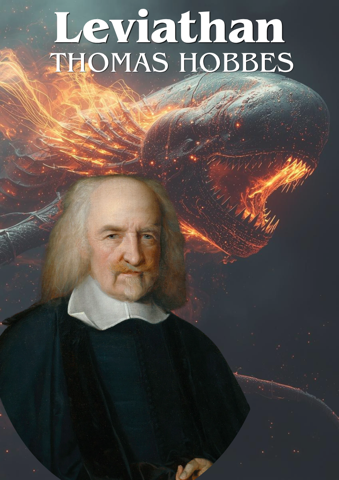
A Foundational Text of Modern Political Philosophy
Written During the English Civil War • Condemned by Parliament • Banned by the Catholic Church
The Book That Invented the Social Contract — and Every Authoritarian Has Quoted Since
Without a sovereign, life is solitary, poor, nasty, brutish, and short. Thomas Hobbes wrote this in 1651. Politicians have been arguing about it ever since.
Published in 1651 against the backdrop of the English Civil War—a society tearing itself apart in precisely the way Hobbes had theorized it would—Leviathan is the book that invented the modern state. Not described it. Not analyzed it. Invented it: gave it a philosophical foundation, a logical justification, and a name drawn from the most terrifying creature in the Book of Job.
Thomas Hobbes begins where no political philosopher before him had dared to begin: with human nature at its most stripped and honest. Remove civilization, remove law, remove the threat of punishment—and what remains is not Rousseau's noble savage or the Transcendentalist's natural virtue. What remains is war. Not war between nations, but a perpetual war of every individual against every other, driven by competition, distrust, and the insatiable desire for dominance. In this state of nature, there is no industry, no culture, no art, no society. There is only the arithmetic of survival.
And then Hobbes offers the only solution his logic permits.
"The condition of man is a condition of war of every one against every one."
—Thomas Hobbes, Leviathan
"Solitary, poor, nasty, brutish, and short."
—Thomas Hobbes, on the life of man without sovereign authority
The Social Contract Hobbes proposes is not a gentle agreement between equals. It is a transaction made under duress, by rational beings who understand the alternative. Individuals surrender their natural liberty—entirely, irrevocably—to a Sovereign: the Leviathan, an artificial man of colossal power whose authority is absolute over civil, military, judicial, and religious matters alike. In return, they receive the only thing Hobbes believes they truly want: security. The preservation of life.
The vision is stark, and Hobbes knew it. The sovereign cannot be overthrown—because the subjects themselves are the authors of the sovereign's actions. To rebel is to contradict yourself. To divide power is to invite the civil war you contracted your way out of. Leviathan offers not freedom but its most honest alternative: order, purchased at the price of absolute obedience.
The Church condemned it. Parliament investigated Hobbes for heresy. The book was banned, burned, and placed on the Catholic Index of Prohibited Books—because what Hobbes had written was more dangerous than obscenity. He had subjected the divine right of kings and the authority of the Church to the cold light of materialist logic, and found them unnecessary. The sovereign's power derived not from God but from the consent—however coerced—of the governed.
Leviathan shaped the thinking of John Locke, who argued against it. Of Rousseau, who reframed it. Of the authors of the American Constitution, who absorbed its logic while rejecting its conclusions. Of Carl Schmitt, who used it to justify the opposite of everything Hobbes intended. It haunts every debate about security versus liberty, about what we surrender when we ask to be protected, about whether the state exists to serve the individual or the individual to serve the state.
These are not historical questions. They are this morning's news.
Hobbes wrote the manual for the modern state in the middle of a civil war. We are still living inside his argument.
Miva: the next reading experience beyond audiobooks
Listen like an audiobook, then ask anything, anytime.
Start Miva's narrationMiva does not just narrate. It keeps explaining based on what you ask.