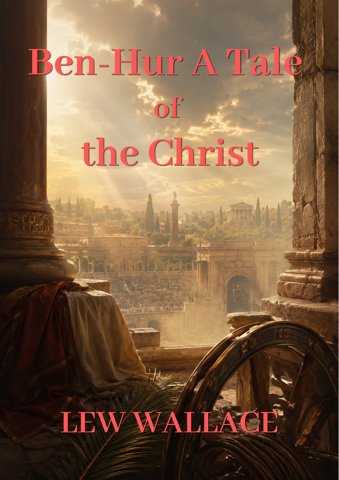
A Tale of Revenge Transformed by an Encounter with Christ
The Nineteenth-Century Bestseller That Became a Global Spectacle
Chariot Racing, Empire, Faith, and Forgiveness
The Novel Hidden Behind One of Cinema's Greatest Epics
Before the celebrated masterpieces came Ben-Hur: A Tale of the Christ: an early work in which Lew Wallace's defining concerns were already taking shape.
Ben-Hur: A Tale of the Christ entered literary history as a work once visible enough to shape popular taste, yet now often remembered only at the edges of the canon.
Ben-Hur: A Tale of the Christ is a novel by Lew Wallace, published by Harper and Brothers on November 12, 1880, and considered "the most influential Christian book of the nineteenth century". It became a best-selling American novel, surpassing Harriet Beecher Stowe's Uncle Tom's Cabin (1852) in sales. The book also inspired other novels with biblical settings and was adapted for the stage and motion picture productions. Ben-Hur remained at the top of the U.S. all-time bestseller list until the 1936 publication of Margaret Mitchell's Gone with the Wind. The 1959 MGM film adaptation of Ben-Hur is considered one of the greatest films ever made and was seen by tens of millions, going on to win a record 11 Academy Awards in 1960, after which the book's sales increased and it surpassed Gone with the Wind. It was blessed by Pope Leo XIII, the first novel ever to receive such an honor. The success of the novel and its stage and film adaptations also helped it to become a popular cultural icon that was used to promote numerous commercial products.
Ben-Hur is a story of a fictional hero named Judah Ben-Hur, a Jewish nobleman who was falsely accused and convicted of an attempted assassination of the Roman governor of Judaea and consequently enslaved by the Romans. He becomes a successful charioteer. The story's revenge plot becomes a story of compassion and forgiveness. The novel is divided into eight books, or parts, each with its own subchapters. Book one opens with the story of the three Magi, who arrive in Bethlehem to hear the news of Christ's birth. Readers meet the fictional character of Judah for the first time in book two, when his childhood friend Messala, also a fictional character, returns to Jerusalem as an ambitious commanding officer of the Roman legions. The teen-aged boys come to realize that they have changed and hold very different views and aspirations. When a loose tile is accidentally dislodged from the roof of Judah's house during a military parade and strikes the Roman governor, knocking him from his horse, Messala falsely accuses Judah of attempted assassination. Although Judah is not guilty and receives no trial, he is sent to the Roman galleys for life, his mother and sister are imprisoned in a Roman jail where they contract leprosy, and all the family property is confiscated. Judah first encounters Jesus, who offers him a drink of water and encouragement, as Judah is being marched to the seacoast to be a galley slave. Their lives continue to intersect as the story unfolds.
By the time of Ben-Hur's publication in 1880, Wallace had already published his first novel, The Fair God; or, The Last of the 'Tzins (1873), and Commodus: An Historical Play (1876) that was never produced. He went on to publish several more novels and biographies, including The Prince of India; or, Why Constantinople Fell (1893), a biography of President Benjamin Harrison in 1888, and The Wooing of Malkatoon (1898), but Ben-Hur remained his most significant work and best-known novel. Humanities editor Amy Lifson named Ben-Hur as the most influential Christian book of the 19th century, while others have identified it as one of the best-selling novels of all time. Carl Van Doren wrote that Ben-Hur was, along with Uncle Tom's Cabin, the first fiction many Americans read. Wallace's original plan was to write a story of the biblical magi as a magazine serial, which he began in 1873, but he had changed its focus by 1874. Ben-Hur begins with the story of the magi, but the remainder of the novel connects the story of Christ with the adventures of Wallace's fictional character, Judah Ben-Hur.
Ben-Hur was popular in its own day despite slow initial sales and mixed reviews from contemporary literary critics, who "found its romanticism passé and its action pulpy". Century magazine called it an "anachronism" and The Atlantic panned its descriptions as "too lavish". For its readers, however, the book "resonated with some of the most significant issues in late Victorian culture: gender and family; slavery and freedom; ethnicity and empire; and nationhood and citizenship". With the chariot race as its central attraction and the character of Judah emerging as a "heroic action figure", Ben-Hur enjoyed a wide popularity among readers, similar to the dime novels of its day; however, its continued appearance on popular lists of great American literature remained a source of frustration for many literary critics over the years. The novel had millions of fans, including several influential men in politics. U.S. president and American Civil War general Ulysses S. Grant, U.S. president James Garfield, and Jefferson Davis, former president of the Confederate States of America, were enthusiastic fans. Garfield was so impressed that he appointed Wallace as U.S. Minister to the Ottoman Empire, based in Constantinople, Turkey. Wallace served in this diplomatic post from 1881 to 1885.
“. With the chariot race as its central attraction and the character of Judah emerging as a ”
Why Ben-Hur: A Tale of the Christ Still Matters
Read today, Ben-Hur: A Tale of the Christ offers more than the curiosity of a famous writer's beginning. It preserves the risks, experiments, and unresolved tensions of a literary voice before later success made that voice familiar.
Return to the beginning, and discover how Ben-Hur: A Tale of the Christ first opened the path ahead.
Miva: the next reading experience beyond audiobooks
Listen like an audiobook, then ask anything, anytime.
Start Miva's narrationMiva does not just narrate. It keeps explaining based on what you ask.