Love and Faith Beneath the Shadow of Vesuvius
The Historical Epic That Defined the Popular Image of Pompeii
Roman Luxury, Religious Conflict, and a City Marked for Destruction
The Once-Famous Novel Overshadowed by Its Author's Worst Opening Line
Before the celebrated masterpieces came The Last Days of Pompeii: an early work in which Edward Bulwer-Lytton's defining concerns were already taking shape.
The Last Days of Pompeii entered literary history as a work once visible enough to shape popular taste, yet now often remembered only at the edges of the canon.
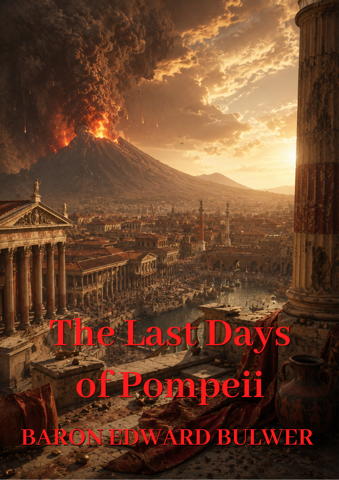
The Last Days of Pompeii is a novel written by Edward Bulwer-Lytton in 1834. The novel was inspired by the painting The Last Day of Pompeii by the Russian painter Karl Briullov, which Bulwer-Lytton had seen in Milan. It culminates in the cataclysmic destruction of the city of Pompeii by the eruption of Mount Vesuvius in AD 79.
Pompeii, A.D. 79. Athenian nobleman Glaucus arrives in the bustling and gaudy Roman town and quickly falls in love with the beautiful Greek Ione. Ione's former guardian, the malevolent Egyptian sorcerer Arbaces, has designs on Ione and sets out to destroy their budding happiness. Arbaces has already ruined Ione's sensitive brother Apaecides by luring him to join the vice-ridden priesthood of Isis. The blind slave Nydia is rescued from her abusive owners, Burbo and Stratonice, by Glaucus, for whom she secretly pines. Arbaces horrifies Ione by declaring his love for her, and flying into a rage when she refuses him. Glaucus and Apaecides rescue her from his grip, but Arbaces is struck down by an earthquake, a sign of Vesuvius' coming eruption. Glaucus and Ione exult in their love, much to Nydia's torment, while Apaecides finds a new religion in Christianity. Nydia unwittingly helps Julia, a rich young woman who has eyes for Glaucus, obtain a love potion from Arbaces to win Glaucus's love. But the love potion is really a poison that will turn Glaucus mad. Nydia steals the potion and administers it; Glaucus drinks only a small amount and begins raving wildly. Apaecides and Olinthus, an early Christian, determine to publicly reveal the deception of the cult of Isis. Arbaces, recovered from his wounds, overhears and stabs Apaecides to death; he then pins the crime on Glaucus, who has stumbled onto the scene. Arbaces has himself declared the legal guardian of Ione, who is convinced that Arbaces is her brother's murderer, and imprisons her at his mansion. He also imprisons Nydia, who discovers that there is an eyewitness to the murder who can prove Glaucus's innocence-the priest Calenus, who is yet a third prisoner of Arbaces. She smuggles a letter to Glaucus's friend Sallust, begging him to rescue them.
Why The Last Days of Pompeii Still Matters
Read today, The Last Days of Pompeii offers more than the curiosity of a famous writer's beginning. It preserves the risks, experiments, and unresolved tensions of a literary voice before later success made that voice familiar.
Return to the beginning, and discover how The Last Days of Pompeii first opened the path ahead.
Miva: the next reading experience beyond audiobooks
Listen like an audiobook, then ask anything, anytime.
Start Miva's narrationMiva does not just narrate. It keeps explaining based on what you ask.