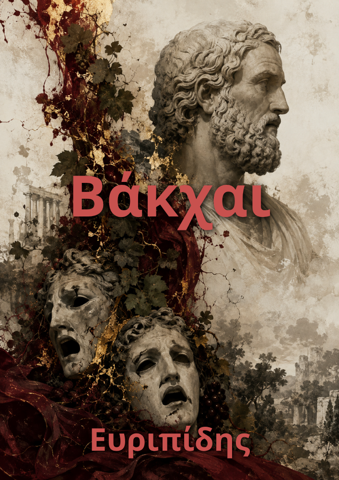
Read Βάκχαι at the source, before centuries of translation made its language familiar in other forms.
The Bacchae, preserved here as Βάκχαι, is one of the works through which ancient Greek literature and thought continue to speak to later centuries. Dionysus returns to Thebes and destroys the ruler who denies him, staging a terrifying conflict between reason, ritual, and ecstasy.
Bacchus is a tragedy by Euripides. It was written in 407 BC, when the poet was in Pella, Macedonia, at the court of King Archelaus, and directed by his son or grandson in 405 BC. in Athens. This tragedy was taught (performed) after the death of its creator, Euripides (406 BC). It was one part of a trilogy, together with the works "Iphigenia en Avlidis" and "Alkmaion o dia Korinthos" (few verses of which have survived). This trilogy won first prize.
The play Bacchae has a genuine Dionysian premise, i.e. it narrates the arrival of Bacchus (Dionysus) in Thebes during which Pentheus is killed by his mother Agave, because he resisted the worship of the new god.
Some based on some internal testimonies and references believe that the work was written to be taught in dramatic contests organized by the Macedonian king in honor of the Muses and Dionysus.
Aeschylus also dealt with the myth of the Theban Theomachus in a tetralogy containing a tragedy entitled Pentheus. We know nothing about this drama. Aristophanes of Byzantium mentions that he had the same issue with the Bacchae. Another tetralogy of Aeschylus, the Lycurgeia, dealt with the impiety and punishment of the king of Thrace, Lycurgus. Some believe that some Bacchic motifs copy the Lycurgeia.
The action is set in Thebes, the city of Cadmus, who has now grown old and has handed over power to the son of Agave's daughter, Pentheus, whose name portends mourning. Another daughter of Cadmus, Semele, had given birth to Dionysus after her union with Zeus, but was killed by his thunderbolts when he appeared before her in his divine majesty fulfilling her own request. After Semele's death, the rest of Cadmus' daughters questioned the divine parentage of their sister's child, and so Dionysus made them roll up the mountains behaving like Maenads (Bacchus). The worship of Dionysus is now also denied by Pentheus, who also does not believe in the divine origin of Semele's child and has begun to arrest deviant women.
The play begins with Dionysus in the Prologue (vv. 1-63) arriving in distraught Thebes, before the palace of Pentheus, transformed into a young mortal, to impose his worship. After introducing himself and describing the purpose of his presence in the city, he departs for Kithairon to meet the women of Thebes. In the Parodos (vv. 64-169) the followers of the Maenads enter the orchestra praising the god and calling Thebes to devote themselves to his worship.
In the First Episode (vv. 170-369) Cadmus and the seer Teiresias appear in a comic scene, submitted to the will of Dionysus, dressed in Bacchic clothing, dancing despite their age. They are surprised to see Pentheus, who arrives enraged at the women's debauchery and aware of the presence of a stranger who is corrupting them. He blames Teiresias for the state of affairs in the city and declares his determination to crush the perverts in any way. But the two elders urge him to accept the new god and warn him of the punishment that awaits him because of his disrespect. Pentheus rejects their advice, mocks them, orders them to arrest the stranger and leaves. In the First Stasis (vv. 370-432) the Maenads criticize Pentheus' blasphemous words and predict the misfortune that awaits him from the gods.
Approaching The Bacchae in its original language brings the reader closer to choices of rhythm, argument, image, and dramatic emphasis that translations must inevitably interpret. The work is not important only because it is old: it remains a living point of reference for writers, philosophers, historians, theatre makers, and readers confronting related questions today.
Euripides was an Athenian tragedian known for psychologically complex outsiders, forceful women, and unsettling revisions of heroic myth.
Euripides (480 BC - 406 BC) was a Greek tragic poet and one of the three great teachers of Attic drama in the ancient Greek theater.
Coming from Phlya, a municipality of Cekropia located in the present-day region of Chalandrio, he is said to have been born in Salamis on the day of the naval battle, when Aeschylus was fighting as a man of battle, and Sophocles as a teenager leading the dance of the Epinicians on the trophy. The gender of the poet was not prominent, like that of other tragedians. His parents are said to be Mnisarchus and Cleito, whom Aristophanes mockingly mentions as a greengrocer (Acharn. 480, Ipp. 19). Euripides lived his youth in a prosperous age, the golden age of Pericles, but grew old during the Peloponnesian War, where he lost one of his sons.
The work of the sophists and in general new ideas and new problems co-exist in the works of Euripides, reflecting the questioning and intellectual disputes of his time. According to Philochoros, the poet was well-educated, he participated in the celebrations of his municipality, he became the torch bearer of Zostiri Apollo, who was worshiped there, and in competitions he took part in pankration and boxing, where he even won the Panathenaic naked competitions. But he quickly renounced sports and hated athletes because according to him:
for among the myriads of evil beings in Greece, there is no evil generation of athletes [evil is enormous in Greece, but there is nothing worse than the generation of athletes].
He also dabbled in painting, and his works were presented in Megara, and his genius is evidenced by most of the images in his tragedies. For a while he dabbled in philosophy and poetry, but also music. His love for the sea was unprecedented, which definitively sealed the entire work of Euripides. Euripides was an antisocial type (he had few friends), introverted, melancholic and inaccessible, he was not interested in the political and social events of his time, while on the contrary he was actively involved in the spiritual movement of enlightenment. He was a listener of Anaxagoras, Prodicus, Protagoras (with whom he maintained the closest relations) but also of Socrates with whom he maintained a long friendship. Admirer of the philosophers Democritus and Heraclitus because he was not only a scholar but also possessed one of the richest libraries (Athens I,3). Although he was particularly open to the influence of spiritual Athens, he nevertheless maintained his intellectual integrity, often formulating various criticisms of the spiritual conceptions of his time.
In this collection, the author's importance is approached through The Bacchae. The work shows how a particular genre or method could become a durable instrument for examining human action, public life, knowledge, memory, and the demands of justice.
Miva: the next reading experience beyond audiobooks
Listen like an audiobook, then ask anything, anytime.
Start Miva's narrationMiva does not just narrate. It keeps explaining based on what you ask.