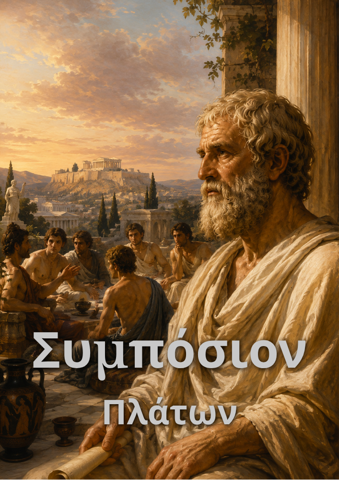
Read Συμπόσιον at the source, before centuries of translation made its language familiar in other forms.
Symposium, preserved here as Συμπόσιον, is one of the works through which ancient Greek literature and thought continue to speak to later centuries. A sequence of speeches at a banquet transforms love from desire for a body into a philosophical ascent toward beauty and truth.
The Symposium is one of the Socratic dialogues of the ancient Greek philosopher Plato, a student of Socrates. It is considered one of the author's best and one of the most beautiful works of ancient literature. The time of its writing is placed after the year 385 BC. from all those who relate what is said about the scattering of the Mantineans in villages.
In the meantime, before the three parts, there is a prologue in the form of a dialogue between Apollodorus and some of his friends, to whom the author deliberately does not attribute any characteristic, except that they are rich and therefore not professional intellectuals. Of these, only one speaks, also anonymous, who prompts Apollodorus to recount the love discussions that took place at Agathon's banquet on the occasion of his victory in the dramatic Linnaean games of 416 BC.
The young poet Agathonas won the prize in Linaia in the year 416 BC, during the reign of Archon Euphimos (Athens. 217a). But the next day he invited to a banquet all the prominent men of the aristocracy of Athens, because they had not been able to attend the feast the day before. The banquet was attended by Aristodemus, Phaedrus, Agathon, the doctor Eryximachus, Pausanias, Aristophanes, Alcibiades and later Socrates, who initially hesitated to attend and waited outside the door listening to what was said. Our first contact with Socrates takes place midway through the text, when he appears at the banquet. The attendees decide to spend the evening not with wild drinking, but nicely and dialectically, discussing a specific topic. The theme of the symposium is therefore the search for the texture of love: "what is love?"
Almost the entire dialogue is in the form of a narration by Apollodorus to Etairus, a friend of his on the way to Athens. Apollodorus overheard the discussion from Aristodemus, who was attending the banquet, and Plato probably learned of what was being said from his brother or the unnamed friend.
The discussion begins with the speech of Phaedrus, who claims that Eros is one of the most ancient deities. While a faithful friend is the greatest happiness, it is love that prompts us to do the most heroic deeds.
Pausanias, also known as Agathon's companion, brings love into relation to the goddess Aphrodite, and argues that, just as Aphrodite has two natures, the human and the divine, so love has two forms; carnal love aims at simple satisfaction, while higher love brings about eternal union with the lover or the beloved.
From a medical point of view, the doctor Eryximachus sees love as a conjunction of four love forces residing in the human body: heat, cold, bitterness and sweetness.
Aristophanes then, before starting his monologue, warns that what he is about to say is more strange than funny. His reason is an explanation for the phenomenon of lovers who say they feel "whole" when they find their partner. First he explains that you have to understand human nature before trying to express the origin of love and how it affects us. Love stems from the fact that once upon a time people had double bodies with two faces and instead of two sexes there were three: men, women and the androgynous, where they had the body of both a man and a woman. Men originated from the sun, women from the Earth and androgynous from the Moon. These people, because of their great power, tried to conquer Olympus and the gods themselves. Zeus initially thought of blowing them up, but he didn't want the gods to lose the sacrifices they made, so he decided to cut them in two, resulting in the separation of the two bodies. Since then people have been looking for their other half or basically their match. Men where they separated from another man are homosexuals. While the women are the lesbians. Heterosexuals are the result of the intersection of "androgynous". He then states that homophobia is an oxymoron since he believes that homosexuals are the most powerful, with their existence in politics as the main presumption. Then Aristophanes mentions the fact that when two soul mates find each other they never wish to be separated again. This feeling remains an enigma to this day. Finally, he warns us to fear the gods so they don't tear us apart again.
Approaching Symposium in its original language brings the reader closer to choices of rhythm, argument, image, and dramatic emphasis that translations must inevitably interpret. The work is not important only because it is old: it remains a living point of reference for writers, philosophers, historians, theatre makers, and readers confronting related questions today.
Plato was an Athenian philosopher and student of Socrates whose dialogues shaped Western ethics, metaphysics, politics, and theories of knowledge.
Plato (Ancient Athens, 428/427 or 424/423 BC – Ancient Athens, 348/347 BC) was an ancient Greek philosopher from Athens, the most famous student of Socrates and teacher of Aristotle. His work, which in the form of philosophical dialogues has survived in its entirety (even some spurious works are attributed to him), exerted a huge influence on ancient Greek philosophy and in general on the Western philosophical tradition until today.
Plato, among others, wrote the Apology of Socrates, a΄[›] which is considered to be a relatively accurate record of Socrates' apology in the trial that sentenced him to death, the Symposium where he talks about the nature of love, "Protagoras" where, among other things, the principle of "prevention" which does not take punishment as absolutely "retributive" 324b, Parmenides and Theaitis, where he establishes the objectivity of speech and idea, while in two long dialogues, the State and the Laws, he described an ideal state b΄[›], a society of three classes: (a) the few, rulers - kings, (b) the auxiliaries, a caste of warriors, (c) the multitude of free citizens who have no access to power. The few, by virtue of wisdom - logic, and the auxiliaries, by virtue of bravery - will, dominate the passions of the multitude.
In the 20th century the philosopher Karl Popper criticized Plato's ideal state as a totalitarian formation. Plato was describing an ideal - utopian society, where it will be clear who are worthy to rule and fight. This is clearly impossible in a real society, something that was certainly known to Plato, whose work was philosophical and theoretical rather than a proposal for government.
His body of work often ranks him among the world's leading and most influential figures of all time, along with his teacher, Socrates, and his student, Aristotle.
In this collection, the author's importance is approached through Symposium. The work shows how a particular genre or method could become a durable instrument for examining human action, public life, knowledge, memory, and the demands of justice.
Miva: the next reading experience beyond audiobooks
Listen like an audiobook, then ask anything, anytime.
Start Miva's narrationMiva does not just narrate. It keeps explaining based on what you ask.