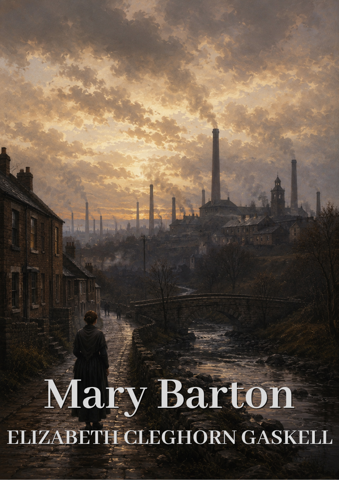
Manchester Seen from the Factory Floor
Elizabeth Gaskell's First Novel
Love and Murder Inside a Divided Industrial City
The Social Novel That Drew Praise from Thomas Carlyle
Before the celebrated masterpieces came Mary Barton: a first book in which Elizabeth Gaskell's defining concerns were already taking shape.
Mary Barton: A Tale of Manchester Life was the first novel by English author Elizabeth Gaskell, first published in 1848. The story is set in the English city of Manchester between 1839 and 1842, and deals with the difficulties faced by the Victorian working class.
The novel begins in Manchester, where we are introduced to the Bartons and the Wilsons, two working-class families. John Barton is a questioner of the distribution of wealth and the relations between rich and poor. Soon his wife dies-he blames it on her grief over the disappearance of her sister Esther. Having already lost his son Tom at a young age, Barton is left to raise his daughter, Mary, alone and now falls into depression and begins to involve himself in the Chartist, trade-union movement. Mary takes up work at a dressmaker's (her father had objected to her working in a factory) and becomes subject to the affections of hard-working Jem Wilson and Harry Carson, son of a wealthy mill owner. She fondly hopes, by marrying Carson, to secure a comfortable life for herself and her father, but immediately after refusing Jem's offer of marriage she realizes that she truly loves him. She, therefore, decides to evade Carson, planning to show her feelings to Jem in the course of time. Jem believes her decision to be final, though this does not change his feelings for her.
Kathleen Mary Tillotson wrote that Mary Barton is "built on the assumptions of Chartism and Past and Present", two works of social criticism by Thomas Carlyle.
The novel was first published anonymously, but its authorship was widely known within a year. Early reception of the novel was divided, with some praising its honesty and fidelity to facts and others criticising it for presenting a distorted picture of the employer-employee relationships. The British Quarterly Review said it was a "one-sided picture", and the Edinburgh Review that the division between employers and employed was exaggerated. They were echoed by the Manchester Guardian and the Prospective Review, however the Athenaeum, the Eclectic Review, the Christian Examiner and Fraser's Magazine took a different stance. The Athenaeum's otherwise positive review raised the question of whether "it may be kind or wise or right to make fiction the vehicle for a plain, matter of fact exposition of social evils". Thomas Carlyle wrote a letter to Gaskell in which he called it "a Book seeming to take its place far above the ordinary garbage of Novels".
“a Book seeming to take its place far above the ordinary garbage of Novels”
Why Mary Barton Still Matters
Read today, Mary Barton offers more than the curiosity of a famous writer's beginning. It preserves the risks, experiments, and unresolved tensions of a literary voice before later success made that voice familiar.
Return to the beginning, and discover how Mary Barton first opened the path ahead.
Set against the stark, industrial backdrop of Victorian Manchester between 1839 and 1842, Mary Barton tells the tragic yet deeply human story of two working-class families, the Bartons and the Wilsons, caught in the crushing gears of social inequality and economic hardship. John Barton, a proud mill worker and devoted father, grows increasingly embittered by the vast divide between the wealthy factory owners and the starving working class. Following the death of his wife and young son, his heart hardens under the weight of grief and despair. He throws himself into the Chartist trade-union movement, seeking justice for the oppressed. Left to raise his beautiful daughter, Mary, alone, he insists she work as a seamstress rather than in the harsh environment of the mills. As Mary grows into adulthood, she finds herself torn between two very different worlds. She is courted by Jem Wilson, a honest, hard-working young man from her own class who genuinely loves her. At the same time, she catches the eye of Harry Carson, the charming and wealthy son of a prosperous mill owner. Tempted by dreams of luxury and the hope of rescuing her father from poverty, Mary foolishly flirts with Carson and turns down Jem’s proposal. However, the moment Jem walks away, Mary experiences a sudden, painful awakening: she realizes she does not love Carson at all, but holds a profound, unshakeable love for Jem. She immediately resolves to break off all ties with Carson and win Jem’s heart back over time. Tragedy strikes when Harry Carson is brutally murdered. Suspicion quickly falls upon Jem Wilson, whose known rivalry with Carson and previous public altercations make him the prime suspect. Jem is arrested and put on trial for his life. However, while searching through her father’s old coat, Mary uncovers a horrifying secret: a scrap of paper matching the gun wadding used in the crime reveals that her own father, John Barton, is the true assassin, driven to murder by violent class hatred and despair. Desperate to save the innocent man she loves without condemning her own father to the gallows, Mary embarks on a frantic race against time. She hunts down an alibi for Jem, tracking down his cousin Will to prove Jem was elsewhere on the night of the crime. Her efforts succeed, and Jem is triumphantly acquitted at his trial, though the tremendous strain plunges Mary into a temporary, severe fever and delirium. Broken in body and spirit, a dying John Barton eventually returns home. Overwhelmed by agonizing remorse, Barton confesses his crime directly to the victim’s father, Mr. Carson. At first consumed by a fierce desire for vengeance, Mr. Carson is profoundly touched by a moment of divine grace and the sight of Barton’s immense suffering. Realizing the destructive cycle of hatred, Carson chooses mercy, forgiving Barton as the dying man passes away in his arms. With the truth exposed, Jem finds himself blacklisted from local foundries due to lingering suspicions, prompting him to seek a new beginning. Securing a position as an instrument-maker in Toronto, Canada, Jem marries Mary. Together with Jem’s mother, Jane, they leave behind the grief and turmoil of Manchester to start a peaceful, hopeful new life across the ocean.
For, brothers, is not them the things we ask for when we ask for more wage? We donnot want dainties, we want bellyfuls; we donnot want gimcrack coats and waistcoats, we want warm clothes, and so that we get 'em we'd not quarrel wi' what they're made on.Mary Barton Chapter XVI. It strips away political abstraction to expose the modest, fundamental nature of the workers' demands for basic human dignity, shelter, and sustenance.
I liked Mr. Harry Carson once—I don't know—I've forgotten; but I loved James Wilson, that's now on trial, above what tongue can tell—above all else on earth put together; and I love him now better than ever, though he has never known a word of it till this minute.Mary Barton Chapter XXXII. This public declaration marks Mary's dramatic shift from superficial romantic fantasies of wealth to an unwavering, selfless commitment to true love under extreme trial.
Lad! thou hast borne a deal for me. It's the meanest thing I ever did to leave thee to bear the brunt. Thou, who wert as innocent of any knowledge of it as the babe unborn.Mary Barton Chapter XXXV. It delivers the emotional climax of the novel's tragedy, combining Barton's ultimate moral collapse with a poignant plea for forgiveness and redemption.
Modern readers generally find Mary Barton accessible, though it presents specific stylistic elements characteristic of nineteenth-century literature. Elizabeth Gaskell incorporates authentic Lancashire dialect into the dialogue of working-class characters, which captures the distinct voice of Victorian Manchester. While these regional phrases and older grammatical structures can require initial adjustment, Gaskell frequently provides contextual clues and explanatory notes to guide the reader. The narrative pacing relies on a blend of melodrama, romance, and political commentary, which keeps the central story moving forward. Beyond the historical vocabulary, the core emotional conflicts, such as romantic confusion, family loyalty, and the struggle against economic pressure, remain clear and compelling. Readers familiar with authors like Charles Dickens or George Eliot will find the structural style familiar, while newcomers will find the central murder trial and dramatic tension easy to follow.
Mary Barton holds a permanent place in the literary canon because it represents one of the earliest and most authentic portrayals of the Victorian industrial working class. Published anonymously in 1848 during a period of intense political unrest across Europe, Elizabeth Gaskell gave a powerful voice to the urban poor of Manchester. Rather than presenting factory workers as mere statistics or passive victims, she depicted them as complex individuals with deep moral struggles, grief, and political agency. The novel broke new ground by integrating social criticism with popular genres like the romance and the murder mystery. Thomas Carlyle and other prominent thinkers praised its fidelity to facts and emotional honesty. Its historical value as a portrait of Chartist movement tensions, combined with its timeless exploration of empathy, systemic injustice, and forgiveness, secures its status as an essential Victorian text.
What happens at the end is the ultimate test of human conscience, love, and redemption. As the courtroom trial reaches its absolute climax, the narrative strips away every illusion of class conflict to confront a far deeper, personal reckoning. A desperate search for proof transforms into a agonizing moral crisis where loyalty to blood clashes directly with the preservation of an innocent life. In the shadow of inevitable tragedy, enemies are brought face-to-face in a quiet room, forced to choose between the fiery satisfaction of vengeance and the quiet dignity of forgiveness. The final pages do not merely resolve a murder mystery; they offer a profound, heartbreaking meditation on the possibility of grace amidst total ruin. Read these closing pages for yourself.
The novel was written during the "Hungry Forties," a period of severe economic depression, mass unemployment, and widespread famine across Great Britain. Gaskell lived in Manchester as the wife of a Unitarian minister, which brought her into direct contact with the suffering of industrial workers. The rise of the Chartist movement, which demanded political rights and voting reform for the working class, forms the structural backdrop of the narrative. Gaskell sought to explain the motivations behind worker radicalism to middle-class readers who often viewed trade unions with fear and hostility.
Gaskell highlights social inequality by juxtaposing the domestic lives of the factory owners with those of their employees. While workers endure damp cellars, disease, and starvation without aid during trade slumps, the mill owners maintain comfortable residences and financial stability. This contrast is shown not just through material wealth, but through emotional disconnect, as the owners fail to understand the genuine distress driving worker strikes, leading to mutual suspicion and violent escalation.
Esther, Mary's absent aunt, serves as both a structural catalyst and a cautionary figure within the plot. Her initial disappearance leads to the grief that contributes to Mrs. Barton's death, altering the family dynamic forever. Later in the narrative, Esther returns as an outcast to warn Mary about the dangers of flirtation with wealthy men, ultimately providing the vital piece of physical evidence that links the crime to its true perpetrator.
Miva: the next reading experience beyond audiobooks
Listen like an audiobook, then ask anything, anytime.
Start Miva's narrationMiva does not just narrate. It keeps explaining based on what you ask.