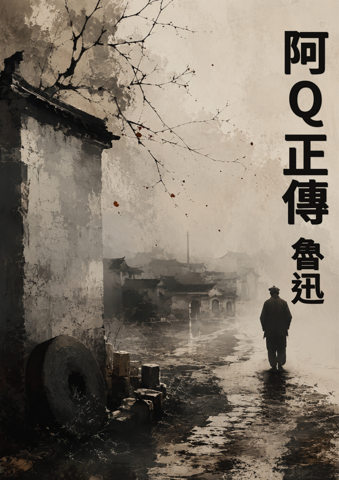
Lu Xun's Only Novella
The Origin of "Ah Q-ism"—Still a Living Term in Everyday Chinese
Praised by Romain Rolland, Invoked Repeatedly by Mao Zedong
China's First Entry to the Cannes Film Festival
Whenever the world humiliates him, he declares himself the winner.
Written by Lu Xun between 1921 and 1922 and serialized in Beijing's Morning Post Supplement, The True Story of Ah Q is his only novella and one of the most influential works in modern Chinese literary history. Set in the rural Jiangnan countryside around the time of the Xinhai Revolution, the story follows the poor peasant Ah Q—cowardly, self-deceiving, cruel to the weak and servile to the strong—through a life of humiliations he transforms, each time, into imaginary triumphs.
This is not a comedy of a fool's delusions. It is a national allegory disguised as one man's psychology. Lu Xun himself insisted the book was never meant to be humorous or to evoke pity, but to depict the soul of a modern Chinese person. Ah Q's "Spiritual Victory Method" became so precisely recognizable that it gave the language a new term—"Ah Q-ism"—still used today to name self-delusion dressed up as dignity. The laughter the story provokes is never really aimed outward. It is aimed at the reader.
"This satirical realist work is universal; there were Ah Qs during the French Revolution too. I will never forget that face of suffering." —Romain Rolland, novelist
The True Story of Ah Q found unusual admirers beyond literary circles. Mao Zedong cited Ah Q's image repeatedly—telling American writer Agnes Smedley in 1937 that many in China lived with Ah Q's spirit of imagined victory, and later invoking him again in a CCP plenary session on national self-respect. On screen, a 1958 Hong Kong adaptation starring Kwan Shan made him the first Hong Kong actor honored at an international film festival, while a 1981 Shanghai Film Studio production starring Yan Shunkai, made to mark the centenary of Lu Xun's birth, became the first Chinese film selected for the main competition at Cannes.
The story reads, on its surface, like satire. Lu Xun spent his later years insisting almost no one had understood how somber it truly was.
Miva: the next reading experience beyond audiobooks
Listen like an audiobook, then ask anything, anytime.
Start Miva's narrationMiva does not just narrate. It keeps explaining based on what you ask.