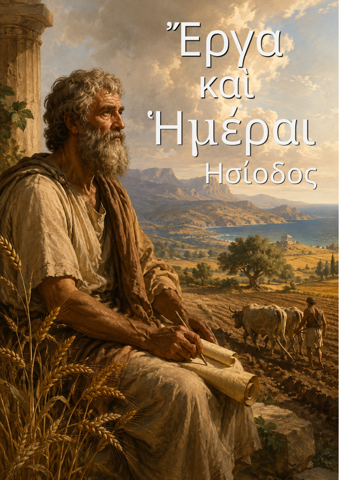
Read Ἔργα καὶ Ἡμέραι at the source, before centuries of translation made its language familiar in other forms.
Works and Days, preserved here as Ἔργα καὶ Ἡμέραι, is one of the works through which ancient Greek literature and thought continue to speak to later centuries. Myths of Pandora and the ages of humanity meet practical advice on farming, justice, labour, and the moral order of daily life.
Works and Days is one of Hesiod's best-known didactic epic poems. It consists of 828 hexameter verses and was written on the occasion of Hesiod's legal dispute with his brother Persis over the paternal inheritance and expresses all the author's bitterness over the fraternal discord. She as Erida is at the center of the first part of the play. The epic begins with an invocation to the Muses of Pieria, as is typical, to give inspiration to the poet to write but also to give sanctity and credibility to the events that will follow. Then the poet praises the supreme god Zeus and essentially begins the epic, which is divided into two parts.
The poet addresses his brother Persis and analyzes the structure of human society, the moral obligations of each person and the origin of evil in the world. He strongly emphasizes the virtues of economy, foresight, moderation, order and sociability useful for the struggle of life. This whole process is done through the telling of mythical stories, such as Prometheus and Pandora.
A little more detailed, in the first part Hesiod, after invoking the Muses, emphasizes that the Gods have their way of bringing the unjust and the powerful to their knees, and then he directly addresses his brother with whom they are still in legal dispute. It describes various human weaknesses such as jealousy and greed, but also the fact that Eris has two sides, one useful and good and one negative and destructive. He mentions that he did not get half the land that was due to him, but less and this Persian managed to "feed the judges who are happy to try such cases in order to be bribed".
Hesiod then indirectly contrasts their case with that of Prometheus and Epimetheus and mentions the story with Pandora. It tells how the gods got angry with the fire that the people took and how to punish them and Prometheus they created Pandora and sent her to seduce Epimetheus, who made the mistake of accepting a gift from Zeus even though Prometheus had advised him otherwise. The gift of the gods was Pandora herself who opened the jar with all the sufferings of the world and from then on all people were unhappy, since inside her so-called "box" only Hope was left.
Hesiod then goes into some detail about the creation of mankind by generations or races and reminds his brother that the gods made from the same material men and demigods or heroes, implying that man has the choice to become good or evil. It states that the golden generation was created first, which was the most perfect and became happy. When she left the earth, the gods created silver, which was far inferior to gold. When that time passed, they created the third generation, made of copper, which was even worse. So the next generation the gods made sure to make it better and so the fourth race the generation of humans were good people and heroes, who became demigods. Many of this generation fought in the age of Oedipus and in the Trojan War "for Helen with the rich hair" and then retired and still live at the ends of the earth.
Finally, the Gods created the fifth race, the generation, which Hesiod implies is the current one and to which he and his brother belong. He describes it in the darkest colors, where respect for the parent is lost, the good is not praised but the strong is rewarded, where strength is also justice, and where Nemesis and Aedos (shame) now depart from the company of men and seek refuge near the gods, leaving weak men to their fate, defenseless against strong power or injustice. The poet states that he would like to live in the previous or even the next generation, which, however, is not named. The prediction of a sixth generation is often downplayed in later scholars' engagements with this myth. In general, Hesiod's greater interest in the fifth genus is distinct, as he devotes more verses to it (28), compared to the previous ones.
Approaching Works and Days in its original language brings the reader closer to choices of rhythm, argument, image, and dramatic emphasis that translations must inevitably interpret. The work is not important only because it is old: it remains a living point of reference for writers, philosophers, historians, theatre makers, and readers confronting related questions today.
Hesiod was an early Greek didactic poet whose works preserve central accounts of divine genealogy, labour, justice, and rural life.
Hesiod was an ancient Greek poet, rhapsodist, writer and mythographer. He was the second greatest poet after Homer. He was born in Askra in Boeotia, where his father fled.
It is estimated that he lived at the end of the 8th century. B.C. Often visiting Mount Helicona, where legends said the Muses resided, he himself said that they gave him the gift of poetry. Because he grew up in this sacred and rural environment his poems have a didactic and religious content. With Hesiod, Greece comes out of the realm of myth only, since he derives his subjects not only from imagination, but also from life, thus bringing poetry closer to man.
The manner and time of his death is confused. One tradition wants Hesiod's tomb in Orchomenos Boeotia, while according to another the oracle of Delphi made an oracle that Hesiod would "die in Nemea", so he fled to Locris, where he was killed in the local temple of Nemean Zeus and buried there.
In ancient times although many poems bore his name, three poems have been saved by time. Hesiod's poems contained the first attempts at lyric writing, iambic and elegiac.
Works and Days, where Hesiod talks about the moral lessons that people should follow. He also gives advice to farmers on cultivating the land and states that work is the only way to ensure success. "Ergon d' neun oneidos, aergii de t' oneidos" that is "no work is a shame, it is a shame not to work". In the same work he also gives advice on maritime, commercial and agricultural projects, as well as on marriage and the upbringing of children, trying to exhort man to become better and more virtuous.
In this collection, the author's importance is approached through Works and Days. The work shows how a particular genre or method could become a durable instrument for examining human action, public life, knowledge, memory, and the demands of justice.
Miva: the next reading experience beyond audiobooks
Listen like an audiobook, then ask anything, anytime.
Start Miva's narrationMiva does not just narrate. It keeps explaining based on what you ask.