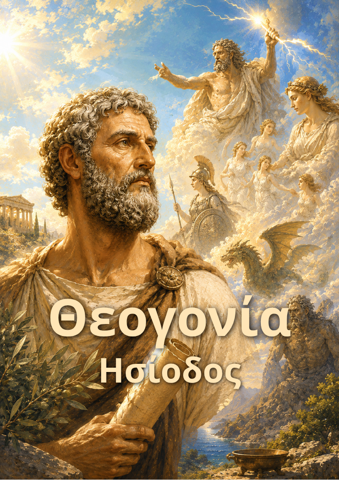
Read Θεογονία at the source, before centuries of translation made its language familiar in other forms.
Theogony, preserved here as Θεογονία, is one of the works through which ancient Greek literature and thought continue to speak to later centuries. Hesiod orders the births and battles of gods from Chaos to Zeus, providing a foundational map of Greek divine genealogy.
The Theogony is an epic poem by Hesiod that describes, in contrast to the cosmogonies of other Eastern peoples, the origin of the gods of Greek mythology as they were born and formed in human perception after early observations along with the Earth (Gaia), the rivers, the vast sea, the bright stars and the wide sky above all. It is considered that it was written after the Homeric epics, which are the source of the work, theoretically calculating its writing around 1000 to 700 BC. The Theogony of Hesiod is a very important source for ancient Greek mythology, which mentions almost all of the ideal deities that the ancient Greeks respected and honored.
The poem consists of 1022 hexameters and begins with the first generation of gods, Chaos, Gaia, continues with Uranus, the Titans and ends with the gods of Olympus and their dominion.
Hesiod's Theogony is a lengthy synthesis of a vast array of local Greek traditions concerning the gods. The work is organized as a narrative telling how the gods were created by creating the early moral and orderly order without laws.
Hesiod, after thanking the Muses for the inspiration they gave him, explains that Chaos spontaneously appeared which gave birth to the first divine Trinity, Earth, as the concept of matter, Tartarus as the concept of time and death and Eros, as the concept of creation. Then, from Chaos sprang Erebus and Nyx. From the union of Night and Erebus were born Aether and Day. The Earth, by parthenogenesis, gave birth to Uranus, Oὔrea (Mountains) and Pontus.
Uranus mated with Gaia and 12 Titans were born: Oceanus, Coius, Creon, Hyperion, Iapetus, Theia, Rhea, Themis, Mnemosyne, Phoebe, Tethys and Saturn, 3 Cyclopes: Brontes, Steropus and Argys and finally 3 Hecatoghires: the Briareus, Kottos and Gygis.
When Saturn cut off the genitals of Uranus, drops of blood fell on the earth and thus the Erinyes, the Giants and the Meliads were created. He then threw the genitals into the sea and from the foam Aphrodite was born. Meanwhile the Night alone gave birth to Moro, Dreams, Destiny, Feud, Momo, Friendship, Old Age, Death, Fates, Nemesis, Hesperides, Sleep, Oizy and Deceit. Eris followed in her mother's footsteps and gave birth to Pain, Battles, Quarrels, Murder, Wrestling, Lies, Disputes, Famine, Disease, Oaths, Stories, Disobedience and Ruin. Gaia married Pontus and gave birth to Forky, Keto, Nireus and Thaumas. Phorcys and Ceto mated and gave birth to Graia and the 3 Mermaids (Stheno, Euryale and Medusa). Medusa and Poseidon gave birth to Pegasus and Chrysaora, who together with Calliroi gave birth to Geryon. Nereus together with Dorida gave birth to 50 Nymphs, the Nereids. Thaumas together with Electra gave birth to Iris (rainbow) and the Harpies. Gaia and Tartarus gave birth to Typhon who together with Echidna gave birth to Orthos, Geryon's dog, Chimaera, Hydra and Cerberus. Orthos and Chimaera gave birth to the Sphinx and the Nemean Lion (raised by Hera). Oceanus and Tithys gave birth to 3,000 rivers and 3,000 Oceanids. Theia and Hyperion gave birth to the Sun, the Moon and the Dawn or Io. Creus and Eurybia gave birth to Astraeus, Pallas and Persis. Pallas and the Oceania Styx gave birth to the 4 Winds and the Stars. Iapetus and Clymene gave birth to Menoitius, Atlas, Epimetheus and Prometheus.
Approaching Theogony in its original language brings the reader closer to choices of rhythm, argument, image, and dramatic emphasis that translations must inevitably interpret. The work is not important only because it is old: it remains a living point of reference for writers, philosophers, historians, theatre makers, and readers confronting related questions today.
Hesiod was an early Greek didactic poet whose works preserve central accounts of divine genealogy, labour, justice, and rural life.
Hesiod was an ancient Greek poet, rhapsodist, writer and mythographer. He was the second greatest poet after Homer. He was born in Askra in Boeotia, where his father fled.
It is estimated that he lived at the end of the 8th century. B.C. Often visiting Mount Helicona, where legends said the Muses resided, he himself said that they gave him the gift of poetry. Because he grew up in this sacred and rural environment his poems have a didactic and religious content. With Hesiod, Greece comes out of the realm of myth only, since he derives his subjects not only from imagination, but also from life, thus bringing poetry closer to man.
The manner and time of his death is confused. One tradition wants Hesiod's tomb in Orchomenos Boeotia, while according to another the oracle of Delphi made an oracle that Hesiod would "die in Nemea", so he fled to Locris, where he was killed in the local temple of Nemean Zeus and buried there.
In ancient times although many poems bore his name, three poems have been saved by time. Hesiod's poems contained the first attempts at lyric writing, iambic and elegiac.
Works and Days, where Hesiod talks about the moral lessons that people should follow. He also gives advice to farmers on cultivating the land and states that work is the only way to ensure success. "Ergon d' neun oneidos, aergii de t' oneidos" that is "no work is a shame, it is a shame not to work". In the same work he also gives advice on maritime, commercial and agricultural projects, as well as on marriage and the upbringing of children, trying to exhort man to become better and more virtuous.
In this collection, the author's importance is approached through Theogony. The work shows how a particular genre or method could become a durable instrument for examining human action, public life, knowledge, memory, and the demands of justice.
The Theogony of Hesiod begins on the sacred, mist-shrouded slopes of Mount Helicon, where the Heliconian Muses dance around the violet-hued spring and the altar of almighty Zeus. It is here that these divine daughters of Zeus appear to Hesiod as he tends his sheep. Calling the rural shepherds mere men of the belly, the Muses reveal that they know how to speak false things that seem true, but also how to utter the absolute truth when they choose. They pluck a wondrous branch of flourishing laurel to hand to the poet as a staff, breathing into him a divine voice to sing of things past and things to come, and commanding him to glorify the eternal race of the immortal gods. Before the existence of gods or earth, Chaos, a vast, dark void, came into being first. From this primal expanse emerged broad-breasted Gaia (Earth), the untamed sea Pontus, and starry Ouranos (Sky), who enveloped Gaia on all sides. Gaia and Ouranos joined together to parent the first divine generation, including the great Titans: Oceanus, Coeus, Crius, Hyperion, Iapetus, Theia, Rhea, Themis, Mnemosyne, golden-crowned Phoebe, lovely Tethys, and lastly, the wily Kronos, the youngest and most terrible of her children. When Kronos wed his sister Rhea, she bore him glorious offspring: Hestia, Demeter, golden-sandaled Hera, Hades who dwells beneath the earth, the loud-crashing Poseidon, and Zeus, the wise father of gods and men. Yet a dark prophecy warned Kronos that he was fated to be overthrown by his own child. To forestall this destiny, Kronos swallowed each infant the moment they reached their mother's knees from her sacred womb. Grief-stricken and desperate to save her unborn child, Rhea appealed to her parents, Gaia and starry Ouranos. They devised a cunning plan, sending Rhea to Crete to give birth to Zeus in secret. In place of the baby, Rhea handed Kronos a great stone wrapped in swaddling clothes, which the titan swallowed whole, unaware that his undefeated son remained alive. Zeus grew rapidly in strength and vigor. Guided by the wise counsel of Gaia, Zeus tricked Kronos into regurgitating the stone along with his swallowed siblings. Reunited, the Olympian gods declared war against Kronos and the elder Titans. For ten continuous years, the Titanomachy raged between the Titans atop Mount Othrys and the Olympians atop Mount Olympus, with neither side gaining an edge in the relentless, heartbreaking strife. The turning point came when Zeus summoned his full, overwhelming power. Leaping from Olympus, he unleashed blazing thunderbolts, lightning, and scorching flames that shattered the earth and set the forests ablaze. To secure final victory, the Olympians allied with ancient forces freed from the depths, casting the defeated Titans into the dark abyss of Tartarus under unbreakable chains. Even after the Titans were subdued, Gaia bore one final, terrifying monster to Tartarus: Typhoeus, a giant creature with a hundred snake heads spitting fire and uttering horrific sounds. Typhoeus threatened to usurp control of mortals and immortals alike, but Zeus leaped forth with thunder and fiery lightning, striking the monster and casting him down into Tartarus. With their colossal labors complete and the grand battle ended, the blessed gods, guided by Gaia’s wisdom, urged the far-seeing Olympian Zeus to reign as king and king over all immortals, and Zeus distributed honors and domains among them.
Field-dwelling shepherds, ignoble disgraces, bellies and nothing more! We know how to speak many lies that seem like truths, but we know also, whenever we wish, how to utter true things.Original: ποιμένες ἄγραυλοι, κάκ᾽ ἐλέγχεα, γαστέρες οἶον, ἴδμεν ψεύδεα πολλὰ λέγειν ἐτύμοισιν ὁμοῖα, ἴδμεν δ᾽, εὖτ᾽ ἐθέλωμεν, ἀληθέα γηρύσασθαι.Theogony Lines 26–28. It establishes the paradoxical nature of poetic truth and divine inspiration, setting up the authority of the epic speaker.
Mother, I would promise and accomplish this deed myself, since I care nothing for our ill-omened father; for he was the first to devise shameful deeds.Original: μῆτερ, ἐγώ κεν τοῦτό γ᾽ ὑποσχόμενος τελέσαιμι ἔργον, ἐπεὶ πατρός γε δυσωνύμου οὐκ ἀλεγίζω ἡμετέρου· πρότερος γὰρ ἀεικέα μήσατο ἔργα.Theogony Lines 168–171. It captures the dramatic shift in cosmic order through violent succession and filial betrayal that defines the early divine generations.
Zeus, most glorious and greatest of the everlasting gods, choose whichever of these the spirit in your breast bids you.Original: Ζεῦ κύδιστε μέγιστε θεῶν αἰειγενετάων, τῶν δ᾽ ἕλε᾽, ὁπποτέρην σε ἐνὶ φρεσὶ θυμὸς ἀνώγει.Theogony Lines 548–549. It displays the legendary intellect and deceit of Prometheus, initiating the fatal contest of wits between god and titan over human destiny.
And from his shoulders grew a hundred heads of a snake, a terrifying dragon, darting forth dark tongues; and from his eyes, in his wondrous heads, fire flashed beneath the brows.Original: ἐκ δέ οἱ ὤμων ἣν ἑκατὸν κεφαλαὶ ὄφιος, δεινοῖο δράκοντος, γλώσσῃσιν δνοφερῇσι λελιχμότες, ἐκ δέ οἱ ὄσσων θεσπεσίῃς κεφαλῇσιν ὑπ᾽ ὀφρύσι πῦρ ἀμάρυσσεν·Theogony Lines 824–827. It illustrates the terrifying, chaotic monsters that Zeus must conquer to establish permanent Olympian order over the cosmos.
The Theogony is remarkably accessible compared to many ancient epics due to its clear structure and focus on narrative genealogy. Composed of 1022 lines of hexameter verse, the work reads like a structured catalog interspersed with dramatic mythic battles. While modern readers may initially feel overwhelmed by the sheer number of obscure divine names and localized mythic lineages, the core plot centers on a dramatic family saga across three generations of god-kings. The narrative builds logically from abstract origins to intense physical confrontations, making it easy to track the primary plot lines once the major figures are understood.
The work is a cornerstone of Western literature because it provides the earliest systematic account of Greek divine genealogy and cosmic creation. Written around the late 8th to 7th century BC, Hesiod synthesized a vast array of regional Greek oral traditions into a single coherent framework. Beyond its historical value, the poem explores timeless human themes regarding power, justice, family conflict, and the transition from raw force to structured law. It served as a foundational cultural text for ancient Greek religion and continues to influence modern storytelling, philosophy, and comparative mythology.
What lies at the conclusion of this epic mythic sequence is the grand culmination of cosmic order. After the devastating clash of elemental titans and the fiery fury of primordial monsters, the universe shifts from chaotic warfare to an established divine hierarchy. The final passages reveal how authority is divided, how mortal and divine realms are forever delineated, and how the ancient world found its lasting structure under a supreme ruler. Rather than a simple resolution, these final moments offer a rich tapestry of mythological lineages and the definitive origin of the cosmos as the ancients understood it. Experience the ultimate triumph and the full majesty of the newly forged universe, and read these closing pages for yourself.
Hesiod explains that the universe begins spontaneously with Chaos, a vast dark void. Immediately following Chaos, Gaia (Earth), Tartarus (the underworld), and Eros (Desire) emerge into existence. From Chaos spring Erebus and Night, which join to produce Ether and Day. Gaia then gives birth to Ouranos (Sky) to cover her entirely, creating the physical stage for divine generation. This description portrays creation not as a magical act by a single creator god, but as an organic evolutionary process where physical elements of nature are personified as self-generating divine entities.
Zeus defeats the elder Titans through a combination of strategic alliances, severe endurance, and supreme elemental power. After growing to adulthood in Crete, Zeus tricks Kronos into vomiting up his swallowed siblings. The young Olympians then wage a ten-year war against the Titans. Acting on Gaia's advice, Zeus frees the three Hundred-Handed Giants from Tartarus, who lend overwhelming physical force to the battle. Zeus then unleashes his full lightning and thunderbolts, setting the earth ablaze and blinding the Titans before binding them in Tartarus forever.
While both Hesiod and Homer were foundational ancient Greek epic poets writing in similar hexameter verse, their subject matters and literary goals differ significantly. Homer focuses on heroic narratives, human tragedy, and specific historical legends like the Trojan War in the Iliad and Odyssey. Hesiod, conversely, focuses on didactic topics, cosmological structures, and moral instruction. In the Theogony, Hesiod acts as a theologian mapping out the divine order, while in Works and Days, he offers practical agrarian advice and moral guidance for daily human life.
Miva: the next reading experience beyond audiobooks
Listen like an audiobook, then ask anything, anytime.
Start Miva's narrationMiva does not just narrate. It keeps explaining based on what you ask.