“The Night Before Christmas” is one of the most vivid and poetic works by Nikolai Vasilievich Gogol, included in the second book of his famous cycle “Evenings on a Farm Near Dikanka.” Researchers differ on the exact timing of the novella's writing, but all agree it falls within the period from 1830 to the winter of 1831–1832. This immortal work was first published in early 1832, when A. A. Plyushar's printing house in St. Petersburg printed the collection under the pseudonym of the fictional editor, the beekeeper Rudy Panko. Censorship permission for publication was granted on January 31, 1832.
Chronologically, the novella's action is tied to a real and highly dramatic episode of Russian history at the end of the 18th century—the reign of Empress Catherine II. The plot unfolds against the backdrop of the last deputation of Zaporozhye Cossacks to St. Petersburg, which took place in 1775. This visit was directly related to the work of the state commission for the abolition of the Zaporozhian Sich, giving Gogol’s fairy-tale romantic narrative a palpable historical authenticity.
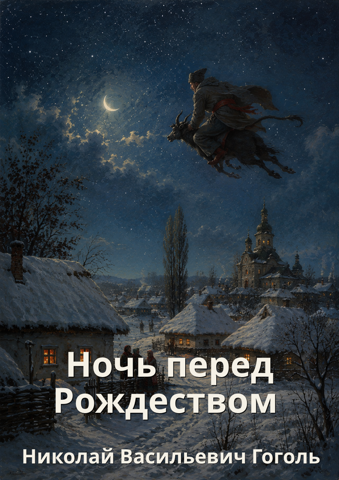
The events of the work take place in the Ukrainian village of Dikanka on the night before Christmas. Taking advantage of the holiday bustle, a devil circles in the sky, steals the moon, and hides it in his pocket. Using the sudden darkness and snowstorm, the devil hopes to keep the wealthy Cossack Korny Chub at home, as Chub had been invited to the deacon's for kutia. The devil does this out of revenge against Chub's son—the pious blacksmith Vakula, who painted a picture of the Last Judgment on the church wall, depicting the devil being shamefully beaten.
Despite the bad weather, Chub leaves the house anyway. The lovestruck Vakula comes to Chub's hut to see his beautiful daughter Oksana, but the proud girl only mocks his feelings. When Oksana's friends arrive, she notices gold-embroidered slippers (cherevichki) on one of them and publicly declares that she will only marry the blacksmith if he gets her the exact same slippers worn by the Tsaritsa herself. At the same time, Vakula's mother, the enterprising Solokha, hosts a succession of suitors—the devil, the village head, the deacon, and the returning Chub. Trying to hide from one another, the guests take turns hiding in empty coal sacks. Returning home, Vakula, unaware of the living contents, carries these heavy sacks out into the street.
Grieving over Oksana's cruel mockery, Vakula decides to drown himself. He leaves the sacks in the street, where they are later found by caroling villagers who quarrel over the unexpected loot, dragging out the deacon, Chub, and the village head. Meanwhile, the blacksmith goes for help to the Zaporozhian Puzaty Patsyuk, who has a reputation as a healer and sorcerer. Receiving a hint from him that the devil is sitting on his shoulders, Vakula deftly grabs the demon by the tail as he jumps out of the bag. Threatening him with the sign of the cross, the blacksmith completely subordinates the evil spirit and orders him to carry him to St. Petersburg, straight to the Empress's palace.
Once in the capital, Vakula joins the Zaporozhian deputation and gains an audience with Catherine II. Struck by the luxury of the palace, the simple-hearted blacksmith falls to his knees before the sovereign and asks her to give him her slippers. Touched by such sincerity, the Empress, in the presence of Prince Potemkin and the writer Fonvizin, orders the request to be fulfilled and gifts Vakula the coveted slippers. Meanwhile, in Dikanka, the village women argue over exactly how Vakula died, which makes Oksana repent and fall head over heels in love with the missing blacksmith. Vakula returns safe and sound and proposes to Oksana; Chub, enticed by gifts and annoyed by Solokha's betrayal, gives his blessing. Oksana agrees to become the blacksmith's wife, admitting she is ready to be with him even without the royal slippers. The happy Vakula starts a family, paints his hut in bright colors, and paints such a hideous devil in the church that all passing parishioners spit in its direction with contempt.
The text of “The Night Before Christmas” is deeply rooted in Christian culture and contains direct allusions to the lives of saints and Orthodox iconography. The scene in which Vakula the blacksmith saddles the devil and forces him to fly to St. Petersburg clearly refers to the famous hagiographic plot of Saint John of Novgorod, who, according to legend, similarly subordinated a demon and forced it to carry him to Jerusalem to the Church of the Holy Sepulchre. Another important symbolic moment occurs upon Vakula's return to his native village, when he severely lashes the devil with a switch. This episode recalls images of early Christian warriors against evil—Saint Nikita the Demon-Beater and the Great Martyr Marina of Antioch, traditionally depicted beating the devil.
Gogol's rich imagery, national flavor, and incredible humor made his novella an inexhaustible source of inspiration for artists. The work formed the basis for many classic musical and cinematic adaptations. In musical theater, the story found life through Nikolai Lysenko's opera “Christmas Night,” Pyotr Tchaikovsky's “Vakula the Smith” (later reworked into “The Slippers”), and Nikolai Rimsky-Korsakov's “The Night Before Christmas.”
The history of film interpretations began at the dawn of cinema with Vladislav Starevich's silent film in 1913. In the Soviet era, masterpieces were created such as the 1951 animated feature and director Alexander Rou's legendary 1961 fairy tale film “Evenings on a Farm Near Dikanka,” which became a New Year's television classic. Later, new animated versions appeared, and at the turn of the century, in 2001, a popular Russian-Ukrainian musical comedy-musical directed by Semyon Gorov was created, confirming the immortal popularity and relevance of Gogol's characters.
Miva: the next reading experience beyond audiobooks
Listen like an audiobook, then ask anything, anytime.
Start Miva's narrationMiva does not just narrate. It keeps explaining based on what you ask.