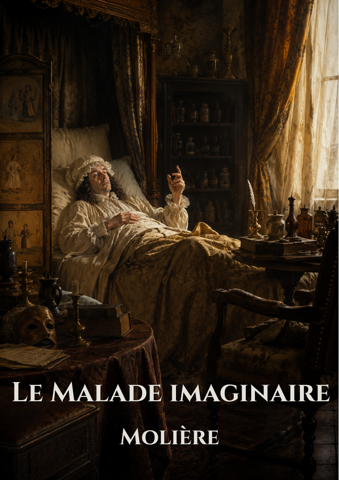
The Imaginary Invalid is Molière's final work, first performed in 1673 at the Théâtre du Palais-Royal in Paris. This comedy-ballet blends theater, music, and dance through a collaboration with the composer Marc-Antoine Charpentier. Today, it is considered one of the greatest comedies in French literature and the culmination of Molière's comic genius.
The play tells the story of Argan, a hypochondriac bourgeois obsessed with his health. Convinced that he is constantly ill, he spends his time consulting doctors and following absurd treatments. His fear of death is so strong that he wants to marry his daughter Angélique to Thomas Diafoirus, the son of a doctor, in order to have a physician in the family. However, Angélique loves another man, Cléante. Meanwhile, Béline, Argan's second wife, pretends to care for him while actually waiting for her inheritance. Faced with the master of the house's blindness, the servant Toinette and Argan's brother, Béralde, attempt to open his eyes through ruses and comic staging.
Through this plot, Molière develops a fierce satire of 17th-century medicine. Doctors appear pedantic, mechanical, and incapable of truly understanding their patients. They speak incomprehensible Latin, repeat absurd diagnoses, and apply ridiculous remedies like enemas or bloodletting. The famous passage where Toinette, disguised as a doctor, responds "The lung!" to all of Argan's symptoms perfectly summarizes this critique of a medicine based more on authority and habit than on science.
But the play is not limited to medical satire. It also explores universal themes such as the fear of death, human gullibility, hypocrisy, money, and family relationships. Argan becomes a prisoner of his obsession to the point of no longer distinguishing between sincere people and those taking advantage of him. Doctors exploit his fear, Béline manipulates his affection, and his blindness threatens his own daughter's happiness. As is often the case in Molière's works, young lovers must fight against the absurd authority of a father dominated by a fixed idea.
Comedy occupies a central place in the work. Molière uses character comedy through Argan's morbid obsession, repetition comedy with the doctors' mechanical speeches, language comedy through grotesque Latin and exaggerated formulations, as well as situational comedy with disguises, misunderstandings, and deceptions. The final ceremony where Argan becomes a doctor in a fake burlesque ritual represents one of the heights of Molière's comic theater: the line between truth and theater disappears completely, transforming medicine itself into a ridiculous spectacle.
This work also possesses a particular tragic dimension, as Molière was seriously ill while performing the role of Argan. On February 17, 1673, after a performance of The Imaginary Invalid, he collapsed and died a few hours later. This coincidence between the suffering author and his character obsessed with illness has deeply marked the history of French theater and contributed to the legend of Molière.
In the heart of seventeenth-century Paris, Argan, a wealthy, incurable hypochondriac, spends his days obsessing over his fragile health. Surrounded by a staggering mountain of apothecary bills, clysters, and purges, Argan relies entirely on his scheming physician, Monsieur Purgon, and his apothecary, Fleurant. So consumed is Argan with his imaginary ailments that he concocts a plan to secure constant medical attention for life: he decides to marry his eldest daughter, Angélique, to Thomas Diafoirus, a pedantic, dull-witted young medical student and the nephew of another prominent doctor. Angélique, however, is deeply in love with a charming young man named Cléante. Horrified by her father’s absurd decree, she turns to her sharp-witted and fiercely loyal maid, Toinette. Meanwhile, Argan’s treacherous second wife, Béline, harbors her own malicious agenda. She cares nothing for Argan’s health or his daughter's happiness, desiring only to secure his entire fortune for herself by persuading him to draft a will in her favor and send Angélique to a convent. To help the star-crossed lovers, Toinette assists Cléante in entering the household disguised as a temporary music master. During a music lesson held under Argan's watchful eye, Cléante and Angélique cleverly express their devotion through a improvised theatrical duet. Soon after, the Diafoirus father and son arrive to formally court Angélique. Thomas delivers embarrassingly stiff, rehearsed speeches, making it abundantly clear that he is entirely unsuited for her. Angélique boldly refuses the match, prompting an enraged Argan to threaten her with a convent if she does not submit within four days. Argan’s sensible brother, Béralde, arrives to intervene. Béralde openly mocks Argan’s blind devotion to medicine, arguing that nature should be left to heal itself and accusing physicians of trading in pompous jargon rather than real science. When Béralde insults Monsieur Purgon, the doctor flies into a rage, tearing up his prescriptions and cursing Argan with lethal afflictions. Panicked by the doctor's curse, Argan sinks into despair. To restore order, Toinette enacts a brilliant double stratagem. First, she disguises herself as an itinerant, grand doctor who diagnoses Argan with ridiculous absurdities, attributing every ailment to his lungs and recommending that he cut off an arm and pluck out an eye to improve his health. Argan is bewildered, but Toinette’s trick exposes the sheer ridiculousness of his medical faith. Next, Toinette and Béralde devise a plan to test the true loyalty of Argan’s family. They convince Argan to feign death. When Béline enters and is told her husband has suddenly passed, she openly rejoices, calling him a nuisance and immediately attempting to steal his money and legal papers. Argan leaps up from his couch, shattering her façade and banishing her from the house. When the fake death is repeated for Angélique, her reaction is entirely different. She bursts into genuine tears, devastated by the loss of her father, and declares she will gladly give up her love for Cléante to honor her father’s memory. Touched by her true devotion, Argan revives and gives his blessing to her marriage with Cléante, on the single condition that Cléante become a physician. Béralde steps in with a far better solution: why should Cléante become a doctor when Argan himself can join the profession? Béralde arranges a grand, comedic mock ceremony where a troupe of actors, playing doctors and apothecaries, admit Argan into the medical faculty with absurd Latin chants and ridiculous rituals. Contented and gloriously duped, Argan becomes a "doctor" himself, securing his own health and granting his daughter her true love.
I am not good at all, and I am mischievous whenever I want to be.Original: Je ne suis point bon, et je suis méchant quand je veux.The Imaginary Invalid Act I, Scene 5. This passage perfectly captures Argan's comical childishness and absurdity, highlighting how his desperate obsession with controlling his household collides directly with his inherent lack of true malice.
Your father is dead.Original: Votre père est mort.The Imaginary Invalid Act III, Scene 12. This dramatic turning point triggers the emotional climax of the comedy, forcing the characters to immediately expose their genuine feelings of grief or greed toward the central patriarch.
Vingt mille francs, m’amour.The Imaginary Invalid Act I, Scene 7. This exchange exposes the central hypocrisy of Argan's marriage, contrasting Béline's predatory financial greed with Argan's gullible devotion.
I don't even have the strength to be able to speak.Original: Je n’ai pas seulement la force de pouvoir parler.The Imaginary Invalid Act III, Scene 3. This line delivers quintessential hypochondriacal irony, as Argan uses the very breath and speech he claims to have lost to passionately complain about his physical infirmity.
Reading the play is quite accessible because it is structured as a fast-paced theatrical comedy centered on relatable human flaws. Molière uses lively dialogue, physical humor, and clear character motivations that translate easily across centuries. While some scenes contain comedic Latin jargon and references to 17th-century medical practices like purges and bleeding, these elements are intentionally absurd and meant to be funny rather than academic. The underlying narrative of a stubborn parent, young lovers, and a clever servant keeps the story engaging and straightforward for modern readers.
The work remains a classic because it combines brilliant social satire with universal human psychology. Molière exposes how fear and obsession make people vulnerable to manipulation, a theme that remains relevant across any era. The play is also historically significant as Molière's final masterpiece, written while he was severely ill himself. Its integration of farce, music, and social commentary represents the pinnacle of French comédie-ballet and comic theater.
Toinette is essential because she serves as the primary engine of the plot and the voice of practical reason. As the household servant, she sees through the pretensions of the doctors and the greed of Béline when Argan cannot. By using disguises, quick wit, and staged theatrical tricks, she protects Angélique's future and orchestrates the moments that ultimately open Argan's eyes.
Molière uses exaggerated language, repetitive diagnoses, and physical farce to mock the medical establishment. Doctors in the play rely on pompous phrases, formal garments, and ancient dogma rather than actual healing. By showing characters who prescribe the exact same absurd remedies for completely different ailments, the play highlights the ridiculousness of trusting blind authority over common sense.
As a comédie-ballet created with composer Marc-Antoine Charpentier, the play integrates music and dance directly into the narrative structure. The interludes provide theatrical spectacle while mirroring the themes of disguise and fantasy present in the main plot. They culminate in the final ceremonial spectacle where the line between actual reality and staged performance dissolves entirely.
The climax of the play brings the conflicts of Argan's household into a single, hilarious theatrical resolution. How Argan is finally persuaded to accept Cléante, the surprising disguise that transforms his perspective, and the grand, satirical ritual that resolves his lifelong medical anxiety are the exact payoffs worth experiencing in the text. Rather than a simple resolution, the story closes with an unforgettable celebration where medicine and theater merge completely.
Miva: the next reading experience beyond audiobooks
Listen like an audiobook, then ask anything, anytime.
Start Miva's narrationMiva does not just narrate. It keeps explaining based on what you ask.