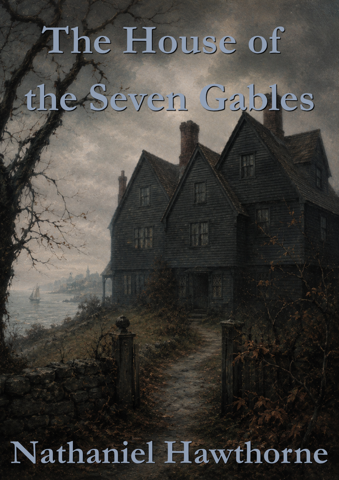
The House of the Seven Gables
Few American novels have left such a lingering stain upon Gothic literature as Nathaniel Hawthorne’s The House of the Seven Gables. Published in 1851, only a year after The Scarlet Letter, the novel transformed the haunted house into something more terrifying than specters: inherited guilt itself. Hawthorne took the decaying architecture of Puritan New England and turned it into a living organism — a mansion swollen with ancestral sin, whispered curses, false accusations, and the slow poison of history refusing to die.
The House itself rises from judicial murder. Colonel Pyncheon seizes land from Matthew Maule by condemning him during the Salem witch trials, and Maule’s dying curse — “God will give him blood to drink” — echoes across generations. From that moment onward, the Pyncheon family becomes spiritually gangrenous. Hawthorne’s genius lies not in proving whether the curse is supernatural, but in suggesting that moral corruption itself becomes a hereditary ghost. The seven gables loom over the novel like sharpened teeth, devouring every descendant trapped within them.
At the center stand Hepzibah and Clifford Pyncheon: relics of a dying aristocracy wandering through dusty corridors haunted by shame and economic ruin. Their decayed gentility, contrasted against Phoebe’s warmth and Holgrave’s modern skepticism, creates one of the great symbolic conflicts in American fiction — the war between inherited history and the possibility of renewal. Hawthorne saturates the narrative with mirrors, portraits, hidden documents, mesmerism, ancestral doubles, and spectral women, crafting a work that would become foundational to American psychological horror.
The novel’s influence radiated far beyond literature. H. P. Lovecraft called it “New England’s greatest contribution to weird literature,” and its shadow can be felt throughout The Shunned House and The Case of Charles Dexter Ward. The DNA of cursed bloodlines, morally diseased mansions, and ancestral doom would later echo through Shirley Jackson, Edgar Allan Poe, William Faulkner, Stephen King, Guillermo del Toro, and countless Gothic video games and horror films centered around collapsing family estates.
Its cinematic afterlife proved equally enduring. The novel received a major 1940 film adaptation starring Vincent Price, whose melancholic performance as Clifford Pyncheon permanently fused Hawthorne’s world with classic Hollywood horror. It later appeared in television adaptations, radio dramas, and even a 2000 opera staged at the Manhattan School of Music. Elements of its architecture and cursed-family mythology can still be recognized in modern haunted-house narratives from Crimson Peak to Resident Evil and The Haunting of Hill House.
Critics and writers repeatedly treated the novel as one of the darkest achievements in American Romanticism. Henry Wadsworth Longfellow described it as “a weird, wild book,” while Herman Melville wrote to Hawthorne:
“There is a certain tragic phase of humanity... never more powerfully embodied than by Hawthorne.”
James Russell Lowell believed it surpassed The Scarlet Letter, calling it “the most valuable contribution to New England history.” More than a Gothic entertainment, the novel became a meditation on whether human beings can truly escape the crimes of their ancestors — a question that would define generations of American literature.
Even now, the image remains immortal: a rotting mansion in Salem, windows staring like dead eyes over centuries of greed, hypocrisy, madness, and guilt. Hawthorne did not merely write a haunted-house story. He wrote the blueprint for the American haunted conscience.
Miva: the next reading experience beyond audiobooks
Listen like an audiobook, then ask anything, anytime.
Start Miva's narrationMiva does not just narrate. It keeps explaining based on what you ask.