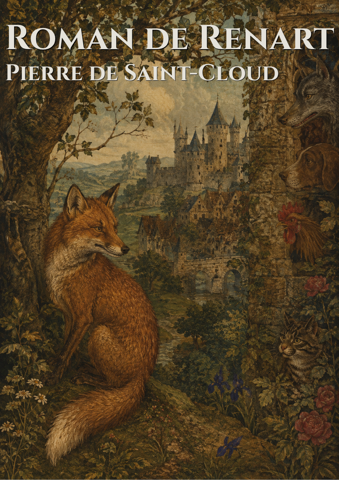
Long before animal tales invaded cinema, comic books, or video games, Le Roman de Renart (Reynard the Fox) had already invented one of the greatest anti-heroes of European literature: a fox who is a liar, charmer, thief, manipulator, and brilliantly funny, capable of ridiculing the powerful as well as the naive. Composed between the 12th and 13th centuries by a multitude of authors—some anonymous and others identified, such as Pierre de Saint-Cloud, Richard de Lison, or the priest of Croix-en-Brie—this vast collection of "branches" in octosyllabic verse is today considered one of the satiric pinnacles of the French Middle Ages.
The genius of Reynard the Fox lies in its extraordinary modernity. Behind the anthropomorphic animals—Reynard the Fox, Isengrim the Wolf, Tybalt the Cat, or Noble the Lion—hides a fierce portrayal of feudal society. The knights are brutal and stupid, the monks hypocritical, the courts corrupt, and the powerful grotesque. Reynard himself survives through speech, lies, and intelligence. He is neither a hero nor a moral role model: he is a survivor. This ambiguity has fascinated entire generations of writers and thinkers.
The success was so immense that the name "Renart" eventually replaced the original word "goupil" in the French language. Few literary works can boast of having permanently transformed the vocabulary of an entire civilization. Through the centuries, the character inspired Flemish, German, English, and Scandinavian traditions. Goethe himself adapted the story in his Reineke Fuchs, while Jacob Grimm saw the work as a true "animal epic come from Germany."
The modern influence of Reynard the Fox is immense. Walt Disney drew direct inspiration from it to design his 1973 Robin Hood: the anthropomorphic and cunning fox of Sherwood is the clear heir to Reynard. René Goscinny and Albert Uderzo briefly considered adapting the work before creating Asterix. Later, series such as De Cape et de Crocs, Fables, and numerous children's comic books would reuse the shadow of the old medieval fox. Animated cinema also embraced it with Ladislas Starewitch's The Tale of the Fox, considered a pioneering masterpiece of puppet animation.
Carl Gustav Jung and the anthropologist Paul Radin were also fascinated by Reynard, whom they linked to the universal figure of the "Trickster," the "divine rogue" who subverts the established order through laughter and cunning. Jung saw in these characters profound representations of the human unconscious and the inner child. This ability of Reynard the Fox to blend popular farce, social violence, and psychological symbolism explains why the work continues to nourish both academic studies and popular culture today.
Medievalist Lucien Foulet spoke of Reynard the Fox as a "masterpiece, and a successful one." As for Jean Dufournet, a great specialist of the text, he wrote: "Reynard is the triumph of intelligence over brute force." This phrase perfectly summarizes the lasting fascination exerted by this immoral, funny, and elusive fox, who has become one of the most living characters in all of French literature.
Miva: the next reading experience beyond audiobooks
Listen like an audiobook, then ask anything, anytime.
Start Miva's narrationMiva does not just narrate. It keeps explaining based on what you ask.