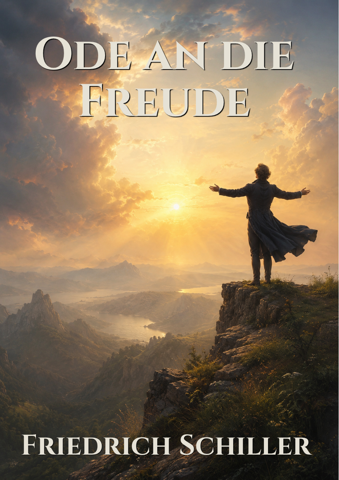
The Most Famous Poem in German Literary History
From a Hymn to Friendship to a Global Symbol of Peace
The Text Behind Beethoven's Immortal Ninth Symphony
The Official Anthem of the European Union
Schiller called it a failure. The world made it eternal.
First composed in the summer of 1785, An die Freude ("Ode to Joy") is one of the most recognizable and far-reaching works in all of Western literature. What began as a deeply personal expression of gratitude has, over two centuries, transformed into a universal emblem of freedom, solidarity, and the brotherhood of humankind.
Yet its author never believed in it. Friedrich Schiller dismissed the ode as pompous and imperfect—"of value for the two of us, but not for the world, nor for poetry." What Schiller could not foresee was the composer who would make it immortal.
1. Origins and Background
Place of composition: Schiller wrote the first version between May and mid-September 1785 in Gohlis near Leipzig, working in parallel on his celebrated drama Don Carlos.
Inspiration: The ode was an act of gratitude—dedicated to his close friend and patron Christian Gottfried Körner, whose support had rescued Schiller from a severe financial and personal crisis.
Publication: The poem first appeared in 1786 in Schiller's journal Thalia. A posthumously revised version followed in 1808, in which two lines were altered—most notably, "Beggars become princes' brothers" becoming "All men become brothers"—and the final stanza was omitted.
2. Schiller's Later Skepticism
Although the poem met with sensational public success, Schiller grew to view it with deep ambivalence. In a letter to Körner in 1800, he declared the ode a failure—"worldly remote," too pompous, too imperfect. The poet had disowned his most beloved work. History would not listen.
3. The Setting by Ludwig van Beethoven
It was Beethoven who granted the ode its worldwide, immortal fame.
The 9th Symphony (1824): Beethoven incorporated the poem into the final movement of his 9th Symphony in D minor (Op. 125)—selecting certain stanzas, rearranging them, and adding his own baritone introduction: "O friends, not these tones! Rather let us raise more pleasing, and more joyful ones."
The Hymn of Europe: In 1972, Beethoven's melody—without the German text—was declared the European anthem by the Council of Europe. In 1985, it was formally adopted as the official anthem of the European Union, a symbol of freedom, peace, and solidarity.
4. Cultural Significance and Historical Use
The melody has resounded across history as a protest song, a freedom hymn, and a signal of transformation.
5. Other Settings
Schiller's poem inspired composers across centuries:
"An die Freude" is a poem its author believed had failed. It became the anthem of a continent. Some works outlive even the doubts of the people who made them.
Miva: the next reading experience beyond audiobooks
Listen like an audiobook, then ask anything, anytime.
Start Miva's narrationMiva does not just narrate. It keeps explaining based on what you ask.