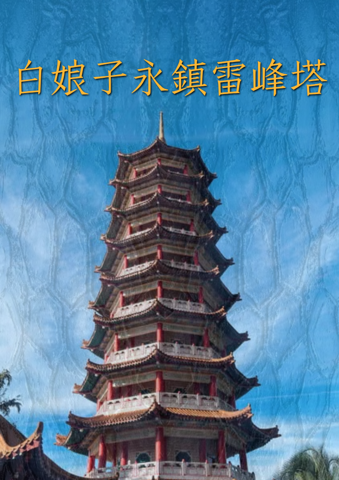
Background:
"Madame White Snake Eternally Imprisoned under the Leifeng Pagoda" is the twenty-eighth volume of the collection Stories to Caution the World (Jingshi Tongyan), compiled by Feng Menglong and first published around 1624. The "Legend of the White Snake" familiar to modern readers is not a single, static novel from ancient times, but a cluster of stories repeatedly rewritten through oral prompt-books (huaben), opera, ballad-singing (tanci), novels, and film. This selection uses the Stories to Caution the World version: the male protagonist is named Xu Xuan, and the characters of Madame White and Qingqing possess strong demonic traits; the narrative ultimately follows the cautionary framework of early oral stories. Common later plot points—such as the name Xu Xian, stealing the immortal herb, the flooding of Jinshan Temple, the birth of a son, and the sacrifice at the pagoda—cannot be assumed to exist in this original text.
Story Synopsis:
Xu Xuan, a young man from Hangzhou, meets Madame White and Qingqing in the rain at West Lake. The borrowing of an umbrella leads to a marriage and a series of incidents involving stolen property, government authorities, and sorcery. Xu Xuan wavers repeatedly between affection, fear, and practical pressure, while Madame White's true identity is gradually forced into light by monks and official powers. This Ming Dynasty huaben weaves together urban life, supernatural rumors, and moral exhortation.
Literary Features:
The work preserves vivid traces of oral storytelling art: the opening introduces West Lake scenery and local history; the narrator frequently inserts judgments, poetry, and reminders to the audience; the plot advances through a sequence of encounters, gift-giving, accusations, exile, and reunions. The urban space is highly concrete, with pharmacies, boatmen, government offices, inns, temples, and seasonal activities forming the rhythm of the story. Character titles, judicial procedures, and the movement of goods ground the supernatural tale in a recognizable daily order. Compared to later romanticized versions, this piece portrays Madame White less as a purely oppressed ideal lover and more as a figure where enchantment, theft, punishment, and warnings of desire coexist. This contradiction, which is not easily absorbed by modern romantic narratives, is precisely the value of reading the original text.
Director: Yue Feng / Production Region: Hong Kong
Starring: Lin Dai, Chao Lei, Tu Chuan
Reason for Inclusion: The Hong Kong Film Archive lists it as the first major production by Shaw Brothers after moving to the Clearwater Bay Film Studio, and it was Yue Feng's first time directing a wide-screen color film in the Shawscope format.
Differences from Original: The film adopts the Huangmei opera style and the later legendary system, including scenes like stealing the herb and flooding Jinshan; these are not in the original text of Volume 28 of Stories to Caution the World. The character also uses the later common name Xu Xian, whereas the original name is Xu Xuan.
Director: Taiji Yabushita / Production Country: Japan
Main Voice Cast: Hisaya Morishige, Mariko Miyagi
Reason for Inclusion: La Cinémathèque française introduces it as Japan's first feature-length color animated film and includes it in selections of important Japanese animation.
Differences from Original: The film reorganizes the legend into an inhibited romantic fairy tale, adding animal companions and animated adventures; it does not retain the huaben structure of Stories to Caution the World composed of government cases, exile, and moral judgments.
Main Versions:
When reading, one must distinguish between at least four textual lineages: the earlier "Record of the Three Pagodas of West Lake" from Qingping Shantang Huaben, the Stories to Caution the World version "Madame White Snake Eternally Imprisoned under the Leifeng Pagoda," the Qing Dynasty operas by Huang Tubi and Fang Chengpei, and the later Miraculous Tale of Leifeng Pagoda and tanci ballad systems. They share characters or landscapes but change names, causality, Madame White's moral position, and the ending. This full text corresponds only to Volume 28 of Stories to Caution the World and does not use the label "Complete Version of White Snake" to obscure version boundaries.
Reading Suggestions:
Initial readers should first verify the actual actions of Xu Xuan, Madame White, Qingqing, and Fahai in this version, then compare them with the familiar versions of Xu Xian, Xiaoqing, and the flooding of Jinshan. In the Japanese market, Ritsuko Inami's translated collections offer introductions to this piece. Research by Jacques Pimpaneau in French collections points toward early stories in the Qingping Shantang Huaben, not a full French translation of this specific version. Searches in German, Spanish, Italian, Korean, and Vietnamese mostly lead to general legends or film titles, which are currently insufficient to designate a mainstream full translation. When choosing a translation, check the original book title, volume number, translator, whether it is an abridgment, and whether the male lead is named Xu Xuan or Xu Xian.
Cultural Significance:
This work stands at a vital turning point where the White Snake story shifts from a supernatural warning to a romantic legend. Later stage and screen versions often lead the audience to sympathize with Madame White, adding plots such as saving her husband, resisting Fahai, and mother-son reunions; returning to Stories to Caution the World allows one to see how early huaben simultaneously mobilized fear of the "other," curiosity about urban desire, and warnings against the loss of order. It also illustrates that the "canonical version" of a folk legend is not created all at once but is formed through continuous competition across different media.
Relationship between Author and Work:
In compiling the "Three Words" (Sanyan), Feng Menglong organized, revised, and published a large number of existing huaben and simulated huaben. Therefore, this piece is best attributed as "Compiled by Feng Menglong" rather than attributing the long-circulating White Snake motif entirely to his personal creation. This role of compiler is the gateway to understanding the work: local anecdotes, storytelling formulas, moral judgments, and performable scenes are organized into a complete text, providing a narrative framework that could be repeatedly dismantled, supplemented, and inverted by Qing Dynasty opera and modern film.
Miva: the next reading experience beyond audiobooks
Listen like an audiobook, then ask anything, anytime.
Start Miva's narrationMiva does not just narrate. It keeps explaining based on what you ask.