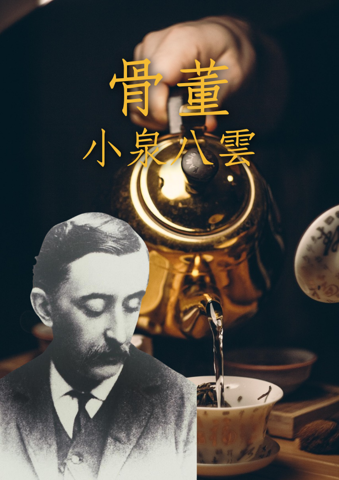
Collecting the subtle sensations of Japan between antiques, legends, and dreams
Kotto: Being Japanese Curios, with Sundry Cobwebs refers to "curios"—antiques, oddities, and stories wrapped in time. This volume includes pieces such as "The Legend of Yurei-Daki," "In a Cup of Tea," "Ikiryō," "Shiryō," "The Story of O-Kame," and "The Eater of Dreams," spanning genres from ghost stories and parables to folklore, dreams, daily curiosities, and philosophical essays. The Project Gutenberg catalog description identifies it as an English work on Japanese social customs and weird tales. Compared to Kwaidan, which focuses more on ghost legends, Kotto is like a drawer filled with old things: each item carries cobwebs, scents, textures, and untold histories.
Author Lafcadio Hearn was born in Greece in 1850 and honed his writing in the American press as a young man, specializing in descriptions of immigrants, low-life, Creole culture, and folk beliefs. This experience allowed him, upon arriving in Japan, to see beyond the institutionalized "Japan" and notice small places, old stories, commoner beliefs, and sensory details. After arriving in 1890, he met Koizumi Setsu in Matsue, hearing numerous legends through his wife and local people, transforming them into Japanese stories for a global audience in his English prose. Hearn passed away in 1904; Kotto, published in 1902, is one of the works from his mature period of Japanese writing.
The relationship between Kotto and Hearn is like a catalog of the author's spiritual collection in his later years: he organized the things he heard, read, and felt during his stay in Japan into a series of short pieces without rushing to categorize them. These stories sometimes resemble ghost tales, sometimes folk notes, and sometimes the remnants of dreams; together they present Hearn's most charming ability—to write cultural differences as a palpable atmosphere rather than cold explanations. Analogous to modern works, Kotto can be contrasted with Natsuhiko Kyogoku's Kosetsu Hyaku Monogatari in its narrative style that wanders between knowledge, rumors, and the supernatural, or compared to the gaze upon ancient sensations, invisible orders, and the spirituality of objects found in Fuyumi Ono's The Twelve Kingdoms or some works by Kaho Nashiki. It is suitable for readers who wish to enter the Japanese imagination of the strange through "objects" rather than a single plot.
Miva: the next reading experience beyond audiobooks
Listen like an audiobook, then ask anything, anytime.
Start Miva's narrationMiva does not just narrate. It keeps explaining based on what you ask.