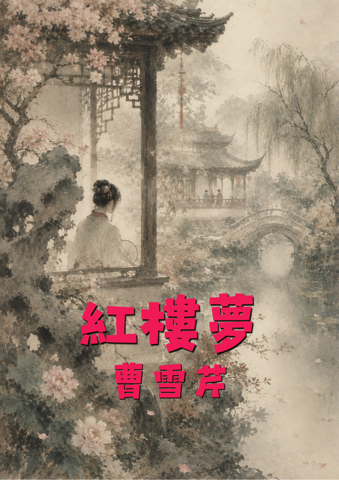
This novel initially circulated in manuscript form and was commonly known as "The Story of the Stone" at the time. Other titles mentioned in the book include "The Record of the Brother of Love," "The Tale of Gold and Jade," "The Precious Mirror of Romance," and "The Twelve Beauties of Nanjing." The introduction tells the story of a rejected stone left over from Nuwa's mending of the sky. Lacking the quality to mend the heavens, the stone transforms into a beautiful jade and accompanies the Shen-ying Attendant into the mortal world to experience life, hence the title "The Story of the Stone." It wasn't until the first movable-type edition was published in 1791 that "Dream of the Red Chamber" replaced other titles to become the most common name.
Versions and Composition Mysteries
Existing versions of "Dream of the Red Chamber" are mainly divided into two systems:
The Zhiben (Rouge) System: Manuscripts containing extensive commentary by "Zhiyan-zhai" and others. Most contain only the first 80 chapters and are considered closest to the author's original draft.
The Cheng-Gao System: The 120-chapter woodblock movable-type edition edited and published by Cheng Weiyuan and Gao E in 1791 and 1792.
Regarding the source of the last 40 chapters, the field of Redology remains in constant debate. Scholars like Hu Shih and Lu Xun believe the last 40 chapters are a "sequel" by Gao E or an anonymous author, while writers like Lin Yutang and Pai Hsien-yung tend to believe they contain Cao Xueqin's original fragments and were repaired by Cheng and Gao. Although the literary quality differs from the first 80 chapters, the tragic ending broke the traditional superstition of the "grand happy ending" in Chinese fiction, and its achievement remains undeniable.
Themes and Prospect Garden
The novel follows the rise and fall of the four great families—Jia, Shi, Wang, and Xue—as its main axis. Through the romantic and marital tragedies of Jia Baoyu, Lin Daiyu, and Xue Baochai, it showcases the social conditions and complex human nature of feudal society.
In the book, the author creates two contrasting worlds: the filthy reality outside Prospect Garden and the pure ideal within. Prospect Garden is a sanctuary for young women, embodying the creator's pursuit of clean and pure ideals. However, as the story progresses, the decaying forces of the real world continuously destroy this ideal world, eventually leading to an inevitable tragic disillusionment.
Core Characters and the Art of Naming
The book features over 700 characters, centered around the male protagonist Jia Baoyu and the intertwined fates of noblewomen and maidservants known as the "Twelve Beauties of Nanjing."
Jia Baoyu: Despises worldly fame and the imperial examinations. He pursues spiritual and aesthetic freedom and is a man of supreme passion (qing).
Lin Daiyu: Aloof and ethereal, highly talented and sentimental. She shares a soulmate connection with Baoyu through the "Pre-ordained Alliance of Wood and Stone," symbolizing pure spirituality.
Xue Baochai: Tactful and steady, well-educated and worldly. She enters into the "Marriage of Gold and Jade" with Baoyu, symbolizing the perfect ideal of social conformity.
Additionally, the book makes extensive use of homophonic naming. For example, the names "Yuan-chun, Ying-chun, Tan-chun, Xi-chun" suggest "Originally one should sigh" (Yuan Ying Tan Xi). "Zhen Shiyin" and "Jia Yucun" represent "True facts hidden, false words preserved," burying fate and irony deep within the text.
Miva: the next reading experience beyond audiobooks
Listen like an audiobook, then ask anything, anytime.
Start Miva's narrationMiva does not just narrate. It keeps explaining based on what you ask.