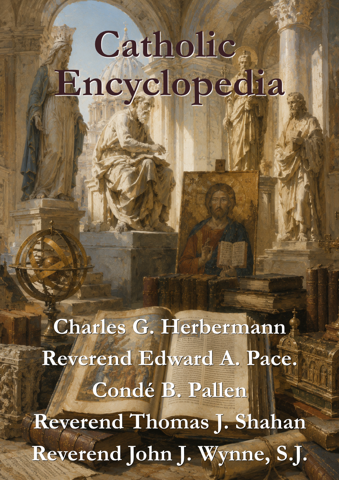
The The Catholic Encyclopedia, formally titled The Catholic Encyclopedia: An International Work of Reference on the Constitution, Doctrine, Discipline, and History of the Catholic Church, was one of the most ambitious intellectual projects undertaken by English-speaking Catholics in the early twentieth century. Published in the United States between 1907 and 1914, it sought to provide a comprehensive and authoritative presentation of Catholic teaching, history, philosophy, theology, institutions, and culture from an explicitly Catholic perspective.
The encyclopedia emerged during a period when Catholic intellectuals in the United States were attempting to establish themselves within modern academic life while simultaneously defending traditional doctrine against both Protestant criticism and secular modernism. It became not merely a reference work, but a declaration that Catholic scholarship could stand alongside the great encyclopedic enterprises of Europe and the English-speaking world.
The encyclopedia was published by the Robert Appleton Company in New York City. The company itself was effectively created for the purpose of publishing the encyclopedia. Later, in 1912, the company changed its name to Encyclopedia Press. The project eventually produced fifteen large volumes plus an index volume, amounting to thousands of pages of scholarship.
The editorial leadership consisted of five major Catholic intellectuals:
Charles George Herbermann, professor of Latin and librarian at the College of the City of New York, served as editor-in-chief.
Edward Aloysius Pace, one of the earliest American psychologists trained under Wilhelm Wundt, contributed philosophical and educational leadership.
Condé Benoist Pallen served as managing editor and literary contributor.
Thomas Joseph Shahan brought expertise in church history and theology.
John Joseph Wynne played a central organizational and editorial role and later became an important figure in American Catholic intellectual life.
The encyclopedia’s scope was extraordinarily broad. Although centered on Catholicism, it extended far beyond internal church matters. Articles covered:
theology,
philosophy,
biblical studies,
saints,
liturgy,
canon law,
medieval history,
classical antiquity,
literature,
science,
political theory,
education,
architecture,
music,
biographies,
and global missionary activity.
This breadth reflected the Catholic intellectual ideal that religion was not isolated from civilization, but connected to every field of human thought and culture.
One of the encyclopedia’s defining characteristics was its apologetic yet scholarly tone. The editors intended the work to defend Catholic doctrine while maintaining academic credibility. This balance was especially important during the era of the Modernist Crisis inside the Catholic Church, when debates over biblical criticism, historical scholarship, and modern philosophy deeply affected Catholic intellectual life.
Unlike many Protestant or secular encyclopedias of the period, the Catholic Encyclopedia openly wrote from a confessional standpoint. The articles were not religiously neutral. Instead, they explicitly interpreted subjects through Catholic theology and ecclesiastical tradition. Yet many entries remain highly respected because of their depth, philological precision, and historical detail.
The encyclopedia also reflected the global ambitions of American Catholicism in the early twentieth century. At the time, Catholics in the United States were still overcoming widespread anti-Catholic prejudice and nativist hostility. Producing a massive scholarly encyclopedia in English demonstrated intellectual maturity and institutional confidence.
The work appeared sequentially between 1907 and 1912:
Volume I began with “Aachen–Assize.”
The final volume concluded with “Tournon–Zwirner.”
An index volume followed in 1914.
The encyclopedia’s production involved extensive editorial coordination. The editors reportedly held more than a hundred formal meetings to supervise the project. Contributors included priests, historians, theologians, philologists, and academics from both the United States and Europe. Some articles were newly written, while others adapted or translated earlier European Catholic scholarship.
Historically, the encyclopedia is deeply shaped by its era. It predates many major developments in both world history and Catholicism itself:
the establishment of Vatican City in 1929,
the Second World War,
the Second Vatican Council,
modern ecumenism,
liberation theology,
contemporary biblical criticism,
and modern archaeological discoveries.
As a result, modern readers often approach it as both a reference work and a historical artifact.
Its strengths remain considerable:
extensive citations,
careful summaries of patristic and medieval theology,
rich biographical coverage,
discussions of liturgy and doctrine before Vatican II,
and insight into how educated Catholics understood their intellectual tradition in the early twentieth century.
At the same time, some articles now appear dated or controversial, especially regarding:
Protestantism,
Judaism,
Islam,
non-Western religions,
historical criticism,
race and colonialism,
and modern science.
Many entries reflect assumptions common among conservative Catholic scholars before the reforms of the twentieth century.
The encyclopedia’s afterlife became especially important in the digital era. Because it entered the public domain in the United States, it was widely digitized.
One of the most influential online editions was created by Kevin Knight through the website New Advent. Beginning in the 1990s, volunteers transcribed the original encyclopedia and made it freely available online. This digital version became enormously influential among Catholics, students, historians, and general readers.
Other versions are available through:
Internet Archive
Google Books
Wikisource
The encyclopedia later received a successor: the New Catholic Encyclopedia, published by The Catholic University of America in 1967 and subsequently revised. The newer encyclopedia reflects post–Vatican II Catholic scholarship and incorporates modern historical and theological developments.
Today, the original Catholic Encyclopedia occupies a unique place in intellectual history. It is simultaneously:
a monument of American Catholic scholarship,
a snapshot of pre–Vatican II Catholic thought,
a valuable historical source,
and one of the most accessible large-scale religious reference works ever digitized.
For historians of religion, theology, and intellectual culture, it remains indispensable not only for the information it contains, but for what it reveals about how early twentieth-century Catholics understood the world, the Church, and the relationship between faith and knowledge.
Miva: the next reading experience beyond audiobooks
Listen like an audiobook, then ask anything, anytime.
Start Miva's narrationMiva does not just narrate. It keeps explaining based on what you ask.