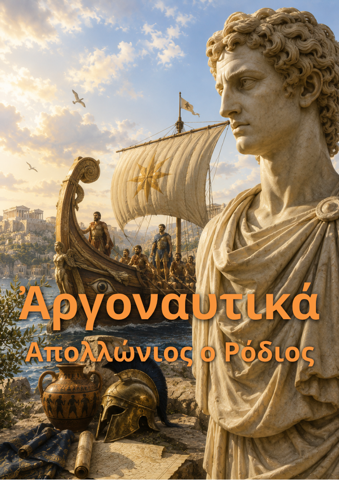
Read Ἀργοναυτικά at the source, before centuries of translation made its language familiar in other forms.
Argonautica, preserved here as Ἀργοναυτικά, is one of the works through which ancient Greek literature and thought continue to speak to later centuries. Jason's voyage for the Golden Fleece joins heroic adventure to Medea's dangerous awakening of love and magical power.
The Argonautica (Greek: Αργοναυτικά, Latin: Argonautica) is an ancient Greek epic poem, written by Apollonius of Rhodius in the 3rd century. B.C. It is the only surviving Hellenistic epic.
They tell the legend of the journey of Jason and the Argonauts to obtain the Golden Fleece from Colchis. Their heroic adventures and Jason's relationship with the dangerous princess/witch Medea of Colchis were already known to Hellenistic audiences, which allowed Apollonius to go beyond a simple narrative, giving it a scholarly emphasis appropriate for the time. It was the time of the great Library of Alexandria, and the epic of Apollonius incorporates his research into geography, ethnography, comparative religion, and Homeric literature. However, his main contribution to the epic tradition lies in the development of love between hero and heroine: he seems to have been the first narrative poet, who studied "the pathology of love".
The Argonauts had a profound effect on Latin poetry: they were translated by Varro Atacinus and imitated by Valerius Flaccus, influenced Catullus and Ovid, and provided Virgil with a model for his Roman epic, the Aeneid.
Map showing the route taken by Argo. "Lake Triton", the point of departure from Libya, may be further east, near Cyrene. [nb 1]
In Medea, a conflicted Medea is shown mixing a potion for a spell, c. 1867 by Frederick Sandys
Asper, Markus (2011), «Apollonius on Poetry», στο: T. Papanghelis; A. Rengakos, επιμ., Brill's Companion to Apollonius Rhodius (second, revised έκδοση), Brill
Bulloch, A. W. (1985), «Hellenistic Poetry», στο: P. Easterling; B. Knox, επιμ., The Cambridge History of Classical Literature: Greek Literature, Cambridge University Press
Fusillo, Massimo (2011), «Apollonius Rhodius as "Inventor"», στο: T. Papanghelis; A. Rengakos, επιμ., Brill's Companion to Apollonius Rhodius (second, revised έκδοση), Brill
Galinsky, G. K. (1972), The Heracles Theme: The Adaptations of the Hero in Literature from Homer to the Twentieth Century, Oxford University Press
Approaching Argonautica in its original language brings the reader closer to choices of rhythm, argument, image, and dramatic emphasis that translations must inevitably interpret. The work is not important only because it is old: it remains a living point of reference for writers, philosophers, historians, theatre makers, and readers confronting related questions today.
Apollonius of Rhodes was a Hellenistic poet and scholar whose Argonautica reshaped heroic epic through learning, psychology, and romance.
Apollonius of Rhodes (295 BC - 215 BC) was an ancient Greek writer, best known for The Argonauts, an epic poem about Jason and the Argonauts and their quest for the golden fleece.
Apollonius of Rhodes was a contemporary of Ptolemy Euergetos. He was born about 295 BC. in Alexandria, Egypt, where he lived most of his life. He directed the library of Alexandria, and was himself a librarian, grammarian, and epic poet. His surname probably refers to his mother's name, Rhodes.
At a young age he wrote The Argonauts, an epic that describes the story of Jason and the Argonauts to get the Golden Fleece. His epic was disapproved, and Apollonius sadly left his homeland and settled in Rhodes, from where he took his name. He later made significant improvements to his epic, and went down in history as one of the great poets of his time.
Apollonius was a student, but also a strong rival and enemy of Callimachus, but they were separated after the end of their lives, since after death their graves were next to each other.
Apollonius Alexandreus, once a poet, was born in Rhodes, son of Silleos, disciple of Callimachus, contemporary of Eratosthenes and Timarchus, invoked by Ptolemy the Benefactor, and successor of Eratosthenes born under the protection of the library in Alexandria.
In this collection, the author's importance is approached through Argonautica. The work shows how a particular genre or method could become a durable instrument for examining human action, public life, knowledge, memory, and the demands of justice.
Miva: the next reading experience beyond audiobooks
Listen like an audiobook, then ask anything, anytime.
Start Miva's narrationMiva does not just narrate. It keeps explaining based on what you ask.