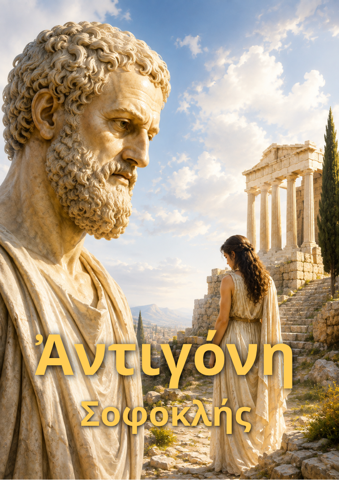
Read Ἀντιγόνη at the source, before centuries of translation made its language familiar in other forms.
Antigone, preserved here as Ἀντιγόνη, is one of the works through which ancient Greek literature and thought continue to speak to later centuries. Antigone's decision to bury her brother sets conscience and sacred obligation against the authority of the state.
Antigone is an ancient tragedy by Sophocles that was probably presented in the Great Dionysia of 441 BC. Its theme comes from the Theban cycle, from which Sophocles drew material for two of his other tragedies, Oedipus the Tyrant and Oedipus at Colonus. The fictional events of Antigone are later chronological than those of the Oedipus tragedies, but Antigone was introduced before them. Its theme is Antigone's attempt to bury her dead brother Polyneices, despite the contrary order of Creon, king of Thebes, placing the honor of the gods and love for her brother above Creon's laws. Antigone is the second oldest extant tragedy by Sophocles, after Aiades.
Antigone was one of the four children that Oedipus had with Jocasta, queen of Thebes, without knowing that she was his natural mother. Their other children were Ismene, Eteocles and Polyneices. Oedipus had cursed his sons to quarrel over the division of their inheritance and kill each other because they had disobeyed his orders.
When Oedipus discovered the truth about his parentage, he exiled himself and the two brothers agreed to take turns ruling Thebes every year. After the first year of rule, Eteocles refused to cede the throne to Polyneices. So the latter left Thebes and went to Argos, where he married the daughter of King Adrastos and organized an expedition against Thebes. The campaign failed, but both brothers were killed in a duel with each other. The throne was then taken over by Creon, Jocasta's brother, who ordered the body of Polyneices to be buried because he betrayed his country.
The prelude to the tragedy is placed in time at the dawn of the day that followed the end of the siege. Creon has already given the order not to bury Polyneices, as a traitor, with the threat of severe punishment (stoning) to anyone who violates the order. Antigone and her sister Ismene appear outside the palace. Antigone announces her decision to bury Polyneices, in accordance with the divine unwritten laws that require that no corpse be left unburied, without funeral honors. Ismene refuses to cooperate, fearing Creon's power, and fails to change Antigone's mind. After their charged conversation follows the procession of the dance, consisting of the elders of Thebes. The parade triumphantly triumphs over enemies. Creon then arrives and announces the new values by which he intends to rule the city, as well as his decision not to bury Polyneices.
In the next scene, one of the guardians of the buried corpse suddenly enters and announces that in an unknown way a symbolic burial has taken place for the deceased, who was now covered by a thin layer of soil. Creon orders the watchman to find the offender, and the episode closes with a chorus extolling man's limitless power but pointing out his weakness in the face of divine powers and his inevitable nature of acting against the laws of gods and men. In the second episode, the guard returns to the scene leading Antigone, who was arrested when she attempted a reburial. An intense confrontation between Antigone and Creon follows, and then Ismene also comes on stage, accused by the king of collaborating in the burial. Although she had not interfered with the burial, Ismene does not fend off the accusations and Creon decides to punish them both. In the second stanza, the dance mourns the fate of the Lavdakid family, whose curses are now affecting its younger members as well.
Approaching Antigone in its original language brings the reader closer to choices of rhythm, argument, image, and dramatic emphasis that translations must inevitably interpret. The work is not important only because it is old: it remains a living point of reference for writers, philosophers, historians, theatre makers, and readers confronting related questions today.
Sophocles was one of classical Athens' three great tragedians and transformed tragic drama through concentrated conflicts of law, kinship, and knowledge.
Sophocles (496 BC - 406 BC) (Ancient Greek: Sophocles ὁ Sofillou ὁ ἐκ Κολονοῦ) was an ancient Greek tragedian of the classical era from Athens. Along with Aeschylus and Euripides, they are the only tragic poets whose complete works have survived. According to ancient accounts, he seems to have written about 123 works of which only seven tragedies are handed down complete.
He was born in Ippios Colonos, Athens. He was the son of Sophillos, a wealthy Athenian who owned a cutlery factory, and was educated according to his financial comfort. He received a careful upbringing and education. He was taught music by the famous music teacher Lambros and harmoniously developed his physical and mental powers. Fifteen-year-old, he was the leader of the dance of teenagers who took part in the victory celebration for the naval battle of Salamis. He was closely associated with political and intellectual figures of the time, such as Pericles, Socrates, Plato and occupied various high positions in politics, religious cults and the arts.
The years 443-442 BC he was treasurer of the Attic naval alliance. And from 441 to 440 BC. he commanded together with Pericles the fleet in the attack against Samos, where all the men of the island were slaughtered. In 428 he was again a general with Thucydides and in 413 he was a member of the oligarchic government of Athens. He had a son with Nicostat, who also became a poet, but also an illegitimate son, also named Sophocles, who proved to be a more important writer than his other son. The great tragic poet introduced the worship of Asclepius to Athens and was honored with the nickname Dexion, because he welcomed the god into his home. The first celebration before the Asclepius under the Acropolis of Athens was finished, took place in the precincts of his house. He even writes a paean about Asclepius.
In this collection, the author's importance is approached through Antigone. The work shows how a particular genre or method could become a durable instrument for examining human action, public life, knowledge, memory, and the demands of justice.
In the wake of a bitter civil war in Thebes, two brothers, Eteocles and Polyneices, fall by each other’s hands in single combat. The new ruler of the city, Creon, issues a strict decree: Eteocles, who died defending the state, will receive a hero’s full honorable burial, whereas Polyneices, who returned from exile with a foreign army to attack his homeland, is branded a traitor. Creon orders that Polyneices’ body be left exposed to the elements and wild beasts outside the city gates, decreeing the penalty of death by public stoning for anyone who dares disobey. Antigone, sister to the fallen brothers, refuses to accept this royal edict. To her, the sacred unwritten laws of the gods, which demand proper burial rites for the dead, supersede any decree made by a mortal ruler. She shares her resolution with her timid sister Ismene, seeking her help. Frightened by Creon’s decree and mindful of their family’s tragic history, Ismene refuses to participate, warning her sister of the fatal consequences. Undeterred, Antigone acts alone under the cover of darkness, performing the symbolic burial rites over Polyneices' corpse by sprinkling it with dry earth and pouring libations. When the sentries discover the covered body, they brush away the dust and remain on guard. Before long, a sudden dust storm sweeps over the plain. As the skies clear, the guards spot Antigone returning to cover her brother once more. She is captured on the spot and brought directly before Creon. Unafraid and resolute, Antigone boldly confesses her act, declaring that Creon’s civic laws cannot override the eternal traditions of the gods. Creon, infuriated by her defiance and perceiving it as a direct challenge to his kingly authority and order, sentences her to die. Even when Ismene steps forward, willing to share her sister’s fate, Antigone rejects her participation, bearing the full responsibility of her moral conviction. Haemon, Creon’s son and Antigone’s betrothed, tries to intervene on her behalf. He gently warns his father that the citizens of Thebes secretly sympathize with Antigone's devotion and view her act as honorable rather than treasonous. Haemon urges his father to remain open-minded and flexible. However, Creon angrily rejects his son's counsel, interpreting it as subordination to a woman. Driven by pride and unwilling to appear weak, Creon commutes the public stoning to a slow punishment: Antigone is to be taken away and sealed alive inside a dark, rock-hewn tomb with only minimal rations, insulating the city from religious pollution while ensuring her death. As Antigone is led to her subterranean cell, she laments her unwed youth and the cruel fate of her lineage, yet she remains steadfast in her devotion to divine law. Soon after her imprisonment, the blind prophet Teiresias arrives at the palace. He warns Creon of ominous omens, revealing that the gods refuse to accept Thebes’ sacrifices because the city’s altars are corrupted by the flesh of Polyneices' corpse. Teiresias prophesies that if Creon does not bury the dead and release Antigone, he will pay for his arrogance with a child of his own flesh. Terrified by the prophet’s dire words, the Chorus of Theban elders advises Creon to relent. Shaken, Creon yields and hurries to undo his orders. He first rushes to Polyneices' body to perform proper rites and cremate the remains, then hastens to the rock-cut tomb to free Antigone. But he arrives too late. Upon opening the chamber, he discovers that Antigone has hanged herself with her own veil. Haemon is found weeping beside her body. Distraught with grief and rage at his father's arrival, Haemon lunges at Creon with his sword. Missing his father, Haemon turns the blade upon himself, collapsing beside Antigone and embracing her in death. Creon returns to the palace carrying his son's lifeless body, overcome with remorse. Upon his return, he receives further tragedy: his wife, Queen Eurydice, learning of Haemon's death, has taken her own life, cursing Creon as her murderer with her dying breath. Broken by the tragic chain of events brought on by his stubbornness and pride, Creon is left alive in total devastation, recognizing too late that wisdom begins with reverence for the gods and humility before their unwritten laws.
And if I seem to you now to be acting foolishly, I am charged with folly by a fool.Original: σοὶ δ᾽ εἰ δοκῶ νῦν μῶρα δρῶσα τυγχάνειν, σχεδόν τι μώρῳ μωρίαν ὀφλισκάνω.Antigone Lines 469–470. This line powerfully demonstrates Antigone's unwavering conviction and sharp intellect, turning Creon's accusation of folly back onto the ruler himself.
For it was no slave that died, but a brother.Original: οὐ γάρ τι δοῦλος, ἀλλ᾽ ἀδελφὸς ὤλετο.Antigone Line 517. It encapsulates the moral heart of the tragedy, asserting that sacred familial bonds and human dignity transcend political factionalism and state law.
Without a husband, without a bridal song, having known no share in marriage nor in the nurturing of children, but thus deserted by friends, I, ill-fated, go living to the hollow graves of the dead.Original: ἄλεκτρον, ἀνυμέναιον, οὔτε του γάμου μέρος λαχοῦσαν οὔτε παιδείου τροφῆς, ἀλλ᾽ ὧδ᾽ ἔρημος πρὸς φίλων ἡ δύσμορος ζῶσ᾽ εἰς θανόντων ἔρχομαι κατασκαφάς.Antigone Lines 917–920. The passage highlights the poignant human cost of her moral defiance, contrasting the life, marriage, and family she forfeits with her cruel sentence.
Alas for the errors of my mindless mind, stubborn and fraught with death! Oh, you who look upon the slayers and the slain of the same blood!Original: ἰὼ φρενῶν δυσφρόνων ἁμαρτήματα στερεὰ θανατόεντ᾽, ὦ κτανόντας τε καὶ θανόντας βλέποντες ἐμφυλίους.Antigone Lines 1261–1264. It marks the climax of Creon's tragic realization and downfall, dramatically illustrating the destructive result of unyielding arrogance and misrule.
While the play originated in fifth-century BCE Athens, its core dramatic structure makes it surprisingly accessible for modern readers. The story focuses on a direct, centralized debate between two strong figures, Creon and Antigone, which keeps the plot forward-moving and clear. Readers primarily encounter challenge in the choral odes, which employ elevated poetic language and reference ancient Greek mythology. Using a clear translation like Francis Storr's helps render these passages understandable. The underlying tensions of justice, obedience, and family duty remain instantly relatable, ensuring that the emotional and political stakes resonate without requiring deep historical expertise. FAQ: Q: Why is Antigone considered a classic? FAQ: A: The work stands as a cornerstone of Western drama because it presents a balanced moral dilemma rather than a simple story of good versus evil. Sophocles structures the play so that both major figures argue from deeply held principles: Creon seeks to restore stability after a violent civil war, while Antigone defends sacred burial traditions. The text avoids offering quick answers, forcing audiences across centuries to examine the boundaries of political authority, individual conscience, and religious obligation. Its enduring framework continues to serve as an vital point of reference for debates on civil disobedience and ethics in public life. FAQ: Q: What happens at the end of Antigone? FAQ: A: Every conflicting force, from royal authority to divine mandate, comes to a sudden collision in the final scenes. As Creon hastens to undo his mandate, he enters a space where human choices arrive too late to alter what has been set in motion. What awaits in these closing pages is a rapid cascade of personal reckonings that strips the ruler of his arrogance and leaves the kingdom forever transformed. Read these closing pages for yourself to witness how the ultimate price of wisdom is paid. FAQ: Q: What is the main conflict in Antigone? FAQ: A: The primary struggle pits the laws of the state against the unwritten obligations of religion and family. Creon insists that a traitor to the city forfeits his right to burial, using political authority to maintain public order. Antigone argues that divine traditions require proper rites for all deceased family members, regardless of political acts. This initial disagreement expands to cover clashes between youth and age, female autonomy and male authority, and personal conscience versus civic rule, ensuring that every character is forced to take a side. FAQ: Q: How does Creon justify his decree regarding Polyneices? FAQ: A: Creon bases his royal edict on the belief that loyalty to the state must take precedence over personal relationships or kinship ties. Because Polyneices brought a foreign military force to attack his native city, Creon brands him an enemy who deserves public dishonor. In Creon's view, rewarding a traitor with honorable burial would undermine civic discipline and invite chaos into Thebes. He views absolute enforcement of his law as the only way to preserve order and prove his strength as a leader. FAQ: Q: What role does the Chorus play in the drama? FAQ: A: The Chorus of Theban Elders acts as a representative of the city's public opinion and traditional morality. Throughout the play, they react to the unfolding dispute, initially offering deference to Creon's royal authority but gradually voicing unease as divine signs turn bad. Their songs provide cultural context, reflect on human ambition, and offer a sober perspective on the dangers of political pride, ultimately advising the king to yield before destruction overtakes the state.
Miva: the next reading experience beyond audiobooks
Listen like an audiobook, then ask anything, anytime.
Start Miva's narrationMiva does not just narrate. It keeps explaining based on what you ask.