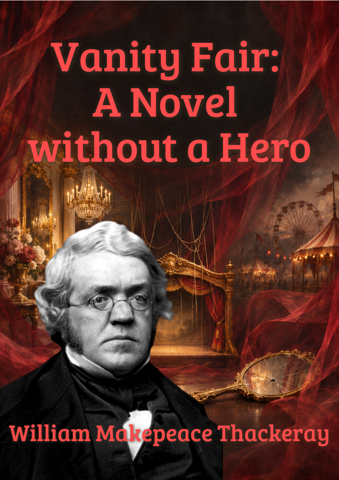
Background:
Published in monthly parts from 1847 to 1848 and set around the Napoleonic Wars, the novel turns the marriage market, military ambition, debt, colonial wealth, and fashionable display into a broad social satire.
The central tension:
Becky Sharp and Amelia Sedley move through sharply different forms of dependence while families rise and fall around money, reputation, and war. The narrator repeatedly interrupts the action so that readers must judge both the characters and the pleasure of watching them.
How the writing works:
An intrusive narrator, panoramic movement, theatrical imagery, irony, parallel careers, and direct addresses to the reader make the book a self-conscious puppet show rather than a transparent chronicle.
The promise of Vanity Fair is not moral comfort but the thrill of watching people improvise identities under pressure. Becky Sharp enters the novel with almost no money, no family protection, and an exact understanding of what a smile, a marriage, or a rumor can buy. Amelia Sedley possesses the gentler virtues society claims to reward, yet those virtues repeatedly leave her unable to read the interests around her. Setting the two women beside one another turns every drawing room into a market and every compliment into a possible transaction.
Thackeray refuses to provide the stable hero announced by the subtitle. His narrator alternately exposes, admires, scolds, and performs for the reader, while the puppet-show imagery reminds us that the storyteller is also arranging the spectacle. The Waterloo chapters demonstrate the method at its largest scale: military history remains partly offstage while panic, vanity, logistics, and private fantasy determine how civilians experience it. The result is funny precisely where it is uncomfortable, because readers are invited to enjoy the same social theater the novel distrusts.
Readers coming from the 2018 series will recognize Becky's direct appeal to the audience, but the novel is wider, harsher, and more interested in money than any screen version can easily be. Track debts, inheritances, allowances, and unpaid bills; they reveal relationships long before declarations of love or loyalty do. The reward is a social world in which almost nobody is innocent, yet very few people are reducible to villains.
What makes Becky irresistible is not that the novel secretly approves of her, but that she sees the price tags attached to virtues other people pretend are priceless. She can read a room before its respectable occupants admit that it is a marketplace. Amelia, by contrast, turns loyalty into a shelter from unwelcome knowledge. Their parallel careers keep upsetting any easy division between cynical intelligence and moral goodness: one woman understands too much about society, the other too little, and both discoveries carry a cost.
The novel's scale is part of its seduction. A marriage proposal can be interrupted by a debt, a military campaign can be experienced through luggage and panic, and a triumphant entrance can already contain the seeds of social expulsion. Thackeray's narrator repeatedly steps between the reader and the scene, offering judgment and then exposing his own appetite for performance. That unstable companionship makes the book feel startlingly alive: we are not merely watching hypocrites but being asked why their theater is so pleasurable to us.
Open the book for Becky, but stay for the crowded world that makes her possible. The pleasure is cumulative: a minor snub becomes a financial clue, a joke becomes a moral trap, and a character dismissed hundreds of pages earlier returns with the power to alter another life. The length gives ambition time to change its costume. By the end, the reader has not merely followed a social climber but inhabited a culture in which nearly everyone is climbing, bargaining, or pretending not to notice the bargain.
Director: James Strong; Jonathan Entwistle
Production country: United Kingdom
Cast: Olivia Cooke, Claudia Jessie, Tom Bateman
Difference from the book: uses a six-episode television structure, foregrounds Becky as the organizing viewpoint, and compresses the novel's long social panorama.
Read all 67 chapters with the subtitle A Novel without a Hero; abridgment easily turns a crowded social satire into Becky's story alone.
Its anti-heroic design and Becky Sharp's social intelligence keep the novel central to discussions of ambition, gender, class performance, and the unreliable moral authority of narrators.
Miva: the next reading experience beyond audiobooks
Listen like an audiobook, then ask anything, anytime.
Start Miva's narrationMiva does not just narrate. It keeps explaining based on what you ask.