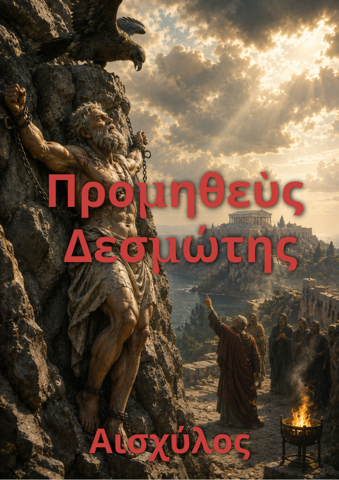
Read Προμηθεὺς Δεσμώτης at the source, before centuries of translation made its language familiar in other forms.
Prometheus Bound, preserved here as Προμηθεὺς Δεσμώτης, is one of the works through which ancient Greek literature and thought continue to speak to later centuries. The chained Titan defends his gift of fire to humanity and turns divine punishment into an enduring drama of knowledge and resistance.
In the tragedy Prometheus Bound, Aeschylus deals with the heroic resistance of Prometheus chained in the Caucasus to submit to the will of Zeus. It is considered by other critics to be the middle or, by most, the first part of a trilogy, consisting of the works Prometheus Lyomenos and Prometheus Pyrphoros.
In modern times, the Greek writer, poet and philosopher Nikos Kazantzakis (see Prometheus (Nikos Kazantzakis)) wrote an epic trilogy on the theme of Prometheus, corresponding to Aeschylus.
The Bound Supplier is undated, as no definitive dating of the project is documented and the issue remains open. The philological evidence that led to the view of a rewritten or spurious or much later Prometheus is no longer considered sufficient to dispute the authorship of the work. Despite all reservations, the work is viewed as Aeschylean, possibly late. Another problem that needs not just a philological, but an ideological and theatrical approach is the image of a merciless Zeus, opposed to the righteous Zeus of the Oresteia. Early critics generally agree that the mystery of this particular image is resolved in the other works of the trilogy. Their views differ, however, as to the nature of the solution: some suppose that the whole composition was intended, as was the case with the Eumenides, to present a gradual triumph of the new principles over the ancient morals, and the victory of the Olympians over the earthly deities.
In Prometheus Bound, part of a trilogy with a questionable order of ranking, Aeschylus reveals his deeply religious temperament, without avoiding – perhaps deliberately, because of his democratic beliefs – some hints of skepticism and questioning of the cosmic authority of Zeus. The core of the work of Prometheus Bound is the theme of an unstoppable struggle against the power of authority, which, in this case, is symbolized by Zeus. The theme of the tragedy is the punishment of the Titan Prometheus by the king of the gods, at the end of the world, at the beginning of the reign of Zeus and the main "heroes" are gods, a simple myth, that is, for the Aristotelian criticism and indeed without a solution, which probably happens to Prometheus Lyomenos.
Already in the introduction of the work, the "sin" of Prometheus is revealed, which is none other than insulting the secular order, since - immortal himself - he takes the part of mortals. Beyond the significant stage difficulties presented by the introduction, the play's prologue as a whole forms a feeling of anticipation for more revelations, the anticipation of a forced change, which is the result of the Titan god's knowledge of the future.
In the tragedy, Gaia (identified as Themis) reveals to her son, Prometheus, the secret of the future crash: the horseshoe of Zeus; namely, that Thetis, with whom Zeus plans to "join," is to give birth to a child who will be stronger than his father. Prometheus hints at this threat right from the start, but then, with ever-increasing clarity, throughout the tragedy. His knowledge of the future is a commitment to the king of the gods. While we cannot be sure exactly how having this knowledge might have served Prometheus in the trilogy as a whole, we can say that the plot and dramatic tension of Prometheus Bound is organized from the outset around the Titan's knowledge that Thetis is the answer to the only question on Zeus' mind.
Approaching Prometheus Bound in its original language brings the reader closer to choices of rhythm, argument, image, and dramatic emphasis that translations must inevitably interpret. The work is not important only because it is old: it remains a living point of reference for writers, philosophers, historians, theatre makers, and readers confronting related questions today.
Aeschylus was the earliest of classical Athens' three great tragedians. The authorship of Prometheus Bound remains disputed, so the traditional attribution is retained.
Aeschylus (Eleusis of Hippothontida, Ancient Athens, 525 or 524 BC - Gela, Great Greece, 456 BC) was an ancient Greek tragedian. Along with Sophocles and Euripides, they are the only tragic poets whose complete works have survived.
He was the son of the noble landowner Euphorion, of the Kodrid family, while he appeared early in the dramatic games, during the 70th Olympiad (499/496 BC), when he competed against the dramatic poets Pratina and Choirilos.
He was an Athenian citizen who participated in the battles against the Persians, while he also had two brothers, who also fought in the battle of Marathon, Amenias and Cynaigerus. The latter even died at Marathon in his attempt to hold with his hands, as he was strong-handed and probably a wrestler, a Persian ship before it went out to sea. This participation of his resonates in the theatrical and poetic field at this very historical moment of the city, he interprets it ideologically, politically and philosophically and is interpreted by it.
In his work, the concept of law is condensed, as well as the consciousness of the poet as a fighting citizen. According to J. Thomson, Aeschylus was a follower of Pythagoras and his plays are full of Pythagorean ideas. He considered his participation in the battle of Marathon, the naval battle of Artemisium and the naval battle of Salamis as the greatest achievement of his life. All of the above must be considered together with his possible participation in the Eleusinian Mysteries, in the worship of Demeter and Persephone. In the prime of his life he traveled to Sicily, in the court of the tyrant Hiero, a powerful lord who invited great artists of his time to Syracuse. There it is likely that he introduced the Persians for the second time. He traveled a second time to Sicily probably because of his disagreement with the Athenian public - as shown in a passage in Aristophanes' Frogs.
In this collection, the author's importance is approached through Prometheus Bound. The work shows how a particular genre or method could become a durable instrument for examining human action, public life, knowledge, memory, and the demands of justice.
Miva: the next reading experience beyond audiobooks
Listen like an audiobook, then ask anything, anytime.
Start Miva's narrationMiva does not just narrate. It keeps explaining based on what you ask.