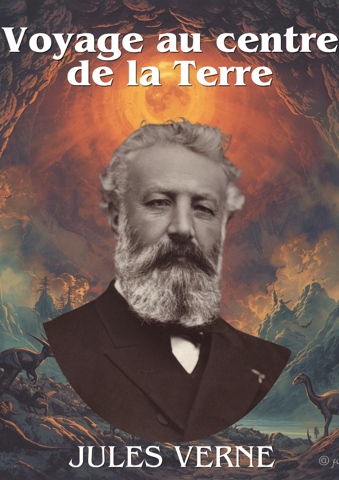
The Novel That Invented the Lost World Genre
A Lawsuit, A Plagiarism Scandal, and Translations So Bad They Renamed Everyone
From James Mason to Brendan Fraser to Rick Wakeman's Concept Album
A professor finds a coded manuscript hidden inside an old book. It says: go to Iceland, descend into a volcano, find the center of the earth. He leaves the next morning.
Published in 1864, Journey to the Centre of the Earth begins with a discovery and ends with an eruption—and in between, Jules Verne constructed something that had not previously existed: a scientific adventure narrative so precisely imagined that its impossibilities feel like facts, and its facts feel like the most natural thing in the world.
Professor Otto Lidenbrock is a polymath of volcanic impatience who discovers a runic manuscript by a 16th-century Icelandic alchemist and deciphers, within days, an invitation to the impossible. His nephew Axel—cautious, sensible, deeply in love with his fiancée, and constitutionally unsuited to descending into active volcanoes—is dragged along anyway. Their guide, the imperturbable Hans Bjelke, says almost nothing throughout the entire journey and is the only reason either of them survives it.
What they find beneath the surface of the earth is not geology. It is time itself—reversed. A subterranean ocean illuminated by luminous gas. Forests of giant mushrooms. A Plesiosaur locked in combat with an Ichthyosaur. A twelve-foot prehistoric humanoid shepherding a herd of mastodons through the Tertiary period, undisturbed by the several million years that have passed above ground.
"Science, my lad, is made up of mistakes, but they are mistakes which it is useful to make, because they lead little by little to the truth."
—Professor Lidenbrock
Verne grounded his impossible premise in the genuine scientific debates of his era. Humphry Davy's oxidation theory—which suggested the Earth's core might not be molten—gave him the loophole he needed. Louis Figuier's The World Before the Deluge supplied the prehistoric creatures. A trip to Scotland in 1859, where Verne studied the volcanic features of Arthur's Seat in Edinburgh, shaped the underground landscape. The science has since been comprehensively disproven. The novel has not suffered for it.
The publishing history is nearly as chaotic as the plot. The 1867 revised edition added two entirely new chapters on the Quaternary Era, reflecting the mid-1860s obsession with prehistory. Early English translations were so unfaithful that the entire cast was renamed—Lidenbrock became "Professor Hardwigg," Axel became "Harry"—and whole paragraphs were rewritten without explanation. In 1877, Verne was sued for plagiarism over the runic manuscript device. He won.
Journey to the Centre of the Earth did not merely tell a story. It established a template—the Lost World subgenre—that Arthur Conan Doyle built The Lost World from, that Tolkien absorbed into the underground architecture of The Hobbit, and that continues to generate films, games, and novels whenever a writer needs to ask what might exist in the places no one has yet looked.
James Mason descended into the earth in the celebrated 1959 adaptation. Brendan Fraser followed in the 2008 3D version, which framed the novel itself as a plot device. Rick Wakeman retold the entire journey as a 1974 progressive rock concept album—narration, orchestra, and electric guitar—that became one of the most ambitious musical tributes to any work of fiction.
The center of the earth, Verne understood, was never really the destination. The descent was.
Three men went into a volcano. Two of them would not have gone willingly. All three came back having traveled through time.
Miva: the next reading experience beyond audiobooks
Listen like an audiobook, then ask anything, anytime.
Start Miva's narrationMiva does not just narrate. It keeps explaining based on what you ask.