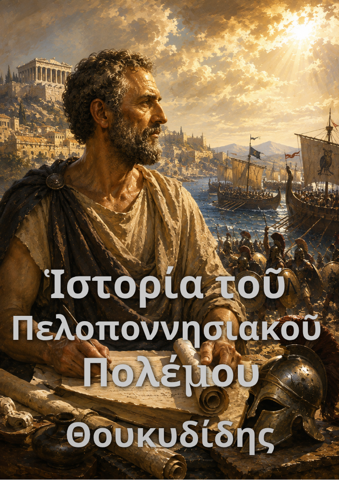
Read History of the Peloponnesian War at the source, before centuries of translation made its language familiar in other forms.
History of the Peloponnesian War, preserved here as Ἱστορία τοῦ Πελοποννησιακοῦ Πολέμου, is one of the works through which ancient Greek literature and thought continue to speak to later centuries. Thucydides analyzes plague, civil conflict, imperial ambition, and failed strategy to explain how power and fear drive war.
The work History of the Peloponnesian War is the recounting of the conflict between Athens-Athenian Alliance and Sparta-Peloponnesian Alliance which began in 431 BC. The author of this work was the Athenian politician Thucydides. It is widely accepted as one of the most important historical texts, and with the thoroughness and sobriety of its writing it is considered the first scientifically written historical study.
The work begins with the classical prologue, to be followed by "Archaeology". This is a compendium of earlier Greek history, based more on evidence, intended to show how much more important the Peloponnesian War was than earlier conflicts, including the Medes. Next, Thucydides sets out his methodological principles for ascertaining the truth and separates the real cause of the war, i.e. the fear of Sparta in the face of the growing power of Athens, from its causes (Corkyra, Potidea episodes). After recounting the causes of the war mentioned above, the rapid rise of the power of Athens in the period between the end of the Medes and the beginning of the Peloponnesian war is recounted. With the last political actions of the opponents, before hostilities begin, the first book of the work closes.
From the second book begins the description of the war, organized into summers and winters, until the victory of the Athenians at Kynos Sima and the recapture of Kyzikos in 411 BC. With a second preface, he completes his autobiographical data and explains why he regards all separate hostilities as parts of a single war. Sporadically, and for special reasons, Thucydides resorts to interjections to describe the brief history of foreign states, past historical events, characterize political figures. In other digressions, the terrible plague of Athens in 430 BC is described. and the consequences of civil wars on human morality.
Although it appears that Thucydides worked on his work throughout the period from the start of the war to 399 BC, he was unable to complete his narrative which stops abruptly after the events of 411 BC.
Since the war was a contemporary of Thucydides, his main source was the information he himself collected from reliable persons and the few official treaties between the city-states. For the period 424 - 404 BC, when he was exiled from Athens, he was forced to be informed about his homeland from indirect sources. Apparently he could easily get information from his acquaintances because his absence does not seem to have affected his knowledge of what was going on in his homeland. Also, his exile would enable him to more easily get information from the Peloponnesian side.
It is not known who undertook to publish the unfinished History of the Peloponnesian War after the author's death. However, it is certain that it was done quickly and without any intervention in the content. The work spread very quickly and met with great success, as shown by the number of writers of that time who decided to continue it (besides Xenophon, we know Theopompus, Cratippus, as well as the anonymous author of Oxyrhychus). The Greeks of Xenophon have been preserved, the first part of which chronicles the Peloponnesian War, from the point where Thucydides left off.
Approaching History of the Peloponnesian War in its original language brings the reader closer to choices of rhythm, argument, image, and dramatic emphasis that translations must inevitably interpret. The work is not important only because it is old: it remains a living point of reference for writers, philosophers, historians, theatre makers, and readers confronting related questions today.
Thucydides was an Athenian historian and general whose analytical account of war became foundational for historiography and political realism.
Thucydides (c. 460 BC - c. 398 BC) was an Athenian general and ancient Greek historian, who wrote the history of the Peloponnesian War. He was of Thracian and Athenian origin and grew up in the municipality of Alimounda in Athens. The information that survives about his life and activity is meager and comes either from the author's own references in his work or from other later sources, such as the dictionary of Souda.
The work of Thucydides laid the foundations of scientific historiography and is the first strictly historical writing of its kind. He uses logical methods and records the historical changes with findings, indications, proofs and presumptions that the research leads to, in order to narrate the events of the war as reliably as possible. With objectivity and critical thinking, he eschews fiction and focuses on the causes and events of the war, while analyzing human nature and power dynamics. His work is characterized by detailed and unbiased narration. His thoughtful writing style and emphasis on the search for truth deeply influenced later historiography and political thought. His description of the importance of leadership, conflicts of interest, and the destructive nature of war make his work timeless, offering valuable lessons about the nature of human society.
Thucydides was born in the municipality of Alimounda in Athens to a rich, aristocratic family. His father, Oloros, had family ties with the eponymous king of Thrace and with the great generals Miltiades and Cimon. The family owned a gold mine in Skapti Yli in Thrace and had influence over the local residents.
Thucydides received a brilliant education, with the philosopher Anaxagoras, a close friend of Pericles, and the orator Antiphon as teachers. It is considered certain that he was familiar with the method and expression of the great sophists, Gorgias of the Leontines of Sicily and Prodicus of Ilia, and with the progress of medicine of his time. His childhood and youth coincided with the most brilliant years of Athenian power, with Pericles dominating the political life of the state, Athens being adorned with works of art that would remain unsurpassed for centuries and intellectual life at its peak with the great achievements of ancient drama, the sophistic movement, medical science.
In this collection, the author's importance is approached through History of the Peloponnesian War. The work shows how a particular genre or method could become a durable instrument for examining human action, public life, knowledge, memory, and the demands of justice.
Thucydides’ History of the Peloponnesian War details the monumental twenty-seven-year conflict between the Athenian Empire and the Peloponnesian League, led by Sparta, which began in 431 BCE. Divided into eight books, the narrative opens with an analytical introduction known as the "Archaeology," where Thucydides traces earlier Greek history to demonstrate that this war was greater in scale and consequences than any preceding conflict. He outlines his rigorous historical methodology, emphasizing reliance on first-hand evidence, critical evaluation of sources, and an objective search for truth. Thucydides famously distinguishes between the immediate pretexts for war, such as disputes over Corcyra and Potidaea, and its true, underlying cause: Sparta’s growing dread of expanding Athenian naval power and imperial influence. The early years of the conflict, known as the Archidamian War, were characterized by contrasting strategies. Under the leadership of Pericles, Athens abandoned the countryside to Spartan land invasions, gathering its population behind the long walls while leveraging its superior fleet to secure supplies and raid enemy coasts. At the end of the first year, Pericles delivered his renowned Funeral Oration, celebrating Athenian democratic institutions, open society, and civic virtue. However, this period of confidence was immediately shattered by the outbreak of a devastating plague in overcrowded Athens, which decimated its military forces, claimed the life of Pericles, and caused widespread moral and social collapse. As the war progressed, leadership on both sides shifted to more aggressive figures. In Athens, figures like Cleon advocated for harsh imperial policies, illustrated by the decision to execute the rebellious population of Mytilene, though a second assembly tempered the sentence. Meanwhile, the conflict metastasized into brutal internal civil wars (stasis) across Greek city-states, most notably in Corcyra, where ideological polarization dissolved social trust and inverted traditional moral language. Despite strategic successes, such as capturing Spartan hostages at Sphacteria, the war brought severe losses, including the death of the Spartan general Brasidas and Cleon at Amphipolis. These setbacks led to a temporary cessation of hostilities in 421 BCE with the Peace of Nicias. The peace proved fragile and unstable. In 416 BCE, Athens asserted its unyielding political realism by invading the neutral island of Melos. In the Melian Dialogue, Athenian envoys dismissed moral considerations of justice, asserting that the strong do what they can while the weak suffer what they must, subsequently subjugating the island. Driven by ambition and persuaded by the charismatic strategy of Alcibiades, Athens embarked on a massive expedition to conquer Sicily in 415 BCE. The Sicilian Expedition ended in total catastrophe by 413 BCE, resulting in the complete destruction of the Athenian armadas, the execution of their commanders, and the death or enslavement of thousands of soldiers. Despite this crippling defeat, Athens managed to rebuild its navy and resist Spartan forces, who were now receiving financial support from Persia. The narrative of Book Eight focuses on the resulting political turmoil in Athens, including an oligarchic coup in 411 BCE that temporarily replaced the democracy with the Council of Four Hundred, as well as complex naval maneuvers in the Aegean and Hellespont, culminating in an Athenian victory at Cynossema. Thucydides worked on his account throughout the war, but he was unable to complete it before his death around 399 BCE. As a result, the work abruptly stops mid-sentence during the events of 411 BCE, leaving the narrative unfinished seven years before the final fall of Athens in 404 BCE.
And for listening, perhaps the absence of fables in my narrative will seem less pleasing to the ear; but whoever desires to examine the clear truth of the events that have happened and of those which will someday, in accordance with human nature, happen again in the same or a similar way, if they judge these records to be useful, it will be sufficient. Indeed, it has been composed as a possession for all time rather than a prize declamation to be heard for the moment.Original: καὶ ἐς μὲν ἀκρόασιν ἴσως τὸ μὴ μυθῶδες αὐτῶν ἀτερπέστερον φανεῖται· ὅσοι δὲ βουλήσονται τῶν τε γενομένων τὸ σαφὲς σκοπεῖν καὶ τῶν μελλόντων ποτὲ αὖθις κατὰ τὸ ἀνθρώπινον τοιούτων καὶ παραπλησίων ἔσεσθαι, ὠφέλιμα κρίνειν αὐτὰ ἀρκούντως ἕξει. κτῆμά τε ἐς αἰεὶ μᾶλλον ἢ ἀγώνισμα ἐς τὸ παραχρῆμα ἀκούειν ξύγκειται.History of the Peloponnesian War Book 1, Section 22.4. This passage defines Thucydides' foundational view of human nature and history, declaring that his work is not temporary entertainment, but an enduring lesson for future generations.
For famous men have the whole earth as their tomb, and their story is not graven only on stone over their native earth, but lives on far away, without written record, engraved on the hearts of men rather than on a monument.Original: ἀνδρῶν γὰρ ἐπιφανῶν πᾶσα γῆ τάφος, καὶ οὐ στηλῶν μόνον ἐν τῇ οἰκείᾳ σημαίνει ἐπιγραφή, ἀλλὰ καὶ ἐν τῇ μὴ προσηκούσῃ ἄγραφος μνήμη παρ’ ἑκάστῳ τῆς γνώμης μᾶλλον ἢ τοῦ ἔργου ἐνδιαιτᾶται.History of the Peloponnesian War Book 2, Section 43.3. It is one of the most celebrated expressions of civic virtue and heroic memory in Western literature, elevating individual sacrifice into a universal, unwritten monument.
Since you know as well as we do that right, as the world goes, is only in question between equals in power, while the strong do what they can and the weak suffer what they must.Original: ἐπισταμένους πρὸς εἰδότας ὅτι δίκαια μὲν ἐν τῷ ἀνθρωπείῳ λόγῳ ἀπὸ τῆς ἴσης ἀνάγκης κρίνεται, δυνατὰ δὲ οἱ προύχοντες πράσσουσι καὶ οἱ ἀσθενεῖς ξυγχωροῦσιν.History of the Peloponnesian War Book 5, Section 89.1. It serves as the ultimate articulate formulation of political realism, stripping away moral rationalizations to expose the raw mechanics of unchecked power.
The work can present a challenge due to its dense analytical structure, complex speeches, and detailed geographical focus across ancient Greece. Thucydides writes with an economical, highly structured style that prioritizes logical precision over sensational storytelling. The long rhetorical speeches embedded throughout the narrative contain intricate philosophical arguments that require careful attention. Additionally, keeping track of numerous military commanders, city-states, and regional campaigns can occasionally feel overwhelming for first-time readers. However, the narrative is organized systematically by winter and summer campaign seasons, which provides a clear chronological framework. Reading a modern translation with clear maps and explanatory notes makes the work entirely accessible, allowing the reader to appreciate its dramatic intensity and sharp insights into political conflict.
The work is celebrated as the first major historical study to apply rigorous, scientific standards of evidence, critical evaluation, and psychological insight without relying on divine intervention or mythical explanations. Thucydides created a new standard for writing history by comparing eyewitness accounts, examining official documents, and analyzing the deeper structural causes of conflict. Beyond its historical value, the text serves as a timeless treatise on political realism, international relations, and human psychology under stress. Concepts introduced in its pages, such as the tension between a rising power and an established empire, remain central to modern geopolitical theory. Its profound reflections on power, rhetoric, and human fragility ensure its continued relevance across millennia.
Thucydides provides a meticulous, firsthand medical and social description of the epidemic that struck Athens in 430 BCE. He details the physical symptoms with clinical precision, noting the intense heat, internal inflammation, skin eruptions, and unquenchable thirst that afflicted victims. Beyond the physical suffering, he focuses heavily on the severe psychological and moral breakdown caused by the disease. As doctors proved helpless and death swept through the city, fear transformed societal norms, leading to widespread lawlessness, despondency, and the abandonment of traditional religious rites and burial customs.
Delivered at the end of the first year of the war to honor the fallen soldiers, Pericles' speech serves as a classic praise of Athenian democratic culture, open society, and civic responsibility. Rather than focusing solely on individual grief or military glory, Pericles uses the occasion to define what makes Athens worth dying for, contrasting its freedom, cultural achievement, and tolerance with the rigid, secretive lifestyle of Sparta. The speech stands as one of history's most celebrated statements on democratic ideals, patriotic duty, and collective civic identity.
The Melian Dialogue is a dramatic exchange between Athenian ambassadors and the leaders of the neutral island of Melos in 416 BCE. Athens demands that Melos join their empire or face total destruction, while the Melians appeal to justice, fair play, and the gods. The Athenians bluntly dismiss these moral arguments, stating that power alone dictates human affairs and that the strong do what they can while the weak suffer what they must. It remains one of the most famous passages in Western political thought, serving as a textbook illustration of unvarnished political realism.
What lies at the end of the narrative is not a tidy resolution, but the dramatic climax of an empire's reckless overreach playing out on distant shores. The text builds toward the fateful campaign in Sicily, where massive fleets collide and political betrayals at home reshape the balance of power. How the grand Athenian armada fares in the waters of Syracuse, what becomes of its commanders, and how a shattered city attempts to piece itself back together amidst political turmoil are precisely the intense human dramas waiting to be experienced directly in the text.
Miva: the next reading experience beyond audiobooks
Listen like an audiobook, then ask anything, anytime.
Start Miva's narrationMiva does not just narrate. It keeps explaining based on what you ask.