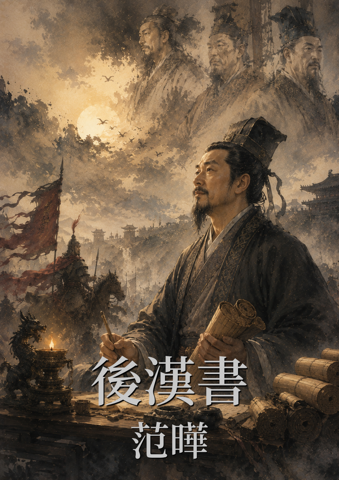
The Book of the Later Han (Hou Hanshu) is a biographical history (jizhuanti) covering the history of the Eastern Han Dynasty (25–220 AD). It is ranked among the "Four Histories" of the classical Chinese Twenty-Four Histories (alongside the Records of the Grand Historian, the Book of Han, and the Records of the Three Kingdoms). It was written by the renowned historian and writer Fan Ye (398–445 AD) during the Liu Song period of the Southern Dynasties.
This historical work is famous for its "brilliant literary style and profound structure," holding an exceptionally high position in Chinese historiography.
The Book of the Later Han was not created in a vacuum, nor was it the first history of the Eastern Han. Before Fan Ye, many works documented this period.
A Masterpiece Born of Political Frustration: In 432 AD, Fan Ye was demoted to Governor of Xuancheng due to improper conduct at a funeral. In his state of political disappointment and melancholy, he decided to "gather many students and exhaustively study old records," embarking on a massive project to revise and rewrite the scattered and complex historical materials of the Eastern Han.
Main Sources: The most important foundation for Fan Ye's compilation was the Dongguan Han Ji, an official history compiled during the Eastern Han. Additionally, he extensively integrated and critiqued the "Eight Versions of the Book of Later Han" circulating at the time, Yuan Hong's Annals of the Later Han, and Chen Shou's Records of the Three Kingdoms. By comparing these texts and refining them, Fan Ye produced a classic that surpassed its predecessors, eventually leading to the gradual loss of the other historical versions.
The Book of the Later Han as we see it today consists of 120 volumes, including 10 Annals (12 volumes), 80 Biographical Sketches (88 volumes), and 8 Treatises (30 volumes). However, this was not the original form of Fan Ye's work, having undergone a strange evolution:
The Tragedy of the Original Work (Missing Treatises): Fan Ye originally planned a massive work of 100 chapters comparable in scale to the Book of Han. However, in 445 AD, he was implicated in a rebellion plot involving Liu Yikang, Prince of Pengcheng. He was exposed and executed before the coup occurred. Legend has it that before his death, he entrusted the drafts of his ten "Treatises" (special chapters on astronomy, geography, officialdom, etc.) to his friend Xie Yan. Out of fear of being implicated, Xie Yan burned the drafts. Consequently, Fan Ye's original Book of the Later Han only contained the "Annals" and "Biographies."
Liu Zhao's Annotations and Sima Biao's Sequel to the Book of Han: During the Liang Dynasty, the scholar Liu Zhao, while annotating the Book of the Later Han, lamented the lack of institutional history. He extracted eight Treatises (30 volumes) from Sima Biao's Jin Dynasty work, Sequel to the Book of Han, and appended them to Fan Ye's work.
The Combined Printing in the Northern Song: In 1022 AD, the Northern Song official Sun Shi mistakenly believed that these 30 volumes of Treatises were written by Liu Zhao himself to fill Fan Ye's gap. He petitioned the Emperor to officially combine Fan Ye's Annals and Biographies with Sima Biao's eight Treatises. Since then, these works by different authors from different eras became the 120-volume Book of the Later Han circulated today.
Fan Ye did not blindly follow the precedents of the Records of the Grand Historian or the Book of Han, demonstrating high artistic awareness and innovation:
Creation of the Annals of Empresses: A key feature of Eastern Han history was the prevalence of Empresses Dowager acting as regents (such as Empress Dowager Deng and Empress Dowager Dou) and the immense power of consort clans. Fan Ye broke tradition by changing the "Biographies of Consort Clans" into the "Annals of Empresses," a unique feature among the Twenty-Four Histories that highlights the profound influence of women and consort clans on Eastern Han politics.
New Specialized Biographies: In response to shifts in social atmosphere and political ecology, Fan Ye added seven unique categories of biographies, including:
Clever "Categorical Narratives": For many historical figures who did not warrant individual biographies but shared similar deeds or characters, Fan Ye creatively grouped them into a single biography for collective description, saving space while strengthening the depiction of social trends.
Fan Ye was not only a historian but also a forward-thinking atheist, filling the Book of the Later Han with a spirit of rational criticism:
Strong Attack on Buddhism and Superstition: Buddhism entered China during the Eastern Han, and even Emperor Huan favored Buddhism. Fan Ye fiercely criticized the Buddhist theories of "the immortality of the soul" and "karma," viewing them as absurd, and offered biting mockery of Buddhist emperors.
Opposition to Mandate and Apocrypha: Eastern Han rulers were extremely superstitious regarding "Chenwei" (apocryphal prophetic texts). Fan Ye detested this, including many of Zhang Heng's scientific arguments against these prophecies in his biography and actively debunking popular superstitions of the time.
Beyond its historical value, the literary merit of the Book of the Later Han ranks among the best in historical writing. Fan Ye was a master of parallel prose; the narrative is concise yet detailed, and the language is elegant and condensed.
The most brilliant parts of the book are the "Appraisals" (historical commentaries) written by Fan Ye at the end of each biography. In a letter to his nephew from prison, he proudly stated his purpose was to "issue judgments within the volumes based on events to rectify the gains and losses of an era." His appraisals are unique, sharp in judgment of character, and written in a spirited, grand style with high literary beauty. During the Tang Dynasty, some were so fond of his appraisals that they collected them into a separate five-volume work.
Historically, the Book of the Later Han has earned unanimous praise from literati and historians:
In summary, the Book of the Later Han is not only an authoritative history of the rise and fall of the Eastern Han for nearly two hundred years but also a masterpiece of classical prose from the Six Dynasties. Through Fan Ye's personal tragedy, Liu Zhao's insightful additions, and the Song Dynasty's combined printing, it remains an eternal light in the firmament of Chinese historiography.
Miva: the next reading experience beyond audiobooks
Listen like an audiobook, then ask anything, anytime.
Start Miva's narrationMiva does not just narrate. It keeps explaining based on what you ask.