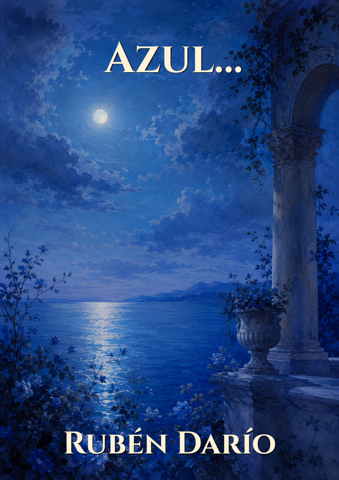
Published in Valparaíso in 1888, Azure... (Azul…) did not just launch Rubén Darío’s literary career: it forever changed the music of the Spanish language. The book appeared at a time when Hispanic literature remained trapped between realism and costumbrismo, and suddenly a work burst forth filled with swans, French gardens, classical mythology, new rhythms, and a completely different sensibility. Octavio Paz would later say: "With Rubén Darío, modern poetry in Spanish begins."
Azure... was initially received with bewilderment. Its mixture of prose short stories and poems seemed too French, too refined, and too strange for the Spanish literary tradition of the late 19th century. Juan Valera, although critical of Darío’s “mental Gallicism,” ended up recognizing in him “a prose writer and poet of talent.” Those letters published in the newspaper El Imparcial ended up becoming the international consecration of Darío and Modernism.
The author himself explained years later that Azure... was “a Parnassian book, and, therefore, French.” In its pages, the Parisian short story, the modernized alexandrine rhythm, symbolist musicality, and a new verbal sensuality influenced by Victor Hugo, Théophile Gautier, and Paul Verlaine appeared for the first time in Spanish. But Darío did not simply imitate France: he transformed those influences into a new language, capable of turning Spanish into a musical instrument.
The color blue, taken as a symbol of dreams and art, ended up becoming the emblem of an entire generation. Darío explained that for him it was “the color of dreams, the color of art, a Hellenic and Homeric color.” Since then, modernist blue remained associated with the desire to escape from bourgeois vulgarity toward a more sensual, aristocratic, and poetic universe.
The structure of the book already reveals Darío’s aesthetic breadth. In stories like “The Bourgeois King,” the poet appears humiliated by a materialistic society incapable of understanding art. In “The Nymph” or “Queen Mab’s Veil,” the sensual exoticism that would define Modernism emerges. And in the poems of the “Lyrical Year,” the seasons appear converted into states of the soul through a musicality unprecedented in Spanish.
Azure... subsequently became a foundational work for all 20th-century Hispanic poetry. Antonio Machado, Juan Ramón Jiménez, Valle-Inclán, Leopoldo Lugones, and Pablo Neruda grew up under its influence. Even later generations, such as the Latin American Surrealists and the Spanish “Novísimos,” continued to see Darío as the great revolutionary of poetic language.
Federico García Lorca, while pointing out its ornamental excesses, wrote of Darío: “His charming bad taste fills many of his verses with humanity.” Pablo Neruda was more direct: “Rubén Darío is the liberator.” Octavio Paz defined him as “the founder.” And Pedro Salinas argued that the appearance of Azure... was equivalent to “a sonic revolution” within the Spanish language.
Although Azure... has not had as many film adaptations as other classic works, its visual and aesthetic influence permeates much of the Latin American modernist imaginary. Its iconography of swans, decadent gardens, princesses, centaurs, and golden marbles inspired illustrations, literary magazines, artistic movements, and even the visual aesthetics of numerous subsequent poets. The book did not just transform poetry: it transformed the very idea of beauty in the Spanish language.
Miva: the next reading experience beyond audiobooks
Listen like an audiobook, then ask anything, anytime.
Start Miva's narrationMiva does not just narrate. It keeps explaining based on what you ask.