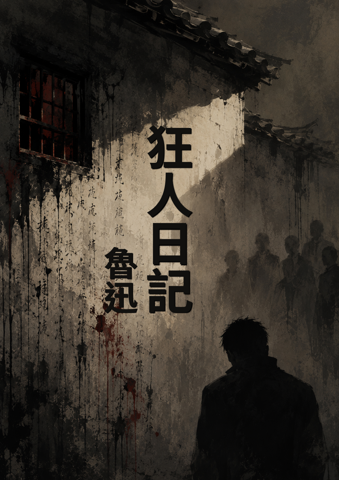
Lu Xun's Founding Work of Modern Chinese Vernacular Fiction
Published in New Youth at the Dawn of the May Fourth Movement
Drawing on Gogol, Forging an Allegory Entirely China's Own
The Phrase "Cannibalism" That Reshaped 20th-Century Literature
"Save the children..." He wrote it as a diary. It read like a diagnosis of an entire civilization.
Published in 1918 in the monthly journal New Youth, Lu Xun's A Madman's Diary is widely regarded as the founding work of modern Chinese vernacular fiction. The story is framed as the diary of a "madman" suffering from persecution complex, preceded by a Classical Chinese prologue explaining that its author has since recovered and departed to await a government post—a framing device that seems designed to dismiss what follows as the ravings of a sick man.
It is not the ravings of a sick man. It is a diagnosis of an entire cultural order. Combing through ancient texts, the stares of his own clansmen, and his brother's meals, the madman uncovers murderous intent hidden beneath the Confucian virtues of benevolence and righteousness, until he can only cry out for children who have not yet learned to eat one another. Personal madness becomes an indictment. The diagnosis outlives the diarist.
[Quote placeholder — let me know if you'd like a specific critic or writer quoted here] —[Author Name], [title/role]
The birth of this story carried the sharp edge of Lu Xun's own turn from medicine to literature. Drawing on the form of Nikolai Gogol's story of the same name, read through Futabatei Shimei's Japanese translation, Lu Xun forged an entirely different allegory from China's own history and family ethics. Lu Xun himself later called the work "very naive and too hurried," but hoped it would break China's loneliness and summon more true creators. Scholar C.T. Hsia later admitted he had undervalued the story in his youth, while May Fourth thinker Wu Yu stated bluntly that Lu Xun had exposed the tricks of cannibals wearing the masks of Confucian morality—cementing "cannibalistic feudal morality" as the core image of the New Culture Movement's critique of tradition.
The diary is only a few thousand words long. The phrase "cannibalism" has outlived every dynasty since.
Lu Xun’s A Madman’s Diary (Kuangren Riji), published in 1918, is a seminal piece of modern Chinese literature that employs a psychological frame narrative to deliver a blistering critique of traditional Confucian social structures. The story opens with a brief classical Chinese preface written by a detached, conventional narrator. This preface explains that a long-time friend recently suffered from a severe bout of "persecution mania." Having since recovered, the friend has departed to take up an official government post, leaving behind thirteen sporadic diary entries written during his illness. These entries, composed in the modern vernacular, form the main body of the narrative. The diary begins as the narrator emerges from thirty years of symbolic darkness, suddenly noticing the beauty of the moonlight. However, this awakening brings an overwhelming sense of paranoia. He grows convinced that everyone in his village, including his neighbors, his elder brother, and even the local children, is staring at him with hostile intent. Observing their hushed whispers and strange looks, he concludes that the villagers belong to a secret, ancestral conspiracy of cannibals who are conspiring to eat his flesh. As the entries progress, the protagonist’s fear deepens into an intellectual deconstruction of Chinese society. He pores over traditional historical texts seeking answers. While the pages are filled with noble phrases praising "Virtue and Morality," he perceives a hidden message scrawled between the lines: the entire history of his culture consists of two words, "Eat people." He recognizes that physical cannibalism serves as a metaphor for the systemic psychological and physical oppression inherent in traditional feudalism, where human individuality and dignity are consumed to maintain the existing hierarchy. The narrator attempts to confront those around him, seeking to reform their ways. He urges his elder brother and a young visitor to abandon their cruel habits, arguing that an unjust practice cannot be defended simply because "it has always been so." His pleas are met with anger, rejection, and further confinement. Tragically, as he reflects on his own family history, he realizes that he himself is not untainted by this oppressive system; he suspects that his elder brother fed him the flesh of their deceased younger sister without his knowledge, rendering him an unwitting participant in the very cannibalism he reviles. The diary reaches its poignant conclusion as the narrator falls into despair over the total corruption of the adult world. Recognizing that those raised within the old traditions are forever compromised, he places his final, desperate hope in the future generation. The narrative abruptly ends with his famous, heart-wrenching plea: "Save the children..." Following this climax, the overarching frame narrative subtly underscores the tragedy. As noted in the opening preface, the protagonist eventually recovers from his "madness" and integrates back into society to accept a standard bureaucratic position. This quiet return to normalcy implies that his former "madness" was actually a period of moral sanity, and that his ultimate cure signifies complete submission to the very "cannibalistic" social order he once sought to dismantle.
Everything requires careful study if one is to understand it. I remembered that people ate people in ancient times, but not very clearly. I opened a history book to check; it had no dates, but scrawled across every page were the words "Virtue and Morality." I couldn't sleep anyway, so I examined it carefully for half the night, until between the lines I finally saw the words: the whole book was filled with two words—"Eat people!Original: 凡事總須硏究,纔會明白,古來時常喫人,我也還記得,可是不甚淸楚。我翻開歷史一查,這歷史沒有年代,歪歪斜斜的每葉上都寫着『仁義道德』幾個字。我橫竪睡不着,仔細看了半夜,纔從字縫裏看出字來,滿本都寫着兩個字是『喫人』!A Madman's Diary Section III. This passage establishes the central metaphor of the entire work, exposing how traditional societal conventions under the guise of virtue function to oppress and consume humanity.
Tonight the moonlight is wonderful. I hadn't seen it for over thirty years; seeing it today, my spirits feel remarkably refreshed. Only now do I realize that the past thirty-plus years were spent in complete confusion. Yet I must be extremely careful. Otherwise, why would the Zhao family's dog have cast those two glances at me? My fear is entirely justified.Original: 今天晚上,很好的月光。我不見他,已是三十多年;今天見了,精神分外爽快。纔知道以前的三十多年,全是發昏;然而須十分小心。不然,那趙家的狗,何以看我兩眼呢?我怕得有理。A Madman's Diary Section I. It marks the onset of the protagonist's heightened sensitivity and paranoia, setting up the key tension between acute critical perception and madness that defines the narrative.
Perhaps there are still children who haven't eaten people? Save the children...Original: 沒有喫過人的孩子,或者還有?救救孩子……A Madman's Diary Section XIII. Serving as the tragic climax of the work, this urgent plea shifts the focus from a despairing critique of the past toward a desperate hope for future moral redemption.
His face changed, turning as gray as iron. Glaring at me, he said, "Perhaps it happens, but it has always been so..."Original: 他便變了臉,鐵一般靑。睜着眼說,『也許有的,這是從來如此……』A Madman's Diary Section VIII. This line captures the systemic entrenchment of injustice, demonstrating how cruelty is normalized and defended simply through the appeal to long-standing tradition.
Readers often find the work both accessible and challenging due to its dual narrative structure. The main body of the text is written in early modern vernacular Chinese, which was revolutionary for its time in its directness and emotional immediacy. However, the short story opens with a formal preface composed in classical Chinese, creating an immediate stylistic contrast. The primary difficulty for modern readers lies not in complex vocabulary, but in navigating the protagonist's fractured psychological state and decoding the dense political allegories embedded in his paranoid observations. Because the narrative jumps between literal fears of bodily harm and symbolic critiques of ancient history, understanding the text requires reading between the lines much like the protagonist himself. The brevity of the work makes it easy to read in a single sitting, but its deep historical and philosophical layers invite repeated study.
Lu Xun's masterpiece holds a legendary status because it effectively marked the birth of modern vernacular fiction in China upon its publication in 1918 in New Youth magazine. Before this work, serious literary composition was dominated by classical Chinese, which was accessible only to an educated elite. By writing a complex psychological story in everyday language, Lu Xun proved that modern vernacular Chinese could handle profound intellectual and artistic themes. Beyond its linguistic impact, the story provided the New Culture Movement with its most iconic metaphor: the concept of traditional Confucian ethics as a cannibalistic system that consumes human potential. Its innovative use of a unreliable, mentally unstable narrator to speak truth to societal hypocrisy introduced modernist literary techniques to the region, forever altering the trajectory of twentieth-century East Asian writing.
At the boundary where psychological collapse meets profound moral awakening, the narrative reaches a point of stark, inescapable tension. The protagonist is forced to look past the hostile faces of his village and peer directly into the history of his own family, uncovering a dark lineage of complicity that leaves no one untainted. What lies at the climax is not merely a resolution to his lingering paranoia, but a devastating moment of clarity regarding the future of society itself. His final realization shifts the story from an isolated struggle for survival into an urgent, heart-wrenching appeal to the reader's conscience, delivering a desperate plea that echoes long after the last page is turned.
The contrast between the classical preface and the vernacular diary creates a brilliant layer of irony that drives the story's critical point. The preface is written in a polite, formal style by a narrator who views the diary entries merely as the record of a temporary mental illness. This opening narrator informs the reader that the madman has since cured his affliction and taken up a conventional government position. When the reader enters the diary, however, it becomes clear that the madman's insanity was actually a rare form of moral awareness. By showing that the protagonist's cure requires him to rejoin the silent, compliant bureaucracy, the framing device subtly reveals that true sanity is treated as illness by a corrupt society.
The narrative deliberately balances on the line between literal clinical insanity and metaphorical insight. On a surface level, the protagonist displays clear symptoms of persecution mania, believing that dogs are giving him coded looks and that his family is fattening him up for a feast. At the same time, his extreme sensitivity enables him to see the brutal realities of feudal oppression that normal citizens have become desensitized to over centuries. His madness is therefore a literary device used to shatter societal complacency. By viewing his world through a lens of total paranoia, he strips away the polite surface of traditional culture to reveal the underlying cruelty that others accept as normal.
The sudden appearance of moonlight in the first entry symbolizes the beginning of the protagonist's intellectual and spiritual awakening. He explicitly notes that he had not seen the moonlight for over thirty years, representing a lifetime spent living in dark, uncritical conformity with societal expectations. Stepping out into the cool light of the moon marks his departure from the collective numbness of his peers. However, this illumination is a double edged sword; while it grants him a clearer vision of his environment, it immediately exposes the terrifying hostility of the world around him, setting his paranoid journey into motion.
Miva: the next reading experience beyond audiobooks
Listen like an audiobook, then ask anything, anytime.
Start Miva's narrationMiva does not just narrate. It keeps explaining based on what you ask.