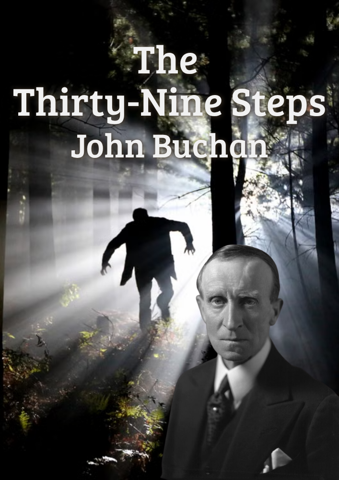
Background:
Published in 1915 during the First World War, Buchan's compact thriller channels fears of espionage, invasion, coded information, and vulnerable national infrastructure. Its speed and ingenuity coexist with period prejudices and a political world presented largely through elite male networks.
What kind of book is it?
Richard Hannay becomes the unwilling custodian of a murdered man's warning and must evade both police and enemy agents while trying to prevent a national-security disaster. The chase across Scotland depends on disguise, improvisation, reading landscapes, and deciding whom to trust.
Literary style:
First-person narration, short chapters, repeated escapes, maps, timetables, overheard clues, and rapid changes of identity create the model later called the man-on-the-run thriller. Hannay's confidence produces momentum while also restricting the social world readers can see.
Reading focus:
Hannay survives less through specialized spycraft than through movement, observation, improvisation, and his ability to perform different social identities. Scotland is therefore not just scenery. Roads, moors, farms, railways, houses, and lines of sight continually change the balance between concealment and exposure. The pursuit also depends on an unstable question: when institutions suspect the wrong man, how can he prove a threat that only he has reason to understand? Buchan keeps the answer moving by making hospitality and danger look alike. A stranger may offer refuge, recognition, or betrayal; a respectable appearance may conceal conspiracy more effectively than a theatrical disguise. The first-person voice adds speed because Hannay usually explains a plan only as he attempts it. Readers familiar with Hitchcock's film should watch for the novel's colder political machinery and the absence of the romantic partnership that later became famous. Its compact design is built around successive tests of reading—of faces, landscapes, schedules, codes, and behavior—so that national security becomes a problem of interpretation before it becomes a question of action.
Director: Alfred Hitchcock/Production: United Kingdom
Principal cast: Robert Donat, Madeleine Carroll, Lucie Mannheim
Why this adaptation:
Alfred Hitchcock's celebrated British version established his comic wrong-man thriller pattern and radically reworked Buchan's plot.
One important difference:
adds the character Pamela, replaces the novel's conspiracy mechanics with Mr. Memory, and makes the flight a romantic comic partnership.
Edition focus:
The original ten-chapter novel is much leaner than its famous film versions and contains neither Pamela nor Mr. Memory.
Reading recommendation:
Choose an unabridged text with notes on First World War espionage and Scottish geography, and do not use a Hitchcock-based retelling as a substitute for Buchan's plot.
Cultural significance:
The novel helped establish the modern pursuit thriller and the ordinary-looking hero trapped inside a conspiracy. Hitchcock's adaptation made the title even more famous, but changed characters, motive, romance, and the meaning of the thirty-nine steps.
Relationship between author and work:
Buchan called this kind of compact adventure a shocker; the novel converts his knowledge of politics, publishing, landscape, and official networks into an unusually economical pursuit narrative.
Miva: the next reading experience beyond audiobooks
Listen like an audiobook, then ask anything, anytime.
Start Miva's narrationMiva does not just narrate. It keeps explaining based on what you ask.