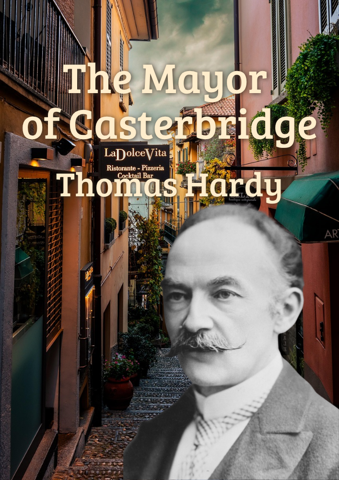
Story:
In a drunken moment, hay-trusser Michael Henchard sells his wife and infant daughter at a country fair. Eighteen years later he has remade himself as the prosperous, respected mayor of Casterbridge—until the family he lost returns and a capable young Scotsman enters his business. Henchard's strength, pride, jealousy, and hunger for affection turn past wrongdoing into a chain of new choices.
Reading Highlights:
Hardy gives the sweep of tragedy to a self-made merchant in a market town. Weather, harvest prices, gossip, and new technology matter as much as coincidence; public success is always vulnerable to private character. Henchard can be appalling and moving within the same scene, making the novel a powerful study of whether remorse can survive pride.
Directed by David Thacker; United Kingdom; starring Ciarán Hinds, Juliet Aubrey, Jodhi May, and James Purefoy. This two-part ITV production is a major modern screen version of the novel.
How it differs from the book:
The serial streamlines Hardy's coincidences and secondary townspeople, while performance places greater emphasis on Henchard's volatility and the central family relationships.
How to choose a reader's edition:
Use a complete 45-chapter edition. Notes help with grain trading, rural occupations, Scottish agricultural innovation, and Hardy's fictional Wessex geography. In translation, names and the town Casterbridge should remain stable, and the language should preserve the contrast between formal public dealings and regional speech.
Published in 1886, The Mayor of Casterbridge belongs to Thomas Hardy's mature Wessex fiction. Hardy had trained as an architect, and his novels repeatedly examine how old structures—social as well as physical—meet economic and technological change. In Henchard he created a tragic protagonist whose ruin grows not from simple villainy but from force of character, making the book unusually concentrated among his major novels.
In Thomas Hardy’s The Mayor of Casterbridge, the tragic trajectory of Michael Henchard begins in a moment of reckless drunkenness at a country fair, where the young hay-trusser impulsively auctions off his wife, Susan, and their infant daughter, Elizabeth-Jane, to a passing sailor named Newson for five guineas. Horrified by his crime upon waking sober, Henchard swears a solemn oath to abstain from alcohol for twenty-one years. Through sheer force of will, ambition, and hard work, he remakes his life in the Dorset town of Casterbridge, eventually rising to become its wealthy, prosperous mayor and most influential grain merchant. Eighteen years later, his carefully constructed world begins to shift. Susan, believing Newson has perished at sea, returns to Casterbridge seeking Henchard to secure a future for Elizabeth-Jane. At the same time, Donald Farfrae, a brilliant and charming young Scotsman equipped with modern agricultural methods, arrives in town. Henchard takes an immediate liking to Farfrae, hiring him as his business manager and treating him as a trusted confidant. Wishing to make amends to Susan while concealing his past disgrace, Henchard arranges a secret meeting with her at the local Roman Amphitheatre. They agree to pretend they are strangers; Henchard will court and remarry her publicly, allowing him to support his family without revealing the shameful truth to Elizabeth-Jane or the public. However, Henchard’s impetuous temper and intense jealousy soon strain his relationships. As Farfrae’s popularity and business acumen eclipse his own, Henchard bitterly dismisses him, turning his former protégé into a fierce commercial rival. Meanwhile, Susan falls ill and dies, leaving behind a sealed letter for Henchard with strict instructions not to open it until Elizabeth-Jane’s wedding day. Overcome by impulse, Henchard breaks the seal early and suffers a devastating revelation: his original daughter died in infancy, and the young woman living with him is actually Newson’s child. Distanced by this discovery, Henchard grows cold toward Elizabeth-Jane, who eventually moves out to become a companion to Lucetta Templeman, a wealthy woman from Jersey with whom Henchard had previously engaged in a compromised romance. Henchard’s fortunes collapse in rapid succession. Farfrae wins both Lucetta’s hand in marriage and Henchard’s lost business, while Henchard’s speculative grain deals fail, forcing him into bankruptcy. His public standing is irrevocably destroyed when a furmity-woman reveals his past crime of selling his wife during a court hearing. Reduced to working as a day laborer for Farfrae, Henchard’s misery reaches a climax after Lucetta dies following a humiliating local mock-parade known as a "skimmity-ride," which exposed her past connection to Henchard. Desperate and isolated, Henchard contemplates suicide at the dangerous "Ten Hatches" weir, but stops when he sees his own effigy floating in the water, a sight he interprets as a miraculous sign. Elizabeth-Jane's gentle care temporarily revives his spirit, but his peace is short-lived. When Newson unexpectedly reappears, alive and seeking his daughter, a terrified Henchard lies and claims Elizabeth-Jane is dead to avoid losing her love. When Newson later discovers the truth and reunites with his daughter, Henchard quietly wanders away from Casterbridge on the eve of Elizabeth-Jane's wedding to Farfrae. Having broken his oath and returned to drinking, Henchard dies in utter poverty in a lonely mud hut on the heath. When Elizabeth-Jane and Farfrae find him, they discover his final written will, which painfully demands that no one mourn him, no bells be tolled, no flowers be planted on his grave, and that "no man remember me."
I, Michael Henchard, on this morning of the sixteenth of September, do take an oath before God here in this solemn place that I will avoid all strong liquors for the space of twenty-one years to come, being a year for every year that I have lived. And this I swear upon the book before me; and may I be strook dumb, blind, and helpless, if I break this my oath!The Mayor of Casterbridge Chapter II. This passage establishes Henchard’s intense, uncompromising nature and sets up the strict temporal clock that drives the plot when his oath expires twenty-one years later.
Thomas Hardy's style can present a moderate challenge for modern readers, primarily due to his rich 19th-century vocabulary, elaborate sentence structures, and occasional use of regional Dorset dialect. The dialogue spoken by rural townspeople frequently reflects local speech patterns, which may require a brief period of adjustment. Additionally, Hardy relies on historical and geographical references to grain trading and traditional Wessex life that are unfamiliar today. However, the narrative drive of the plot is exceptionally strong and structured like a fast-paced drama. The intense personal rivalries, secret revelations, and constant shifts in fortune keep the story engaging, making the initial effort to adapt to Hardy's prose well worth the rewarding reading experience.
The novel is celebrated as a masterpiece of Victorian fiction because of its profound psychological depth and its powerful exploration of tragic character. Hardy presents Michael Henchard not as a simple villain or ideal hero, but as a deeply flawed human being whose immense strength, pride, and hunger for affection cause his own downfall. Furthermore, the book brilliantly captures a crucial turning point in English history, documenting the tension between traditional rural customs and modern agricultural innovation. Hardy's mastery of setting, dramatic irony, and complex moral dilemmas ensures that the story remains universally relevant, offering an unforgettable meditation on pride, remorse, and human resilience.
The conclusion brings the full weight of destiny down upon its proud protagonist in a series of quiet, heartbreaking reckonings. Rather than offering a simple resolution, the final sequence assembles every choice, lie, and hidden truth from Michael Henchard’s past into an ultimate test of character. What waits in these final pages is a deeply moving portrayal of solitude, human dignity, and the devastating cost of isolation. The final written testament left behind on the desolate heath stands as one of the most haunting farewells in classical literature, and the exact terms of that final request are best discovered directly in the text.
Casterbridge functions almost as a character itself, serving as an ancient Roman-built market town that tightly connects public reputation with private conduct. Its compact geography, featuring central meeting spots like the Roman Amphitheatre and the town bridges, ensures that personal secrets quickly become public knowledge. The town's economic life revolves entirely around the grain trade and local weather, making financial success contingent on nature and community trust. By placing Henchard's drama within this enclosed, traditional environment, Hardy emphasizes how deeply an individual's identity and standing are bound to the community around them.
The relationship begins as a deep professional and personal affection, with Henchard viewing the talented young Scotsman as a trusted brother and manager. However, their contrasting personalities quickly turn admiration into rivalry. Farfrae represents modern efficiency, calm judgment, and social adaptability, whereas Henchard relies on emotional instinct, traditional methods, and volatile pride. As Farfrae steadily succeeds in business, politics, and romance, Henchard's jealousy prompts a series of rash decisions intended to crush his rival. Instead, these vengeful choices backfire, accelerating Henchard's own financial and personal decline while elevating Farfrae to prominence.
The opening auction at the country fair serves as the catalyst for the entire narrative, establishing the primary debt that Henchard spends the rest of his life trying to repay. It exposes Henchard's central character flaw, his inability to control his temper and actions when intoxicated. His immediate remorse and twenty-one-year vow of sobriety demonstrate his capacity for immense willpower and moral ambition. However, the initial crime creates a dark foundation of secrecy that haunts his later success, proving that no amount of public achievement can fully erase an unatoned past.
Miva: the next reading experience beyond audiobooks
Listen like an audiobook, then ask anything, anytime.
Start Miva's narrationMiva does not just narrate. It keeps explaining based on what you ask.