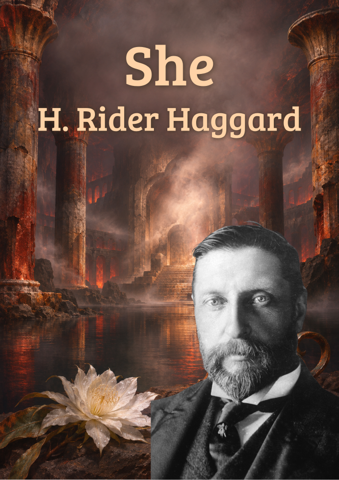
Background:
Published in book form in 1887, the novel combines lost-world adventure, archaeology, immortality, gender anxiety, evolutionary speculation, and imperial fantasy.
The central tension:
Horace Holly and Leo Vincey follow an inherited account into Africa and encounter Ayesha, the ruler known as She-who-must-be-obeyed. The expedition's claims to knowledge are inseparable from desire and colonial assumptions.
How the writing works:
A framed manuscript, pseudo-editorial apparatus, first-person travel narrative, inscriptions, spectacle, and repeated acts of interpretation make the book imitate a discovered record while advertising its own uncertainty.
Ayesha enters the novel as ruler, scholar, spectacle, threat, and object of desire, and no single role contains her. Her promise of life beyond ordinary human limits makes the expedition to Kôr more than a search for treasure. The travelers confront the fantasy that knowledge, beauty, and power might defeat time, while the narrative repeatedly turns that fantasy into fear of female authority.
Haggard frames the adventure as an edited manuscript supported by inscriptions, translations, and archaeological objects. Those devices imitate scholarly proof while making the imperial act of interpretation visible: the English travelers assume they can read bodies, ruins, and cultures into a story centered on themselves. The ruined city and the fire of life therefore belong to both fantasy and colonial epistemology.
The novel's influence on lost-world fiction is easy to recognize, but its racial hierarchy and imperial imagination require direct attention. The 1935 film relocates the kingdom to an Arctic landscape and converts Kôr into Art Deco spectacle, demonstrating how adaptable Ayesha became once separated from the novel's African geography.
Ayesha dominates the book because she exceeds every category the explorers bring with them. She is learned and theatrical, cruel and persuasive, apparently timeless yet governed by an ancient desire. Holly's narration cannot decide whether to treat her as sovereign, scientific impossibility, erotic threat, or supernatural punishment. That instability gives their encounters an intensity far stranger than a conventional treasure quest.
The documentary frame—manuscript, inscriptions, translations, genealogical claims—pretends to make fantasy accountable to evidence. At the same time, it displays the explorers' confidence that foreign bodies, ruins, and histories exist to be decoded by them. Kôr is therefore both an unforgettable imagined city and a construction of colonial knowledge. The novel invites wonder while providing the material for distrust. Reading those responses together reveals why Ayesha survived countless imitations while the ideology surrounding her remains a live critical problem.
Few novels introduce a presence as overwhelming as Ayesha. Long before every mystery is explained, her voice, veils, subterranean realm, and command of competing stories reorganize the book around her. The adventure offers ruins, danger, desire, and metaphysical speculation in extravagant measure, yet its excess is intellectually revealing. Readers interested in fantasy's history will encounter a foundational lost-world narrative; readers interested in power will encounter a woman the male narrator can neither domesticate nor describe without exposing his own fear.
Director: Lansing C. Holden; Irving Pichel
Production country: United States
Cast: Helen Gahagan, Randolph Scott, Nigel Bruce
Difference from the book: moves the quest to an Arctic setting, modernizes the expedition, and transforms Ayesha's realm into an Art Deco spectacle.
The complete 28-chapter novel bears the subtitle A History of Adventure. Rights in later illustrations should be assessed separately from the underlying prose.
Ayesha became one of popular fiction's most durable figures, influencing lost-world fantasy and screen culture. That afterlife must be studied alongside the novel's racism, imperialism, and fear of female authority.
Miva: the next reading experience beyond audiobooks
Listen like an audiobook, then ask anything, anytime.
Start Miva's narrationMiva does not just narrate. It keeps explaining based on what you ask.