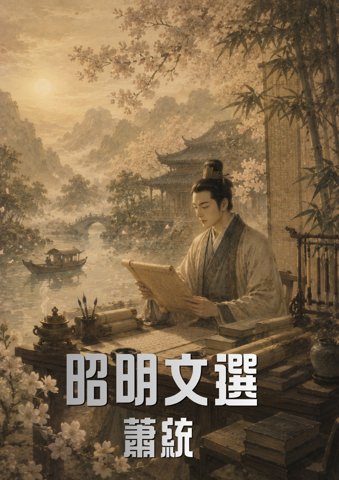
The Wen Xuan (commonly known as Zhao Ming Wen Xuan because it was compiled by Crown Prince Zhaoming of the Liang Dynasty) is the oldest surviving anthology of poems and essays in China. Spanning from the Zhou Dynasty to the Liang Dynasty of the Southern Dynasties, it gathers the essence of literary creation. The birth of this anthology marked a milestone in the transition of Chinese literature from "utilitarian value" to "pure literary self-awareness." It not only exerted a decisive influence on the imperial examinations and literature after the Tang and Song Dynasties but also became part of the common cultural vocabulary of the entire East Asian Kanji cultural sphere.
I. The Compiler and Historical Background
The Wen Xuan was born during the Southern Liang Dynasty (6th century AD), a period of highly developed cultural and intellectual thought.
Crown Prince Zhaoming, Xiao Tong (501–531 AD):
The eldest son of Emperor Wu of Liang, he was intelligent and studious, and was named Crown Prince at the age of two. He was not only an excellent political successor but also a top-tier man of letters and Buddhist scholar (he famously divided the Diamond Sutra into the "thirty-two chapters" commonly used today). In 526 AD, he suffered from his father's suspicion due to the "Wax Goose Sorcery Incident." Filled with internal distress, he died at the young age of 30 and was posthumously honored with the title "Zhaoming."
The Eastern Palace and the Ten Scholars of the High Hall:
Xiao Tong placed great importance on scholars and books. He built the "Wen Xuan Pavilion" in the Eastern Palace, housing 30,000 volumes. To compile this anthology, he invited the finest scholars of the time to form the "Ten Scholars of the High Hall" (including Zhang Zuan, Zhang Shuai, Zhang Mian, Liu Xiaochuo, Dao Qia, Lu Chui, Wang Yun, Wang Xi, Xie Ju, and Wang Gui). Together, they discussed classics and selected articles, eventually completing this masterpiece that has spanned a thousand years.
II. Core Selection Criteria: "Thought born of deep reflection, beauty residing in refined writing"
Before the Wen Xuan, the definition of "literature" was vague; history, philosophy, political discourse, and poetry were often conflated. In the Preface to the Wen Xuan, Xiao Tong pioneered the standards for pure literature:
"Thought born of deep reflection, beauty residing in refined writing"
Reflection (Chensi): Refers to the depth of conception and sentiment the writing must possess.
Refined Writing (Hanzao): Refers to the beauty of the diction, rhetoric, and phonology.
Based on this principle, the Wen Xuan made bold breakthroughs in selection:
Exclusion of Canonical, Philosophical, and Historical Texts: The philosophy and classics of Confucius, Mencius, Laozi, and Zhuangzi, or prose focused on historical records like the Records of the Grand Historian or Book of Han, were excluded due to their high utilitarianism and status as non-pure literary works. However, "historical commentaries" and "prefaces" within history books that possessed high literary value were included as exceptions.
Exclusion of Living Authors: To ensure objective and fair evaluation, all 130+ authors included (such as Cao Cao, Cao Zhi, Tao Yuanming, and Xie Lingyun) had passed away at the time of compilation. The latest author, Lu Chui, died in 526 AD.
Historical Omissions: The famous Preface to the Orchid Pavilion Collection by Wang Xizhi was not included, sparking much speculation among Song Dynasty scholars. Most believe it was because Wang Xizhi's literary status had not yet reached its peak at that time, and his writing leaned toward metaphysical discourse, which did not fit Xiao Tong's aesthetic standards.
III. Structure and Classification of Genres
The Wen Xuan was originally compiled into thirty volumes (Li Shan's commentary in the Tang Dynasty split it into sixty volumes), containing over 700 works. The arrangement uses "genre as the framework," subdivided into 37 types of writing:
It is mainly divided into three core categories: Rhapsodies (Fu), Poetry (Shi), and Elegies (Sao), followed by detailed subcategories such as Decrees, Appointments, Mandates, Instructions, Documents, Memorials, Petitions, Declarations, Accusations, Letters, Dispatches, Dialogues, Treatises, Prefaces, Eulogies, Inscriptions, Epitaphs, Sacrificial Texts, etc.
This extremely detailed classification laid an essential foundation for the study and development of stylistics in later generations. Many famous pieces from lost ancient books (such as Cao Pi's Authoritative Discourses: On Literature, China's earliest literary criticism) were preserved only because of their inclusion in the Wen Xuan.
IV. The Rise of "Xuanology" and the Commentary System
With the rise of the imperial examination system in the Tang Dynasty, the Wen Xuan became a mandatory textbook for scholars because it contained the most standard and beautiful parallel prose and poetry. In the Northern Song Dynasty, a folk proverb circulated:
"Master the Wen Xuan, and you're halfway to being a scholar."
The study and annotation of the Wen Xuan developed into a specialized discipline in the Tang Dynasty known as "Xuanology" (Xuan Xue), rivaling the study of the Five Confucian Classics. There are three major historical commentary systems:
Li Shan's Commentary (Academic Orthodoxy, 60 volumes):
Created by the scholar Li Shan during the reign of Emperor Gaozong of Tang. It is famous for "citing classics and being profound." He meticulously traced the origins of every word and allusion, preserving a vast amount of ancient literature that was later lost. It is recognized as the best and most academically valuable commentary. The version with Hu Kejia's textual research from the Qing Dynasty is the current standard.
Five Ministers' Commentary (Popular Circulation):
Jointly annotated by five officials during the Kaiyuan era of the Tang Dynasty. They believed Li Shan's commentary was too difficult, so they created a popular version with simpler text focused on literal explanation. While easier to read, it is often criticized for inaccuracies and is not accepted as academic orthodoxy.
Six Scholars/Six Ministers' Commentary (Combined Edition):
In the Song Dynasty, booksellers combined the notes of Li Shan and the Five Ministers. These combined editions served as essential references for readers and are now considered national treasures in some library collections.
V. Historical Evaluation
Evaluations of the Wen Xuan have shifted with literary trends:
Proponents: Zhang Jie of the Song Dynasty noted that while the Wen Xuan had some questionable inclusions and exclusions, the masterpieces it preserved were of immense value and served as the standard for learning poetry.
Critics: Han Yu and Liu Zongyuan of the Tang Dynasty promoted the "Classical Prose Movement," opposing the ornate parallel prose of the Six Dynasties, and thus criticized the aesthetic tendencies of the Wen Xuan. The great writer Su Shi gave a stinging review, claiming the classification was disorganized and calling Xiao Tong a child playing at understanding serious matters.
VI. International Influence: Impact on Japanese Culture
The influence of the Wen Xuan reached far overseas. When it was introduced to Japan, it quickly became a "Sinology Bible" for the Heian period aristocracy.
More strikingly, the Wen Xuan profoundly shaped the vocabulary of modern Japanese. Japanese classical scholars integrated a large number of Chinese terms from the book into the Japanese language. Many Kanji terms commonly used in Japanese today find their origins in the Wen Xuan, such as:
Hero (Eiyū), Prosperity (Eiga), Enshō (Going up in flames), Dissolution (Kaisan), Fortune and Misfortune (Kafuku), Family (Kamon), Rock (Ganseki), Instrument/Machine (Kikai), Strange (Kigai), Event (Gyōji), Murder Weapon (Kyōki), Gold and Silver (Kin-gin), Management (Keiei), Authority (Ken'i), Wise Man (Kenjin), Time (Kōin), Regret (Kōkai), Hometown (Kokyō), Era Name (Nengō), Nation (Kokka), King (Kokuō), Territory (Kokudo), Vitality (Genki), School (Gakkō), Entertainment (Goraku), Nations (Bankoku), Master (Shujin), Noble and Humble (Kisen), Gratitude (Kanjiki), Exhaustion (Hipei), and more.
It can be said that without the Wen Xuan, the modern Japanese vocabulary would look completely different. The Selections of Refined Literature not only preserved the sparks of ancient Chinese literature but also became a shared spiritual wealth across the East Asian cultural sphere.
Miva: the next reading experience beyond audiobooks
Listen like an audiobook, then ask anything, anytime.
Start Miva's narrationMiva does not just narrate. It keeps explaining based on what you ask.