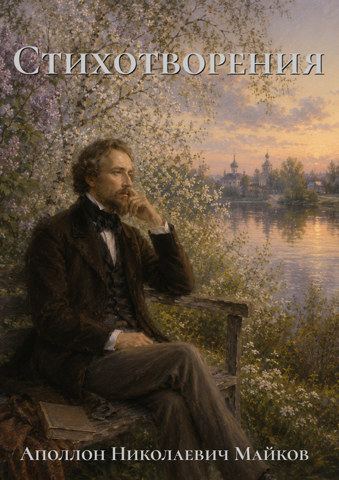
"Poems" is the first poetry collection by the Russian poet Apollon Nikolayevich Maikov, published in St. Petersburg in 1842. It was this book that established Maikov as one of the most prominent young poets of the post-Pushkin era and brought him widespread critical acclaim. For this collection, Emperor Nicholas I awarded the poet a monetary prize and provided him the opportunity for an extended journey across Europe.
The main feature of the book was a combination of ancient harmony, plasticity of images, and vivid lyrical feeling, which was unusual for Russian poetry of that time. Maikov turned to the aesthetics of ancient Greek and Roman poetry, continuing the traditions of Batyushkov and Gnedich; however, he did so not as an imitator, but as an independent artist. His verses are filled with sunlight, a sense of proportion, and the beauty of the human body, nature, and art. In Maikov's work, the ancient world is not a dead past, but a living culture contrasted with the spiritual poverty of modernity.
The poem "Sleep" became especially famous, which the critic Vissarion Grigoryevich Belinsky called a work worthy of Pushkin. Belinsky wrote that in anthological poetry, Maikov "hardly had any equal" among many Russian poets of his time. He admired the "plastic artistry" of the poems and called them a model of true art:
"In Pushkin's own work, this poem would be among his best anthological pieces."
Critics particularly noted the surprising "Hellenic" nature of Maikov's talent. Belinsky wrote of him:
"He looks at life through the eyes of a Greek."
The collection divided readers and critics into two camps. Some saw Maikov as the heir to ancient clarity and Pushkinian harmony, while others reproached him for coldness and detachment from modern life. Belinsky himself believed that Maikov's talent was revealed more strongly in works on ancient themes than in attempts to write social and contemporary poetry.
Nevertheless, it was "Poems" that became the foundation of the poet's entire future career. The main themes of his work already appeared in this book: the beauty of art, antiquity, nature, the philosophy of history, and the clash between the pagan and Christian worlds. These motifs would later develop in his major works — "Three Deaths," "Two Worlds," "The Death of Lucius," and the cycle "Sketches of Rome."
The collection had a great influence on the development of Russian "pure poetry" in the 19th century. Subsequently, Maikov would be perceived as one of the most important representatives of the aesthetic movement, opposed to social and revolutionary-democratic literature. His poems were highly valued by Afanasy Afanasyevich Fet, Fyodor Mikhailovich Dostoevsky, Yakov Petrovich Polonsky, and many composers, including Pyotr Ilyich Tchaikovsky and Nikolai Andreyevich Rimsky-Korsakov, who later set Maikov's works to music.
Miva: the next reading experience beyond audiobooks
Listen like an audiobook, then ask anything, anytime.
Start Miva's narrationMiva does not just narrate. It keeps explaining based on what you ask.