Story:
Dorothea Brooke longs for a life of serious purpose and mistakes the scholar Edward Casaubon for a guide to it. The ambitious doctor Tertius Lydgate arrives in Middlemarch hoping to reform medicine, only to find that love, debt, reputation, and local alliances can reshape a vocation. Around them, marriages, inheritances, elections, secrets, and small acts of generosity form the living web of a provincial town.
Reading Highlights:
George Eliot makes no life truly secondary. The novel moves among idealists, gossips, bankers, clergy, patients, and relatives, showing how one private decision alters many futures. Its great pleasure is moral intelligence: the narrator can be witty about self-deception without withdrawing sympathy from the deceived. Few novels make ordinary compromise feel so consequential.
Directed by Anthony Page for the BBC; United Kingdom; starring Juliet Stevenson, Rufus Sewell, Douglas Hodge, Patrick Malahide, and Trevyn McDowell. The six-part serial is the best-known screen adaptation.
How it differs from the book:
The serial preserves the main interlocking plots but reduces Eliot's essayistic narrator, philosophical commentary, and some minor-town networks in favour of enacted scenes and clearer dramatic parallels.
How to choose a reader's edition:
Choose an unabridged edition containing the Prelude, eight books, and Finale. A character list can help, but avoid one that reveals later relationships. Notes on the 1832 Reform Act, medical practice, inheritance, and provincial politics enrich the novel; translations should preserve the narrator's irony as carefully as the dialogue.
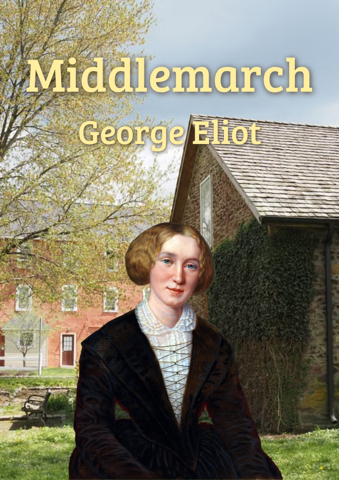
George Eliot first issued Middlemarch in eight instalments in 1871 and 1872. Writing about a provincial town before the 1832 Reform Act, she used historical distance to examine reform, vocation, science, marriage, and the limits of idealism. The novel brings together the intellectual range and psychological sympathy of her mature career, allowing individual errors to be seen within an entire social network.
In the provincial English town of Middlemarch, two distinct idealists attempt to navigate the boundaries of 19th-century society: Dorothea Brooke, an ardent young woman who longs to dedicate her life to a grand intellectual and spiritual cause, and Tertius Lydgate, an ambitious young doctor driven to revolutionize medical science. Seeking a noble purpose, Dorothea marries Edward Casaubon, an elderly scholar whose dry, pedantic nature conceals a profound self-doubt. She hopes to assist him in completing his masterwork, a comprehensive study of mythology, but soon finds herself isolated in a cold, stifling marriage. Meanwhile, Casaubon becomes deeply jealous of the affection developing between Dorothea and his idealistic, artistic cousin, Will Ladislaw. Before dying of a sudden heart condition, Casaubon adds a spiteful codicil to his will, decreeing that Dorothea will lose her entire inheritance if she ever marries Ladislaw. Concurrently, Dr. Lydgate arrives in Middlemarch determined to reform healthcare and establish a modern hospital with the backing of the wealthy, hypocritical banker Nicholas Bulstrode. Lydgate falls in love with and marries Rosamond Vincy, the vain and status-conscious daughter of a local merchant. Their marriage quickly turns bitter as Rosamond’s extravagant spending drives Lydgate into severe financial ruin. Desperate for funds, Lydgate accepts a loan from Bulstrode. However, when a shadowy former associate of Bulstrode dies under Lydgate’s care, the town suspects Bulstrode of murder and Lydgate of accepting a bribe to cover it up. Though innocent of corruption, Lydgate’s reputation is irrevocably ruined. In another thread of town life, Rosamond’s brother Fred Vincy leads a reckless youth, accumulating debts that jeopardize the savings of Caleb Garth, a respected estate manager. Devoted to Caleb's pragmatic, upright daughter Mary, Fred turns his life around, forsaking his family's high expectations to learn practical farming under Caleb's guidance, eventually securing a stable life and winning Mary’s hand. As scandal engulfs Middlemarch, Dorothea demonstrates profound empathy. Believing in Lydgate's innocence, she steps forward to clear his debts and restore his standing. She also confronts Rosamond, attempting to heal the rift between the doctor and his wife. In doing so, Dorothea discovers that Ladislaw's devotion to her has remained steadfast. Recognizing that genuine love and human connection outweigh social status and wealth, Dorothea chooses to renounce Casaubon’s fortune in order to marry Will. The primary characters ultimately follow divergent paths. Lydgate abandons his noble scientific ambitions to cater to wealthy patients in London, viewing his career as a failure until his death at fifty. Fred and Mary Garth achieve a quiet, enduring happiness managing the Stone Court estate. Dorothea settles with Will in London, where he achieves success as a reform-minded Member of Parliament. Though Middlemarch society continues to view her choices as unconventional, Dorothea spends her life quietly enriching the lives of those around her, her legacy defined not by grand historical fame, but by the quiet, diffusive influence of her unhistoric acts.
If we had a keen vision and feeling of all ordinary human life, it would be like hearing the grass grow and the squirrel’s heart beat, and we should die of that roar which lies on the other side of silence. As it is, the quickest of us walk about well wadded with stupidity.Middlemarch Book II, Chapter 20. This passage offers a profound philosophical observation on the psychological necessity of human insensitivity, framing tragedy not as rare catastrophe, but as an overwhelming element embedded in everyday existence.
Her finely touched spirit had still its fine issues, though they were not widely visible. Her full nature, like that river of which Cyrus broke the strength, spent itself in channels which had no great name on the earth. But the effect of her being on those around her was incalculably diffusive: for the growing good of the world is partly dependent on unhistoric acts; and that things are not so ill with you and me as they might have been, is half owing to the number who lived faithfully a hidden life, and rest in unvisited tombs.Middlemarch Finale. Serving as the emotional and thematic capstone of the entire novel, it elevates quiet, ordinary moral devotion above grand historical achievements, defining the novel's humanist philosophy.
Here was a man who now for the first time found himself looking into the eyes of death—who was passing through one of those rare moments of experience when we feel the truth of a commonplace, which is as different from what we call knowing it, as the vision of waters upon the earth is different from the delirious vision of the water which cannot be had to cool the burning tongue.Middlemarch Book V, Chapter 42. It brilliantly captures the existential psychological shift that occurs when abstract mortality suddenly transforms into immediate, inevitable personal reality.
Then came the hour in which the waves of suffering shook her too thoroughly to leave any power of thought. She could only cry in loud whispers, between her sobs, after her lost belief which she had planted and kept alive from a very little seed since the days in Rome—after her lost joy of clinging with silent love and faith to one who, misprized by others, was worthy in her thought—after her lost woman’s pride of reigning in his memory—after her sweet dim perspective of hope, that along some pathway they should meet with unchanged recognition and take up the backward years as a yesterday.Middlemarch Book VIII, Chapter 80. The passage vividly renders the visceral physical and emotional anguish of shattered ideal faith, marking a pivotal crucible in Dorothea's emotional growth.
Middlemarch is a rich, complex Victorian novel, but it is remarkably accessible once you adapt to its rhythmic, reflective style. The primary challenge for modern readers lies in its sentence structure and broad philosophical scope rather than obscure vocabulary. George Eliot writes with immense psychological clarity, introducing an essayistic narrator who directly interprets the inner thoughts, self-deceptions, and subtle motives of every character. Rather than relying on fast-paced action, the narrative builds momentum through multi-layered domestic conflicts, political reforms, and romantic misunderstandings. Readers who approach the book with patience soon find that the narrator's sharp wit and warm empathy make the story deeply engaging. The characters feel startlingly modern in their flaws and desires, ensuring that the initial effort yields an extraordinary literary experience.
Middlemarch stands as a monument of realist fiction because of its unparalleled psychological depth and masterfully constructed plot web. Writing under the pen name George Eliot, Mary Ann Evans brought an astonishing intellectual range to the novel, incorporating Victorian scientific thought, political reform movements, and philosophical reflections. What makes the book a classic is its moral intelligence: no character is treated as a simple hero or villain. Even the antagonist or self-deceived figures are portrayed with tragic humanity and understanding. Eliot demonstrates how ordinary decisions, financial pressures, and social expectations shape human destiny, making provincial life feel as monumental as classical drama. Its profound observation of human nature and timeless insights into love, work, and community ensure its enduring place in world literature.
The conclusion of Middlemarch brings the grand web of provincial life to a deeply satisfying, quiet resolution. Rather than relying on dramatic twists or sudden victories, the final chapters measure how each character's early dreams have survived the friction of reality, debt, and public scrutiny. What waits in these concluding pages is an unexpected, profoundly moving reckoning with what constitutes a truly meaningful life, showing how small, hidden choices echo through an entire community. Every major relationship reaches its ultimate, permanent alignment in ways that challenge the town's conventional standards. Read these closing pages for yourself to experience the true emotional weight of their journeys.
While Middlemarch is an ensemble novel without a single protagonist, Dorothea Brooke and Dr. Tertius Lydgate serve as its two primary narrative pillars. Both arrive in the town filled with elevated aspirations, and their parallel struggles against provincial narrowness form the emotional heart of the work.
The novel is set in the fictional English Midlands town of Middlemarch between 1829 and 1832. This specific historical backdrop allows Eliot to explore significant social transitions, including the arrival of the railways, medical advancements, and the political tensions surrounding the 1832 Reform Act.
Mary Ann Evans adopted the male pen name George Eliot to ensure her novels were taken seriously in a literary market that often dismissed women's writing as light romance. The pseudonym also allowed her to publish without the interference of public gossip surrounding her personal life and unconventional relationship with George Henry Lewes.
Miva: the next reading experience beyond audiobooks
Listen like an audiobook, then ask anything, anytime.
Start Miva's narrationMiva does not just narrate. It keeps explaining based on what you ask.