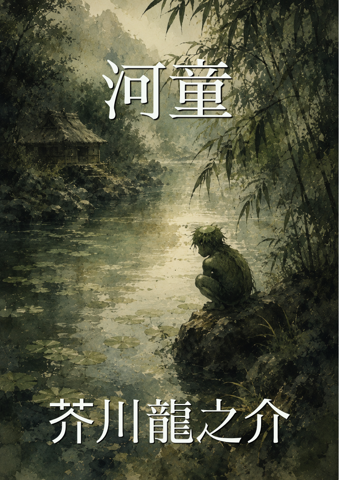
Ryūnosuke Akutagawa's Final Major Work
Written Months Before His Death—His Death Anniversary Now Called "Kappaki"
Ranked Alongside Swift's Gulliver's Travels and Wells's The Time Machine
Reimagined for Stage as a Near-Future Correctional Facility
In Kappaland, the unwanted are asked before birth if they wish to exist at all.
Published in 1927 in the magazine Kaizō, Kappa is Ryūnosuke Akutagawa's satirical novel, framed as the account of a patient in a psychiatric hospital. While chasing a Kappa through the Hotaka Mountains, the protagonist stumbles into "Kappaland"—a mirror world where every human convention is inverted: females pursue males, the unborn are asked whether they wish to be born, and unemployed laborers are euthanized and served as meat.
This is not merely a fantastical satire. It is a scalpel turned inward on human society, wearing the mask of an absurd other world to say what could not be said plainly. The philosopher Magg's aphorism—that a fool always considers everyone but himself a fool—runs through the novel like a diagnosis. By the end, the protagonist returns to the human world and finds himself homesick for the Kappa, cleaner beings than his own kind. The satire never stops biting. It simply turns, at the last moment, to grief.
[Quote placeholder — let me know if you'd like a specific critic or writer quoted here] —[Author Name], [title/role]
Subtitled "Please pronounce it as Kappa," this was written only months before Akutagawa took his own life; July 24, the anniversary of his death, is now observed in Japan as "Kappaki" in honor of this late masterwork. Due to its scope, Kappa is frequently discussed alongside Jonathan Swift's Gulliver's Travels and A Modest Proposal, H.G. Wells's The Time Machine, and Lu Xun's A Madman's Diary. It has been adapted repeatedly for stage and screen, including a 2006 film directed by Masatoshi Akihara and a 2021 stage production directed by Katsuhide Suzuki, which relocated the story to a near-future correctional facility.
You will finish this story and feel relieved to return to the human world. Akutagawa did not.
The narrative begins in a mental hospital outside Tokyo, where Patient No. 23, a man who appears deceptively young, relates the extraordinary tale of his journey to the land of the Kappas. Three years earlier, during a summer trek from Kamikochi up Mount Hotaka, the protagonist loses his way in a dense, blinding fog along the Azusa River Valley. As he navigates through the tall bamboo grass, he spots a strange creature, a Kappa. Driven by curiosity, he pursues the swift creature through the forest. When a wild bull blocks the Kappa's path, the creature tumbles into the brush. Reaching out to grab it, the protagonist slips and falls headlong into a deep, pitch-black hole, losing consciousness just as he recalls the famous Kappa Bridge. Upon waking, he finds himself lying on his back, surrounded by a crowd of Kappas. A Kappa physician named Chack, wearing pince-nez spectacles over his wide beak, examines him with a stethoscope before having him transported on a stretcher through a bustling subterranean city. To his astonishment, the underground Kappa civilization closely mirrors human society, complete with paved streets, modern storefronts, gas lamps, and automobiles. Chack takes the protagonist to his home to recover, administering transparent medicine. Soon, the protagonist learns that humans hold a unique privilege in this realm: simply by virtue of being human, they are provided for without needing to work. He forms friendships with several notable Kappas, including Bag, a fisherman; Mag, a philosopher who contemplates life under colorful lanterns; Lap, a student with a decaying beak; and Tok, an iconoclastic poet. Through them, he gains deep insights into Kappa society, a world that serves as a mirror to human absurdities, where social norms, morality, and legal systems operate on strikingly inverted or cynical principles. Over time, however, the strange nature of Kappa society weighs heavily on him. A growing sense of melancholy settles over him, especially after witnessing the tragic end of his friend Tok. Driven to despair by his artistic struggles and existential dread, Tok takes his own life by shooting himself in the head with a pistol, leaving his grieving partner behind. Rooked by grief and disillusioned with the Kappa world, the protagonist decides he must return to the human realm. Seeking a way out, he consults an old, wise Kappa living quietly on the outskirts of the town. Following directions to escape, he eventually finds his way back to human society. Yet, returning home brings no peace. Unable to readjust to human life, he finds human beings to be hypocritical, cruel, jealous, and greedy compared to the aquatic creatures he left behind. Desperate to return to the underground realm, he attempts to board a train on the Chuo Line but is detained by the police and ultimately committed to Dr. S’s asylum. Now confined to his hospital room, Patient No. 23 spends his days gazing out the barred window at a leafless oak tree. He receives occasional visitations from his old Kappa friends in his mind, clinging to his memories of their world. Whenever visitors approach, his nostalgic despair turns into sudden fury, and he screams at them to leave, reviling humans as foolish, vain, and cruel beasts.
We are more unfortunate than humans. Humans are not as evolved as Kappas.Original: 我々は人間よりも不幸である。人間は河童ほど進化していない。Kappa Chapter 11. It ironically subverts conventional ideas of progress and evolution, suggesting that greater intellectual awareness only deepens spiritual suffering and unhappiness.
Akutagawa's novella is remarkably accessible, clear, and direct in its prose style. Written in an engaging framed narrative, it avoids overly dense historical jargon in favor of crisp dialogue and vivid allegorical scenes. The primary challenge lies not in decoding the language, but in digesting the sharp, cynical satire underlying its simple fable-like structure. Readers who enjoy philosophical allegories like Swift's Gulliver's Travels will find its pacing brisk and its themes deeply engaging.
The work stands as a monumental masterpiece of Japanese modernism, written just months before Akutagawa's death. It synthesizes European satirical traditions with traditional Japanese folklore, turning a mythical creature into a mirror for modern industrial society, capitalism, and human hypocrisy. Its enduring legacy is cemented by its historical weight, as Akutagawa's death date is commemorated as Kappa-ki, marking this novella as the definitive artistic statement of his final period.
What awaits in the final pages is a total collapse of the boundary separating sanity from delusion, and myth from reality. Having returned from the subterranean realm, the protagonist faces a haunting reckoning with human isolation behind the walls of an asylum, accompanied by spectral visitors from his past. The final sequence explores whether his vision is a true escape or the ultimate delusion of a broken mind. Read these closing pages for yourself to experience the resolution.
In traditional folklore, the Kappa is a mischievous or dangerous water imp known for dragging victims into rivers. Akutagawa transforms this folklore figure into a civilized, bourgeois citizen who wears spectacles, drives automobiles, and operates industrial factories. By modernizing these creatures, Akutagawa uses them as an allegorical lens to criticize modern Japanese institutions, intellectual arrogance, and capitalistic greed.
The text serves as a deeply personal document written during a period of severe nervous exhaustion and health decline for Akutagawa in 1927. The character Tok's artistic struggles, the philosophical cynicism expressed by Mag, and the pervasive fear of insanity mirror Akutagawa's own documented mental strain. Through the protagonist's confinement, the author processed his anxieties about human society, creative failure, and his impending suicide.
In one of the novella's most famous satirical scenes, childbirth is handled through an inverted, highly rationalized process. Before a female Kappa gives birth, the father stands over her womb and asks the unborn child if it truly wishes to enter the world. If the fetus declines after considering the burdens of existence, the pregnancy is immediately terminated with a liquid injection, highlighting the society's bleak existential pragmatism.
Miva: the next reading experience beyond audiobooks
Listen like an audiobook, then ask anything, anytime.
Start Miva's narrationMiva does not just narrate. It keeps explaining based on what you ask.