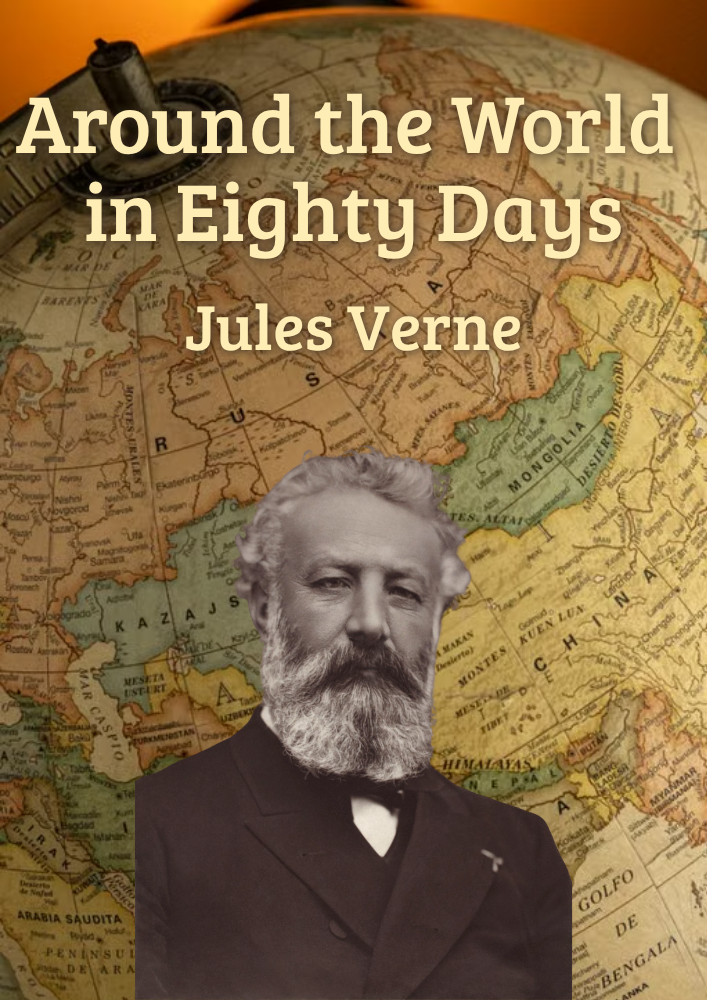
Book Introduction
Background:Published in French in 1872, the novel emerged during rapid expansion of railways, steamship routes, telegraphy, and standardized timetables. Its wager converts the nineteenth century's new global transport network into a narrative clock. This English text is George Makepeace Towle's translation of Verne's French novel. The story also responds to contemporary newspaper debates about whether new routes had made such a journey practically possible. Verne turns that public fascination into a test of planning, wealth, and imperial infrastructure.
Story Summary:The methodical Phileas Fogg wagers that he can circle the globe in eighty days and leaves London with his newly hired servant Passepartout. Delays, mistaken suspicions, and unexpected obligations repeatedly force the pair to balance punctual calculation against human responsibility. Because the reader knows the deadline, even routine transfers and border procedures acquire dramatic force. The journey also gradually reveals qualities in Fogg that his tightly regulated London life kept hidden.
Literary Features:The novel uses short chapters, precise timekeeping, geographic transitions, and comic contrast between Fogg's composure and Passepartout's impulsiveness. Suspense comes less from hidden motives than from schedules, routes, and accumulating delay. The narration also reflects nineteenth-century European assumptions, which modern readers may examine alongside its fascination with global mobility. Recurring calculations give the book a mechanical surface, but coincidence and human choice repeatedly disrupt it. The narration alternates admiration for modern mobility with satire of travellers who pass through places without truly seeing them.
Film and Television Adaptations
Around the World in 80 Days (1956)
Directed by Michael Anderson in the United States, starring David Niven, Cantinflas, Shirley MacLaine, and Robert Newton, this large-scale production won the Academy Award for Best Picture. It expands the journey into spectacle, adds prominent cameo appearances, and changes or enlarges several episodes beyond the novel.
Around the World in 80 Days (2004)
Directed by Frank Coraci in the United States, starring Jackie Chan, Steve Coogan, and Cécile de France, this version makes Passepartout an action-oriented central figure and introduces new villains and inventions. The wager remains, but characterization and route incidents are extensively rewritten.
Both films preserve the wager while changing the balance among travelogue, comedy, romance, and action. Their departures help distinguish the novel's schedule-driven suspense from later cinema's preference for spectacle and star performance.
Editions and Translations
The first French edition appeared as Le Tour du monde en quatre-vingts jours. Early English versions are not interchangeable: titles, names, omissions, and phrasing differ. This intake uses the George Makepeace Towle translation, so quotations and chapter wording should be checked against that text rather than against a modern translation.
Later translations may restore material, revise colonial terminology, or supply historical notes on routes and currencies. A scholarly reading benefits from an edition that identifies its French base text and explains nineteenth-century transport geography.
The Author and the Work
Relationship Between the Author and the Work:The novel is central to Verne's Voyages extraordinaires because it shifts emphasis from speculative machinery to transport systems already operating in his own time. Its disciplined itinerary lets Verne combine adventure, topical geography, social comedy, and a sustained argument about what punctuality can and cannot measure. The novel helped make the timed global journey a durable popular narrative pattern. Within Verne's career, it is distinctive because the apparent marvel is not a single invention but the coordination of systems across the world.