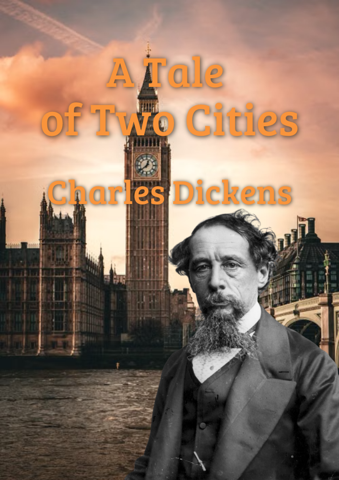
Story:
“Recalled to life” after eighteen years in the Bastille, Doctor Manette is reunited with his daughter Lucie and carried from Paris to London. Years later, the lives of French émigré Charles Darnay and dissolute English lawyer Sydney Carton converge around Lucie as revolution engulfs France. Old crimes return as public fury, and private loyalty is tested against the machinery of vengeance.
Reading Highlights:
Dickens gives historical upheaval the pace of a thriller. Doubles, secrets, echoes, and repeated images bind the three books together, while the contrast between London and Paris makes personal identity feel politically dangerous. At its centre stands one of literature's most memorable transformations: a wasted life discovering what it might still be worth.
Directed by Jack Conway for MGM; United States; starring Ronald Colman, Elizabeth Allan, Edna May Oliver, Reginald Owen, and Basil Rathbone. Ronald Colman's performance makes this classic Hollywood version a particularly memorable route into Sydney Carton's story.
How it differs from the book:
The film condenses Dickens's three-book plot, reduces political and secondary material, and gives Sydney Carton's emotional and sacrificial journey stronger dominance.
How to choose a reader's edition:
A complete edition retains Book the First, Book the Second, and Book the Third, comprising 45 chapters. Notes on the Bastille, the French Revolution, and Dickens's historical sources help separate history from invention. Avoid school abridgements if you want the carefully planted repetitions that make the ending work.
Charles Dickens published A Tale of Two Cities in weekly instalments in 1859, launching it in his own periodical All the Year Round. Inspired in part by Thomas Carlyle's history of the French Revolution and by Dickens's involvement in Wilkie Collins's play The Frozen Deep, it is both historical spectacle and tightly designed personal drama. Its three-part architecture is notably lean beside Dickens's larger social panoramas.
Charles Dickens’s A Tale of Two Cities begins in 18th-century France and England, framing a nation on the precipice of violent revolution. In 1775, Jarvis Lorry, an agent for Tellson’s Bank, travels to Paris to assist Lucie Manette. Lucie learns that her father, Dr. Alexandre Manette, is not dead as she believed, but has been held in secret confinement in the Bastille for eighteen years. Dr. Manette, severely traumatized and reduced to making shoes to cope with his isolation, is reunited with his daughter and brought to London to recover. Through Lucie’s devotion, he is gradually restored to sanity. Five years later, Charles Darnay, a French émigré living in England, is tried for treason at the Old Bailey. He is acquitted after his defense counsel, Mr. Stryver, and brilliant but dissolute lawyer Sydney Carton point out a striking physical resemblance between Darnay and Carton, shattering a key witness's identification. Despite their identical appearances, the two men lead vastly different lives: Darnay is noble and virtuous, while Carton is a self-loathing alcoholic who views himself as a wasted talent. Both men fall in love with Lucie, but Carton recognizes his own ruin and promises Lucie that he would make any sacrifice, even giving his life, to preserve her happiness and the lives of those she loves. Lucie ultimately marries Darnay, who has renounced his hidden aristocratic background as the nephew of the cruel Marquis St. Evrémonde. In 18th-century Paris, mounting oppression drives the working class of the Saint Antoine district to rise up. Led by the wine-shop owner Ernest Defarge and his vengeful wife, Madame Defarge, the revolutionaries storm the Bastille in 1889, initiating the Reign of Terror. Unaware of the growing peril, Darnay returns to Paris in 1792 to save Gabelle, a family servant imprisoned by the revolutionaries. Upon arrival, Darnay is arrested as an aristocrat and an enemy of the Republic due to his Evrémonde heritage. Lucie, Dr. Manette, their child, and Mr. Lorry rush to Paris. Dr. Manette uses his heroic status as a former Bastille prisoner to secure Darnay's acquittal. However, Darnay is immediately rearrested the same night, denounced anew by Madame Defarge and Ernest Defarge. At the trial, Defarge produces a document hidden by Dr. Manette in his old Bastille cell, which reveals that the Marquis St. Evrémonde and his brother were responsible for the deaths of Madame Defarge’s entire family and for Dr. Manette's long imprisonment. Condemned by his family’s past crimes, Darnay is sentenced to the guillotine within twenty-four hours. Sydney Carton arrives in Paris and discovers Madame Defarge’s plot to execute Lucie and her child next. Determined to fulfill his promise, Carton uses a secret leverage over the prison spy Barsad to gain entry to the Conciergerie. Carton drugs Darnay, swaps clothing with him, and has the unconscious Darnay smuggled out of the prison to escape France with Lucie, her father, and Mr. Lorry. Remaining behind in Darnay's place, Carton comforts a young seamstress scheduled to die alongside him. As he approaches the guillotine, Carton finds ultimate peace and redemption in his choice, comforted by a vision of a peaceful future for Lucie's family and the knowledge that his act of love will echo through generations.
“It is a far, far better thing that I do, than I have ever done; it is a far, far better rest that I go to than I have ever known.”A Tale of Two Cities Book III, Chapter 15. It represents the ultimate thematic climax of redemption and self-sacrifice, transforming a hitherto wasted life into a heroic act of profound love.
“Eighteen years!” said the passenger, looking at the sun. “Gracious Creator of day! To be buried alive for eighteen years!”A Tale of Two Cities Book I, Chapter 3. It establishes the core thematic motif of being "recalled to life" after suffering long, unjust imprisonment in the Bastille.
“We have borne this a long time,” said Madame Defarge, turning her eyes again upon Lucie. “Judge you! Is it likely that the trouble of one wife and mother would be much to us now?”A Tale of Two Cities Book III, Chapter 3. It vividly illustrates the hardened, unyielding vengeance driven by decades of aristocratic oppression, showing how suffering can extinguish personal empathy.
It was the best of times, it was the worst of times, it was the age of wisdom, it was the age of foolishness, it was the epoch of belief, it was the epoch of incredulity, it was the season of Light, it was the season of Darkness, it was the spring of hope, it was the winter of despair.A Tale of Two Cities Book I, Chapter 1. It sets up the pervasive dualities of the entire novel through iconic rhythmic prose, capturing the paradoxical nature of a revolutionary era.
Readers often wonder if Dickens's classic language makes this novel difficult to navigate. Compared to his sprawling social panoramas, this work features a remarkably lean, three-part architecture that moves with the rapid pace of a political thriller. While the opening chapter introduces formal eighteenth-century prose and complex historical context, the narrative quickly settles into dramatic action, dramatic trials, and tight suspense. The carefully planted repetitions and interconnected storylines keep the reader engaged, making it one of Dickens's most accessible works for modern audiences.
The work maintains its status as a classic because it combines historical spectacle with deeply personal human drama. Dickens draws inspiration from Carlyle's histories to capture the terrifying momentum of the French Revolution, contrasting the chaos of Paris with the domestic stability of London. Beyond its historical setting, the novel offers timeless explorations of redemption, mob violence, and personal sacrifice. Its famous dualities, memorable characters, and tightly designed plot ensure that its central themes resonate across different generations of readers.
Everything the story has been building toward converges in a single, intense climax within revolutionary Paris. As the Reign of Terror reaches its peak, long-buried secrets hidden in Bastille cells come to light, threatening to destroy the Manette family. The final chapters deliver a profound series of choices where deep personal devotion confronts the unyielding machinery of public vengeance. How a longstanding promise is kept, who stands before the revolutionary tribunal, and the quiet vision that closes the work provide a powerful payoff that must be experienced directly in the text.
Dickens was heavily inspired by Thomas Carlyle’s famous history of the French Revolution, which he read repeatedly while preparing the book. He was also influenced by his personal participation in Wilkie Collins’s play, The Frozen Deep, which explored themes of self-sacrifice and devotion. Dickens sought to craft a narrative that prioritized a lean, continuous plot driven by historical upheaval rather than relying solely on his typical episodic comic characterizations.
The book establishes a constant deliberate opposition between the two capital cities to explore safety versus political chaos. London is depicted as a realm of relative order, legal proceedings, and quiet domestic harmony centered around Lucie Manette’s home. Conversely, Paris is portrayed as a pressure cooker of extreme poverty, aristocratic cruelty, and eventual revolutionary mob terror. This structural contrast emphasizes how individual identity and safety become fragile when caught up in historical storms.
Cinematic adaptations, such as the classic 1935 MGM film starring Ronald Colman, necessarily condense Dickens's extensive narrative structure. Film versions often streamline secondary political subplots and focus more heavily on the central character dramatic arc of Sydney Carton. While these movies capture the emotional core of Carton's journey, reading the complete text reveals carefully woven echoes, double motifs, and detailed historical context that screen adaptations usually shorten.
Miva: the next reading experience beyond audiobooks
Listen like an audiobook, then ask anything, anytime.
Start Miva's narrationMiva does not just narrate. It keeps explaining based on what you ask.