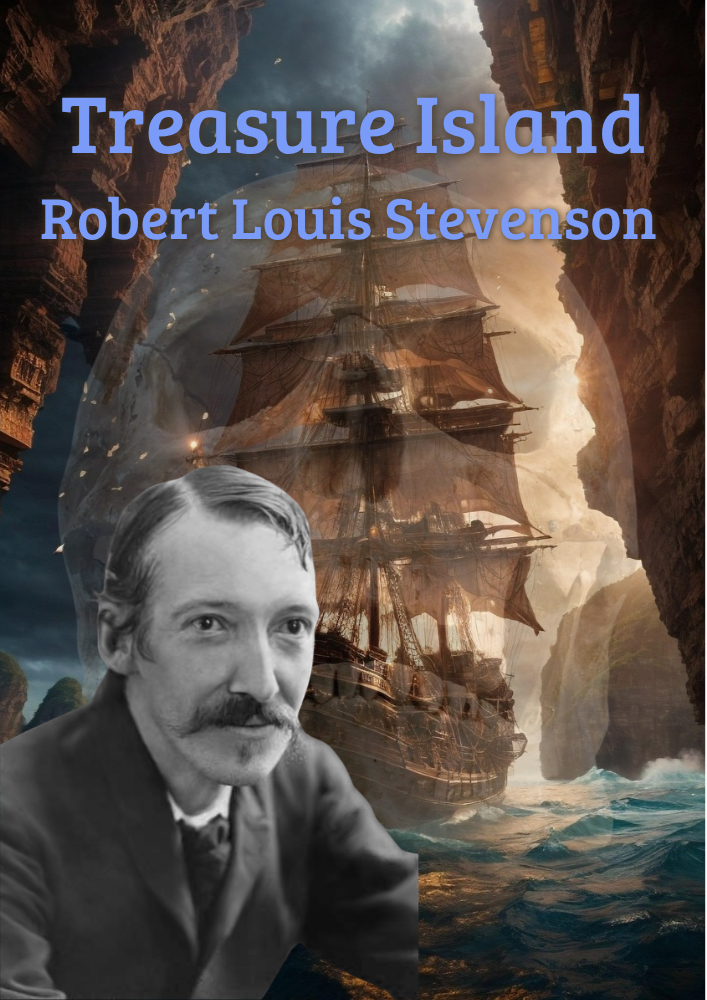
Book Introduction
Background:Treasure Island first appeared in serial form in the children's magazine Young Folks under the title The Sea Cook, and was published as a book in 1883. Stevenson drew on adventure traditions while giving the pirate story many of its most durable modern images: the marked map, buried treasure, the one-legged seaman, and divided crews. The book appeared when maritime adventure already had a long tradition, yet Stevenson concentrated its materials into an unusually economical design. Its imagined eighteenth-century setting allowed contemporary readers to encounter piracy as both history and theatrical legend.
Story Summary:Young Jim Hawkins discovers a map among a dead sailor's effects and joins an expedition to a distant island. When he learns that Long John Silver and much of the crew are planning mutiny, the voyage becomes a contest of judgment, courage, and shifting allegiance. Jim must repeatedly decide whom to trust while adults around him conceal plans or change sides. His education is therefore moral as well as practical, and the treasure never fully resolves the unease created by the voyage.
Literary Features:Jim's first-person account gives the adventure immediacy while preserving the uncertainty of a young observer. Stevenson alternates confined spaces with open sea and island terrain, using overheard speech and sudden reversals to sustain tension. Silver's charm, intelligence, and opportunism prevent the moral conflict from becoming a simple division between heroes and villains. Several chapters temporarily shift narration to Dr. Livesey, widening the field beyond Jim's knowledge and controlling suspense. Nautical vocabulary and sharply differentiated speech lend material weight without slowing the action for long explanations.
Film and Television Adaptations
Treasure Island (1950)
Directed by Byron Haskin in the United Kingdom and the United States, starring Bobby Driscoll and Robert Newton, this production became especially influential through Newton's performance as Long John Silver. It condenses the voyage and violence, while emphasizing Silver's theatrical bond with Jim.
Treasure Planet (2002)
Directed by Ron Clements and John Musker in the United States, with Joseph Gordon-Levitt, Brian Murray, and Emma Thompson, this animated version transfers the plot to outer space. The map, mutiny, Jim-Silver relationship, and treasure quest remain, but ships, setting, and family background are radically reimagined.
These versions also reveal how strongly screen adaptations depend on the Jim-Silver relationship. The closer that bond moves toward surrogate fatherhood, the further the emotional centre shifts from the novel's broader conflict among competing adults.
Editions and Translations
The selected text is the English original. Editions differ in illustrations, introductions, spelling modernization, and whether they preserve the novel's six-part organization and chapter headings. Readers seeking Stevenson's wording should distinguish the unabridged novel from children's abridgments and retellings.
Some editions reproduce Louis Rhead, N. C. Wyeth, or other influential illustration cycles, while others silently shorten dialogue and violence. A complete contents list and the presence of all thirty-four chapters are practical checks against abridgment.
The Author and the Work
Relationship Between the Author and the Work:Treasure Island was Stevenson's first major novel and grew from a map he drew while entertaining his stepson Lloyd Osbourne. The book established his command of sustained adventure narrative, yet its enduring force also comes from the unstable trust between Jim and Silver, a relationship more morally complicated than the genre's familiar props suggest. The novel fixed a vocabulary of pirate fiction that later works frequently quote, parody, or relocate. At the same time, Silver's mixture of menace, affection, and calculation remains harder to reduce than the genre conventions surrounding him.