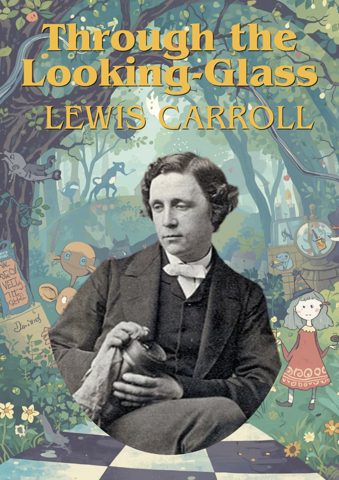
The Book That Invented Nonsense as a Serious Art Form
The Novel That Gave Science a Hypothesis • The Poem That Gave English a Dozen New Words
A Lost Chapter Rediscovered After a Century • Still Impossible to Fully Explain
Alice steps through the looking-glass. On the other side, everything is reversed, the chess pieces are alive, and to get anywhere at all, you must first walk in the opposite direction.
Published in 1871, Through the Looking-Glass is the sequel to Alice's Adventures in Wonderland—and in many ways its darker, stranger twin. Where the first book tumbles Alice down a rabbit hole into summer chaos, this one walks her deliberately through a mirror into a world of winter logic: a giant chessboard where Alice begins as a pawn and must reach the eighth rank to become a Queen, and where the rules of cause and effect have been quietly, systematically inverted.
Lewis Carroll was a mathematician at Oxford, and it shows. The Looking-Glass world does not merely ignore logic—it applies it in reverse, with merciless consistency. To reach the Red Queen, Alice must walk away from her. To stay in one place, she must run at full speed. Jam is available yesterday and tomorrow, but never today. The White Queen believes as many as six impossible things before breakfast, and she does so as a matter of discipline.
What Carroll constructed beneath the whimsy was a precise philosophical argument: about the arbitrariness of language, the instability of identity, and the peculiar violence of growing up.
"It's a poor sort of memory that only works backwards."
—The White Queen, Through the Looking-Glass
The novel's linguistic legacy is staggering for a children's book. "Jabberwocky"—the nonsense poem Alice finds in the Looking-Glass house—introduced galumphing, chortle, and frabjous into the English language, and gave linguists and philosophers a century of material on how meaning operates independently of definition. Humpty Dumpty's theory of portmanteau words—two meanings packed into one—became a standard term in linguistics. "Un-birthday" entered the lexicon. "Six impossible things before breakfast" became shorthand for a particular kind of willful optimism.
A chapter featuring a wasp in a yellow wig was cut from the original proofs because illustrator John Tenniel declared it beyond the appliances of art. The missing text was not rediscovered until 1977—a century later—when it surfaced among Carroll's papers and was published for the first time.
"Curiouser and curiouser."
—Alice
The book's influence has migrated far beyond literature. In evolutionary biology, the Red Queen Hypothesis—the principle that a species must constantly evolve simply to maintain its fitness relative to the systems it co-evolves with—takes its name directly from the Red Queen's explanation to Alice that here, you must run as fast as you can just to stay in place. Jorge Luis Borges drew on Carroll's mirrors and dream logic throughout his work. Douglas Adams absorbed the novel's particular brand of philosophical nonsense into the DNA of The Hitchhiker's Guide to the Galaxy. The Royal Shakespeare Company has staged it. The BBC has adapted it repeatedly.
The book is more melancholy than its predecessor—shadowed by winter, by the passage of time, by the sense that childhood is ending and cannot be recovered. The White Knight, who escorts Alice to the final brook with kind, bumbling ineffectiveness, is widely read as Carroll's portrait of himself: an inventor of beautiful, useless things, watching the child he wrote for grow beyond his reach.
A mathematician wrote a children's book about chess and mirrors. Scientists are still finding theorems inside it.
On a cold November night, Alice sits in an armchair playing with her kittens and wondering about the mysterious world behind the drawing-room mirror. Stepping onto the mantelpiece, she passes through the glass into a reflected house where chess pieces are alive and move about on their own. In this inverted realm, books are printed in mirror-script, prompting her to hold up the famous nonsense poem "Jabberwocky" to read it properly. Venturing outside, Alice discovers that the surrounding countryside is laid out like a giant chessboard, divided by hedges and streams. She meets the Red Queen in the Garden of Live Flowers and learns that she can participate in the grand game. Alice enters as a White Pawn, replacing the White Queen’s daughter, Lily, with the goal of advancing across the squares to the Eighth Rank to become a queen herself. To move forward in this strange landscape, she must often walk backward or run at full speed just to remain in one place. Her journey across the board takes her through a series of surreal encounters. In a dark forest where things have no names, she and a Fawn temporarily forget their identities until they reach the forest edge. Further along, she meets the nursery-rhyme twins Tweedledum and Tweedledee, who recite "The Walrus and the Carpenter" and introduce the unsettling idea that Alice may not be real, but merely a figment in the dream of the sleeping Red King. Continuing her progression, Alice encounters Humpty Dumpty sitting perched precariously on a high wall. He boasts about his power over language, explaining how he commands words to mean whatever he chooses them to mean, and translates the strange coinages of "Jabberwocky" for her. Soon after, she witnesses the Anglo-Saxon messengers, Haigha and Hatta, alongside the White King, as the Lion and the Unicorn battle fiercely for the royal crown. As Alice nears her destination, a Red Knight attempts to capture her, but she is rescued by a kindly, clumsy White Knight. Mounting his horse with constant tumbles, the eccentric inventor escorts her to the final boundary while sharing his absurd creations and singing a mournful ballad about an old man on a gate. Leaving the knight behind, Alice leaps across the final brook onto a soft, mossy lawn and finds a heavy golden crown resting upon her head. Now Queen Alice, she is immediately subjected to a bewildering examination by the Red and White Queens, who interrogate her with paradoxical logic, strange arithmetic, and chaotic etiquette rules. The queens then fall asleep in her lap before a lavish celebratory banquet begins inside the palace. The dinner rapidly degenerates into surreal madness: dishes introduce themselves, the mutton leg vanishes, candles stretch to the ceiling, and utensils fly through the air. Unable to endure the escalating chaos, Alice grabs the tablecloth and pulls it away, sending the plates and guests crashing down. Furious, she turns on the tiny Red Queen, who has shrunk to the size of a small doll, and begins to shake her vigorously to make her turn into a kitten. Alice suddenly wakes up back in her own living room, realizing she is holding her black kitten. Looking back on her journey, she ponders the boundary between reality and imagination, wondering whether the adventure was her own dream or if she was indeed part of the Red King's dream all along.
’Twas brillig, and the slithy tovesThrough the Looking-Glass Chapter 1. It is one of the most celebrated examples of literary nonsense verse in the English language, instantly immersing the reader in Carroll's playful linguistic invention.
“Now, here, you see, it takes all the running you can do, to keep in the same place. If you want to get somewhere else, you must run at least twice as fast as that!”Through the Looking-Glass Chapter 2. This passage introduces the famous "Red Queen's Hypothesis" concept, encapsulating the absurd logic of the Looking-glass world where standard physical rules are completely inverted.
“The rule is, jam to-morrow and jam yesterday—but never jam to-day.”Through the Looking-Glass Chapter 5. It serves as a brilliant, memorable satire of temporal logic and unfulfillable promises, highlighting the comedic frustration of Alice's interactions with chess piece royalty.
“When I use a word,” Humpty Dumpty said in rather a scornful tone, “it means just what I choose it to mean—neither more nor less.”Through the Looking-Glass Chapter 6. This iconic declaration is the philosophical heart of the book, brilliantly capturing the themes of semantic authority, power, and the arbitrary nature of language.
Readers often wonder if the complex wordplay, logical paradoxes, and Victorian framing make Through the Looking-Glass a difficult book to navigate. While the novel contains sophisticated linguistic jokes, invented vocabulary such as the poem "Jabberwocky," and structural mechanics based on a formal game of chess, the underlying narrative remains exceptionally light, playful, and accessible. Children can easily follow Alice's straight journey across the chessboard as a whimsical sequence of fairy-tale encounters. At the same time, older readers and literary scholars find immense depth in analyzing the mathematical logic, satire, and philosophical dilemmas embedded within every conversation. The prose flows with remarkable rhythmic ease, balancing nonsensical charm with clever dialogue. Anyone can enjoy the story on a basic narrative level, while those interested in deeper meaning can appreciate the brilliant intellectual layers that Carroll weaves into Alice's interactions.
Through the Looking-Glass is celebrated as a landmark achievement in English literature because it fundamentally revolutionized children's writing. Before Lewis Carroll, Victorian stories for young people were heavily didactic, focusing on moral lessons and strict instruction. Carroll discarded these conventions to create a world of pure imagination, liberated nonsense, and profound intellectual play. The book introduced iconic coinages and phrases into the English language, including portmanteau words, un-birthday presents, and running to stay in place. Beyond its influence on literature, the book's clever concepts have crossed into scientific fields, such as evolutionary biology's Red Queen Hypothesis. Its rich synthesis of mathematical logic, linguistic philosophy, enduring original illustrations by John Tenniel, and memorable characterization has ensured its place as a masterpiece that continues to inspire artists, thinkers, and readers worldwide.
Beyond the final brook lies the ultimate destination of Alice's journey, where the game of chess reaches its climax and her entry into royalty is finally realized. Upon attaining the Eighth Rank, she is thrust into a grand, chaotic celebration where the rules of logic, speech, and etiquette break down entirely. The distinction between dream and reality blurs as the inhabitants of the mirror world gather for a bizarre feast that rapidly descends into absolute madness. What awaits at the culmination of this surreal night is a sudden, dramatic awakening and a profound philosophical question regarding who was truly dreaming the adventure all along. Read these closing pages for yourself.
The structure of Through the Looking-Glass is strictly modeled on a real game of chess, with the landscape itself physically laid out in a grid of alternating hedges and streams. Alice begins her journey as a White Pawn on the Second Rank, filling the position of the White Queen's child, Lily. Her movements from chapter to chapter correspond directly to legal chess moves across the board, advancing through squares represented by forests, brook crossings, and open ground. Along the way, she meets other living pieces, including the Red Queen, the White King, and the White Knight, each behaving in accordance with their royal or eccentric natures. The ultimate goal of her journey is to reach the Eighth Rank on the opposite side of the board, where a pawn achieves promotion to become a queen.
"Jabberwocky" is widely regarded as the greatest nonsense poem in the English language, appearing early in the book when Alice finds it printed in mirror-script. Though the poem contains dozens of entirely invented words, such as "slithy," "frumious," and "galumphing," its heroic narrative arc remains completely clear to the reader. It tells the classic tale of a brave youth who ventures into a dangerous forest, slays a terrifying monster with a voracious sword, and returns home to a joyful welcome. Carroll uses the poem to demonstrate that sentence structure, rhythm, and phonetic sound can convey vivid meaning and emotion even when the individual words have no pre-existing definitions. Later in the story, Humpty Dumpty provides Alice with a famous line-by-line breakdown, explaining how two meanings can be packed into one portmanteau word.
During their encounter with Alice, the twin brothers Tweedledum and Tweedledee lead her to the sleeping Red King, who is snoring loudly under a tree. They inform Alice that the King is currently dreaming about her, and they advance the eerie philosophical proposition that Alice is not real at all. According to their argument, she exists purely as a temporary character inside the King's mind, and if he were ever to wake up, she would instantly vanish like a blown-out candle. This disturbing idea upsets Alice, who insists on her own reality through her tears. The scene introduces a central theme of identity and existential doubt that runs through the novel, forcing both Alice and the reader to question the boundary between the dreamer and the dream.
Miva: the next reading experience beyond audiobooks
Listen like an audiobook, then ask anything, anytime.
Start Miva's narrationMiva does not just narrate. It keeps explaining based on what you ask.