Ryunosuke Akutagawa's First Foray into Children's Literature
Published in the Inaugural Issue of Akai Tori
Its True Source Traced to a German-Born American Scholar of Religion
Adapted into Ballet by Akutagawa's Own Son
One thread. One act of kindness. One shout of "Get off!" undoes it all.
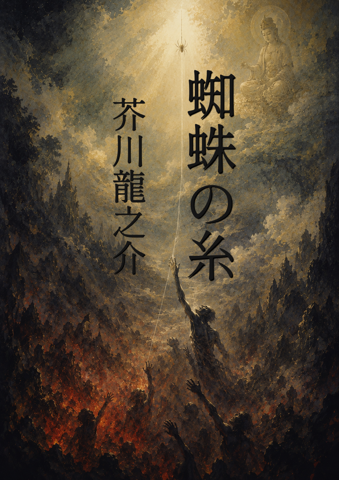
Published in 1918 in the inaugural issue of the children's magazine Akai Tori, founded by Miekichi Suzuki, Ryunosuke Akutagawa's "The Spider's Thread" was written for children but has endured as a fable that cuts deepest into adults. The Buddha, gazing from the lotus ponds of Paradise into the depths of Hell, lowers a single silver thread to the thief Kandata—whose one act of mercy in life was sparing a spider. As Kandata climbs, he looks down to see the thread crowded with other sinners climbing behind him.
This is not merely a children's parable. It is egoism and karma compressed into a few hundred characters, weighted with the full force of Buddhist teaching. Kandata's cry—"This thread is mine! Get off!"—is the exact instant the thread snaps above him, and mercy withdraws as swiftly as it was given. Salvation was never about the thread. It was about what he did once he was on it.
[Quote placeholder — let me know if you'd like a specific critic or writer quoted here] —[Author Name], [title/role]
Research into its sources is its own quiet revelation. Once believed to echo the "An Onion" episode in Dostoevsky's The Brothers Karamazov, the current consensus traces its true origin to Inga no Oguruma, a Japanese translation of Paul Carus's Karma—meaning a story that reads like ancient Buddhist scripture was, in fact, the creation of a German-born American scholar of religion. Its influence has only widened since: Akutagawa's own son, composer Yasushi Akutagawa, adapted it into the ballet The Spider's Thread; science fiction writer Sakyo Komatsu wrote a parody reversing Heaven and Hell; and musicians from Kinniku Shojo Tai to Mika Nakashima to Sakanaction have carried Kandata's cry into song.
The story takes less than five minutes to read. Kandata's cry has echoed through Japanese culture for over a century.
Miva: the next reading experience beyond audiobooks
Listen like an audiobook, then ask anything, anytime.
Start Miva's narrationMiva does not just narrate. It keeps explaining based on what you ask.