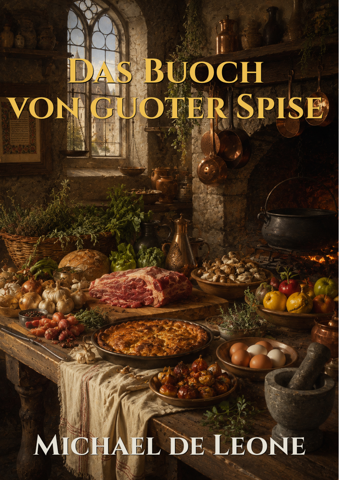
The Oldest German-Language Cookbook
Written Around 1350 in Würzburg — Still Consulted Today
101 Recipes From the Kitchens of the Medieval Urban Elite
A Window Into Courtly Life, Feasts, and the Social Power of Food
The recipes do not tell you how long to cook. They assume you already know. That assumption tells you everything.
Written around the middle of the 14th century, Das Buoch von Guoter Spîse ("The Book of Good Food") is the oldest known cookbook in the German language — and far more than a collection of recipes. Preserved as part of the house book of Michael de Leone, a large compiled manuscript created between 1347 and 1350 in Würzburg and now held by the University Library of Munich, it stands as one of the most important sources for medieval food culture in the German-speaking world.
Its 101 recipes, divided into two parts — general dishes and humorous entries in the first, a more systematic arrangement of Lenten and meat dishes in the second — open a window onto a world in which cuisine, courtly culture, and social status were inseparable. What this book fed was not only the body. It was the performance of wealth, refinement, and power.
"The rhymed introduction promises to instruct inexperienced cooks. The recipes themselves assume the reader already knows how to make almond milk and prepare dough. The book's true audience was never the beginner."
The Cuisine of the Elite
The ingredients alone tell the story. Saffron, pepper, cloves, and galangal — spices imported from the Orient and treated as luxury goods — appear throughout. Game dishes featuring pheasant, deer, and partridge point unmistakably to a courtly or affluent origin. Sweet and savory flavors were combined in ways that may surprise the modern reader, reflecting a medieval palate shaped above all by the prestige of spice.
A special place belongs to the so-called Blamensire — light dishes of almond milk, rice, and chicken, considered delicate, refined, and easy to digest. Extraordinarily popular in medieval Europe, they appear here as emblems of the cultivated table.
Beyond the Recipes
The work does not confine itself to serious instruction.
Humorous passages: Two joking "recipes" list absurd ingredients — mosquito feet, frog throats — reminding us that medieval cookery literature was meant to entertain as well as instruct. The parody was part of the genre.
Display dishes: Among the most striking entries are elaborately arranged foods designed not to satisfy hunger but to demonstrate the host's wealth and cultural sophistication. One recipe describes a decorated calf's head presented on an artistically layered dish of meat and apples — food as theatre, as social statement.
Influence and Legacy
The Book of Good Food did not end with its manuscript. In the 15th century, several cookery manuscripts adopted or adapted its recipes — most notably the Mondseer Cookbook and the Vienna Cookbook. Many recipes were simplified or modernized linguistically, but remained closely connected in content to the original collection.
Today the work holds enormous cultural-historical value — documenting not only medieval techniques and eating habits, but the social meaning of feasts, hospitality, and the table in late medieval Germany.
"The Book of Good Food" is a cookbook that could not have been written for everyone. That exclusion is precisely what makes it such a precise record of the world it came from.
Miva: the next reading experience beyond audiobooks
Listen like an audiobook, then ask anything, anytime.
Start Miva's narrationMiva does not just narrate. It keeps explaining based on what you ask.