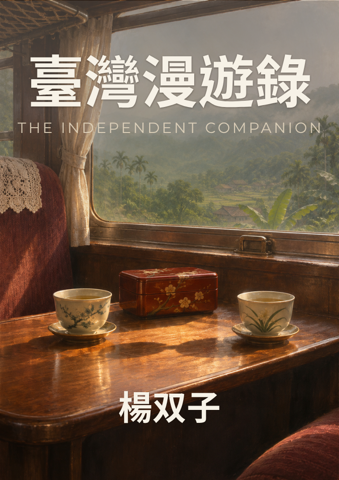
In 1938, a Japanese female writer and a Taiwanese interpreter travel by train. One dish after another brings them closer together, yet also causes the "Taiwan" seen by the colonizer and the colonized to gradually diverge.
Winner of the 2024 National Book Award for Translated Literature (English edition: Taiwan Travelogue, translated by Lin King); Winner of the 2024 Japan Translation Award (Japanese edition).
Yang Shuang-zi constructs this novel through pseudo-translation, pseudo-historical documents, and travel writing, following Chihoko Aoyama and Wang Chih-ho as they taste regional cuisines along the railway. This guide organizes the intersections of cuisine, landscape, language, and power, while preserving the reading surprises of relationship dynamics and textual mechanisms.
The railway in the work is both a tool for movement and a system used by the colonial government to organize space, resources, and the tourist gaze. Aoyama’s "discoveries" are often already familiar aspects of Wang Chih-ho’s life, meaning their knowledge gap does not equate to a power advantage. Readers should also note how Japanese, Taiwanese, Mandarin, and food names are translated or preserved: every choice determines whose experience is seen and who can only leave a mark through another's words.
The Japanese traveler’s gaze carries imperial knowledge and romantic imagination; the interpreter’s additions, evasions, and counter-questions reveal different political positions for the same scenery.
From melon seeds and rice noodles (mì-shī-mù) to jute soup and honey bean ice, these are not just local flavors but links to class, ethnicity, labor, modernization, and memory.
The foreword, footnotes, and the fictional author establish a seemingly reliable documentary framework, while constantly exposing that translations and archives are never neutral.
Each chapter allows you to track three clues simultaneously: how cuisine connects to industry, ethnicity, and local memory; how Chihoko Aoyama’s tourist gaze is supplemented or refuted by Wang Chih-ho; and how the foreword, notes, and fictional translator create a suspicious sense of documentary authenticity. Reading this way avoids treating the work solely as a gourmet travelogue, revealing how colonial railways, linguistic power, and female intimacy are intertwined. The most profound aspect of the novel is the brief closeness between the two as they share food, which nevertheless fails to erase the inequality of their social positions.
Suitable for readers interested in Taiwanese historical fiction, the Japanese colonial period, food writing, female friendship, and metafiction. The pleasure of food and travel is not canceled out by political interpretation; rather, because different memories and power positions exist behind every dish, the reading experience becomes more layered.
This product is an independently produced chapter guide and summary, not the full text of the original work; it is recommended as a review and reading aid to accompany the complete book.
Miva: the next reading experience beyond audiobooks
Listen like an audiobook, then ask anything, anytime.
Start Miva's narrationMiva does not just narrate. It keeps explaining based on what you ask.