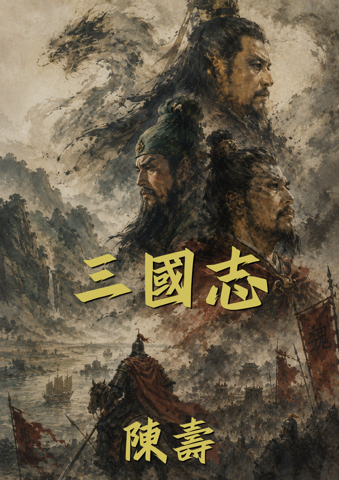
The Unique Skeleton of the Records of the Three Kingdoms: A Biographical History Without "Treatises"
Although titled Sanguozhi (Records of the Three Kingdoms), its structure is quite rebellious—it completely lacks the "Treatises" (covering economy, geography, institutions) and "Tables" (timelines) found in traditional histories. The entire work consists purely of Imperial Annals (Benji) and Biographies (Liezhuan).
Originally totaling 66 volumes (the postscript volume is lost; 65 survive), it records 96 years of history from the Yellow Turban Rebellion (184 AD) to the unification under the Western Jin (280 AD). It was merged from three originally independent parts during the Northern Song Dynasty:
Book of Wei (30 volumes): The largest section. Because Chen Shou used the most abundant official records of Cao Wei (such as Wang Shen's Book of Wei and Yu Huan's Weilüe), it is the most detailed.
Book of Shu (15 volumes): The shortest section. Since the Shu Han regime did not establish official historians or records, Chen Shou pieced this together in Luoyang using his personal memories from his service in Shu and folk collections; it is therefore extremely concise.
Book of Wu (20 volumes): Mid-sized. Primarily based on the Book of Wu written by Wei Zhao of Eastern Wu.
Writing Between the Lines: The "Political Correctness" of a Western Jin Official
Chen Shou was an official of the Western Jin when he wrote the book. Since the Western Jin's throne was "ceded" from the Cao Wei, Chen Shou displayed masterful "survivalist writing" to maintain the legitimacy of the current dynasty:
Cao Wei as Orthodoxy: Only the rulers of Wei (Cao Cao, Cao Pi, etc.) are included in the "Annals," receiving the treatment of legitimate emperors.
Rectifying Liu Bei's Name for Shu Han: Although he did not use the state title "Han" (referring to it as "Shu"), Chen Shou remained considerate of his former master, Liu Bei. He did not use Liu Bei’s personal name, but referred to him respectfully as the Biography of the Former Lord, using the imperial term "cu" (pass away) to record his death.
The Marginalization of Eastern Wu: Regarding Sun Quan, Chen Shou used his personal name directly, and the imperial proclamations of his ascension were deliberately omitted from the main text.
Taboos for Jin Dynasty Ancestors: To respect the Jin rulers, Chen Shou provided no biographies for Sima Yi, Sima Shi, or Sima Zhao (who were posthumously declared emperors). He referred to them only by posthumous titles (e.g., King Xuan of Sima) and never by their personal names.
The History Completion Project: Pei Songzhi’s "God-Tier Assist"
Due to the minimalist literary style of the late Eastern Han and Chen Shou's rigorous scholarship—where he "preferred not to use unreliable sources"—the original text of Sanguozhi was too brief. Over a century later, Emperor Wen of the Southern Song could not bear it and ordered the historian Pei Songzhi to annotate it.
This annotation pushed Sanguozhi to the pinnacle of historiography. Pei Songzhi collected over 240 types of historical materials, making the content three times longer than the original! His completion project utilized six main methods:
Judging Right and Wrong: Citing various commentaries to distinguish the rights and wrongs of historical events.
Verifying Falsehoods: Comparing different accounts to check for authenticity.
Explaining Details: Providing the causes and consequences for events written too briefly (such as details of the Battle of Red Cliffs).
Filling Gaps: Adding historical events completely unrecorded in the original text.
Detailed Life Stories: Writing detailed biographies for people the original text failed to describe clearly or mentioned not at all.
Historical Echoes:
When Luo Guanzhong wrote Romance of the Three Kingdoms in the Yuan Dynasty, much of the famous "70% fact, 30% fiction" plot was not made out of thin air, but taken from the precious folk legends and anecdotes preserved in Pei Songzhi's annotations.
The Ultimate Academic Debate of Two Millennia
Post-historical criticism of Chen Shou and the Sanguozhi focuses on two highly dramatic points of contention:
Controversy 1: Did Chen Shou settle personal scores?
The Book of Jin, compiled in the Tang Dynasty, heavily criticized Chen Shou, accusing him of being narrow-minded: claiming he asked Ding Yi's descendants for "a thousand bushels of grain" as payment for a good biography, and upon being refused, he omitted the Ding brothers; and claiming his father was punished with "shaving the head" (a shameful punishment) by Zhuge Liang due to the Ma Su incident, leading Chen to disparage Zhuge Liang as lacking military strategy.
Counter-argument: Qing Dynasty scholars pointed out that the Ding brothers' entire family was executed by Cao Pi 13 years before Chen Shou was born; there were no descendants to give him rice. The lack of a biography was simply because they were criminals of the Wei state with insufficient deeds. As for the evaluation of Zhuge Liang, it is considered an objective historical judgment that does not negate his governance.
Controversy 2: Was "Cao Chong Weighing the Elephant" a true event or an Indian fairy tale?
Modern masters like Chen Yinke questioned the story, arguing there were no elephants in the Central Plains and that the story was likely folk literature adapted from the Indian Buddhist scripture Zabaozang Jing.
Modern Scientific Rebuttal: Modern historical geography and biological research have countered this doubt. Data shows that the northern limit of Asian elephant activity during the Three Kingdoms period was the Qinling-Huaihe line. Jiangdong, controlled by Sun Quan (including present-day Fujian and Guangdong), was a habitat for elephants. Sun Quan’s gift of an elephant to Cao Cao to curry favor is entirely plausible in terms of timeline, geography, and political motivation.
Miva: the next reading experience beyond audiobooks
Listen like an audiobook, then ask anything, anytime.
Start Miva's narrationMiva does not just narrate. It keeps explaining based on what you ask.