The Birth of Modern Italian Poetry
Cornerstone of Italian Decadentism
A Collection Born from Grief, Written in the Language of Small Things
The Work That Broke Italian Poetry Open
The poems are short. The silences inside them are not.
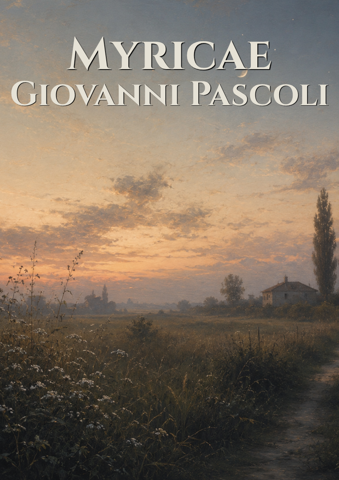
First published in 1891 with only twenty-two poems and expanded to its definitive 156-poem edition in 1903, Myricae is Giovanni Pascoli's first major collection and one of the most consequential works in the history of Italian literature. Its title comes from a line in Virgil's Eclogues—"not everyone likes shrubs and humble tamarisks"—a declaration of poetics as much as a title: not heroic verse, not celebratory grandeur, but poetry of small things.
The collection is dedicated to Pascoli's father, Ruggero, who was murdered when the poet was still a child. From this wound, everything follows. Family grief, a sense of irreversible loss, fear of the outside world, the desperate need to shelter inside the "nest" of home—these are the currents running beneath Myricae's seemingly tranquil countryside. Nature here is never mere description. It becomes a language of mystery, death, memory, and solitude.
"Pascoli's gaze is that of a child who has already seen too much—and cannot stop looking."
The poems move through the changing seasons, peasant labor, animals, birdsong, nocturnal atmospheres, and the obsessive memory of the dead. Among the collection's most celebrated works are Lavandare, X Agosto, Novembre, L'assiuolo, Temporale, Il lampo, and Il tuono.
In these poems Pascoli shatters the Italian poetic language of his century. Syntax fractures. Sentences grow short and musical. Onomatopoeia, alliteration, sudden pauses, and sonic echoes replace rhetorical weight. The influence of Verlaine and Mallarmé is felt, but Pascoli's voice is entirely his own: evocative rather than narrative, interior rather than monumental.
A storm, the cry of a nocturnal bird, the distant sound of a bell—in Myricae, these are never only themselves. They are signs of something invisible and indecipherable, apprehended through what Pascoli called the gaze of the "little child": the capacity to marvel at the simplest things and sense the hidden meaning within them.
Myricae does not celebrate heroes or historical deeds. It transforms the everyday world into inner experience—and in doing so, it did not merely contribute to Italian Decadentism. It announced that Italian poetry would never again be the same.
Miva: the next reading experience beyond audiobooks
Listen like an audiobook, then ask anything, anytime.
Start Miva's narrationMiva does not just narrate. It keeps explaining based on what you ask.