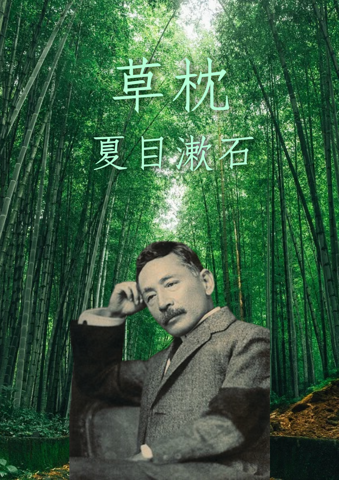
Leaving the world of human sentiment to contemplate how art is established amidst mountain paths and hot springs
Kusamakura unfolds through the perspective of a traveling painter. While the narrative seems thin, it is filled with reflections on art, emotional distance, nature, female archetypes, and modern life. Soseki proposes the concept of "hininjo" (detachment/non-humanity), attempting to allow artists to temporarily leave behind secular interests and view life as if it were a scene in a painting.
Natsume Soseki (born Natsume Kinnosuke, 1867 in Edo) graduated from the English Department of Tokyo Imperial University and studied in England. Upon returning to Japan, he taught before rising to fame in 1905 with I Am a Cat. In 1907, he joined the Asahi Shimbun as a professional writer, producing core works of modern Japanese literature such as Sanshiro, And Then, The Gate, and Kokoro. He passed away in 1916 due to a stomach ulcer.
The relationship between Kusamakura and Soseki lies in its role as a work seeking the place of art amidst the trauma of his studies in England, the pressure of modernization, and the gap between Eastern and Western aesthetics. In a modern analogy, it is less like a plot-driven novel and closer to the rhythm of Haruki Murakami's early works—intertwining travel, loneliness, and abstract thought—and can also be cross-referenced with Yasunari Kawabata's aesthetic gaze.
Miva: the next reading experience beyond audiobooks
Listen like an audiobook, then ask anything, anytime.
Start Miva's narrationMiva does not just narrate. It keeps explaining based on what you ask.