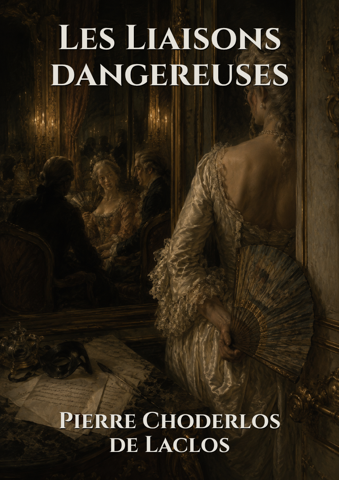
Published in 1782, Pierre Choderlos de Laclos’s Dangerous Liaisons remains one of the most cruel, refined, and psychologically devastating novels in French literature. Presented as an epistolary novel composed entirely of letters exchanged between aristocrats, the work dissects with surgical precision the games of power, desire, manipulation, and destruction that gnawed at the French nobility on the eve of the Revolution.
At the center of this infernal mechanism are two figures who have become mythical: the Marquise de Merteuil and the Vicomte de Valmont. Former lovers, allies, and then enemies, they transform seduction into a strategic weapon. They do not seek love, but absolute control over others. Cécile de Volanges, a young innocent fresh from a convent, and Madame de Tourvel, a married woman of irreproachable virtue, become victims of their moral and sexual experiments. But in this world where every letter hides a mask, the manipulators eventually find themselves consumed by their own games.
The genius of the novel lies in its ambiguity. Laclos never explicitly condemns his characters; he lets them speak, lie, seduce, and betray themselves. The reader thus becomes judge, voyeur, and accomplice. André Malraux saw in Merteuil and Valmont "the first characters in European literature whose acts are determined by an ideology." This idea explains why the novel seems incredibly modern: behind the libertine intrigues lies a cold reflection on power, narcissism, and the construction of social identities.
Upon its release, the book caused an immense scandal. Many saw it as a direct attack on the French aristocracy and the hypocrisy of the Ancien Régime. Yet, some nobles themselves—including Marie-Antoinette—admired the work despite its sulfurous reputation. Laclos had stated his intention to "write a work that departed from the ordinary path, that would make a noise, and that would still resound on earth after he had passed." Rarely has a literary prophecy been so accurate.
The influence of Dangerous Liaisons spans centuries. The novel inspired countless stage adaptations, operas, ballets, series, and films. Christopher Hampton’s 1985 stage version became an international triumph before being adapted for the screen by Stephen Frears in 1988, starring Glenn Close, John Malkovich, and Michelle Pfeiffer. This film, now considered a classic of British and Hollywood cinema, received several Oscar nominations. Miloš Forman later directed Valmont in 1989, while Cruel Intentions transported the plot to 1990s bourgeois America, turning Valmont and Merteuil into wealthy, toxic Manhattan teenagers. Even Korea, China, and Brazil have reinvented the novel within their own cultural contexts.
The book has also deeply impacted modern literary criticism. Wayland Young wrote: "The mere fact of analyzing libertinism with such mastery was enough to condemn the book." As for André Malraux, he asserted: "Merteuil and Valmont are unprecedented." Their legacy is found today in countless figures of elegant and perverse manipulators, from contemporary psychological cinema to modern series about toxic elites.
But beyond the scandal and sexual intrigues, Dangerous Liaisons remains above all a novel about language itself. Letters become weapons; every sentence can seduce, lie, humiliate, or kill. Laclos thus transforms the epistolary novel into a psychological battlefield. Two centuries later, this cold war of desire continues to fascinate because it reveals something timeless: behind civilization, politeness, and refinement, the human being remains capable of the most elegant forms of cruelty.
Miva: the next reading experience beyond audiobooks
Listen like an audiobook, then ask anything, anytime.
Start Miva's narrationMiva does not just narrate. It keeps explaining based on what you ask.