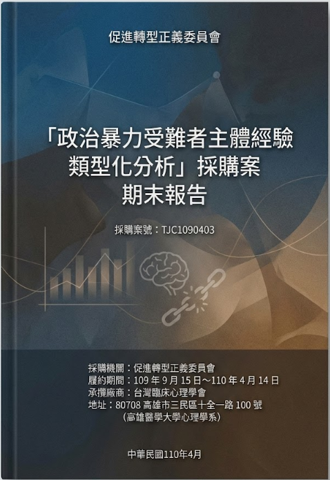
Research Objectives: To enhance the trauma-informed sensitivity of frontline professionals across various disciplines and to plan restorative programs and integrated services that meet the needs of different generations within families affected by political violence, it is necessary to gain a more detailed understanding of the physical and mental states and living situations of political survivors and their family members. This study aims to grasp the complex portrait of these families as much as possible. Using qualitative depth interview data obtained from the Transitional Justice Commission's investigation into the needs of political victim families as a foundation, this research integrates interpretive phenomenological psychology and psychoanalytic dynamics for in-depth thematic analysis. Based on the results, the study proposes recommendations for cross-professional healing and holistic assistance service models tailored to the individual needs of family members.
Methodology: This study employs a blended methodology, using phenomenological psychology as the "warp" and Interpretative Phenomenological Analysis (IPA) as the base, integrated with the phenomenological methods of the "Sheffield School" from the UK. It emphasizes examining seven essential characteristics indispensable to human existence: selfhood, sociality, embodiment, temporality, spatiality, project, and discourse used in describing experiences. The "weft" of the methodology is psychoanalysis, involving a psychoanalytic perspective on trauma sensitivity, manifested in the depth of understanding of the victims' experiences. Additionally, this study introduces a new "collaborative" dimension to IPA, where the principal investigator, two co-investigators, and one researcher perform collaborative analysis. This collective work serves as a shared witnessing of political violence trauma, representing a common effort to find understanding and language for the subjective experience of trauma.
Research Results: Through the examination of the seven essential characteristics, we found fundamental differences between the experiences of the direct victims and their family members. Therefore, the results are categorized into:
The Prisoner’s Cage and Its Aftereffects: This section addresses the impact of traumatic experiences—such as improper torture and harsh imprisonment—on the victims' existence as human beings.
The Prisoner Outside the Prison and Intergenerational Legacy: During the growth of the second generation, the absence of the parent victim created a kinship gap, making them "orphans with parents." Intergenerational legacy refers to how the second generation was forced to inherit established social relations before they could understand themselves, including their identity as descendants of "political prisoners," the stigma of state violence, and the expectation to carry on the elders' political stances or unfinished missions.
Overall, the study found that political violence under authoritarian rule was the "State" acting as a supreme power over all sociality, intruding into victims' lives through forced detention and long-term imprisonment, tearing them from their social positions and destroying their foundational social existence. The second generation was forced to inherit this legacy; political violence deprived them of the possibility of participating in a shared community and communicating with others, turning political victim families into "isolated islands" unable to connect with the outside world.
Recommendations: Based on the observed characteristics of delayed and intergenerational trauma and the current state of medicalized trauma treatment in Taiwan, the research team makes two recommendations:
Developing a local cross-professional healing model centered on restoring the relational subject. The state must take full responsibility for repairing the groups it victimized by creating healing models and mechanisms capable of supporting state-level restorative projects. To this end, a central-level political violence trauma healing center should be established to enhance trauma-informed capabilities among professionals and create cross-disciplinary collaboration mechanisms.
Establishing specialized central agencies and fostering local cross-professional collaborative networks. Care for victims and families should not rely solely on the traditional "medical-psychological-social work" model. Instead, specialized agencies should be created to foster local networks that witness suffering through deep empathetic listening, allowing victims to be re-recognized and integrated as members of the community.
Miva: the next reading experience beyond audiobooks
Listen like an audiobook, then ask anything, anytime.
Start Miva's narrationMiva does not just narrate. It keeps explaining based on what you ask.